I’ve seen how one small spelling difference can create confusion, especially when you’re writing an email, message, or article and want every word to look right. In case is the correct form, while incase usually means something different. So, when should you use each one? This guide makes the difference simple, clear, and easy to remember.
Quick Answer
In case is the correct form when you mean “if something happens,” “because something might happen,” or “as a precaution.” It is normally written as two words: in case. Incase is also a real English word, but it has a different and much less common use: it is a verb meaning to enclose or cover something in a case. So, for everyday phrases such as “just in case,” use in case, not incase.
Quick Comparison
| Form | Main Use | Example |
| in case | A precaution or possible situation | Take an umbrella in case it rains. |
| incase | A verb meaning to enclose or put something in a case | The artist incased the object for display. |
| encase | The more familiar verb for enclosing something | The statue was encased in glass. |
The key point is simple: “in case” and “incase” are not interchangeable spellings. They can represent different grammatical uses.
What Does “In Case” Mean?
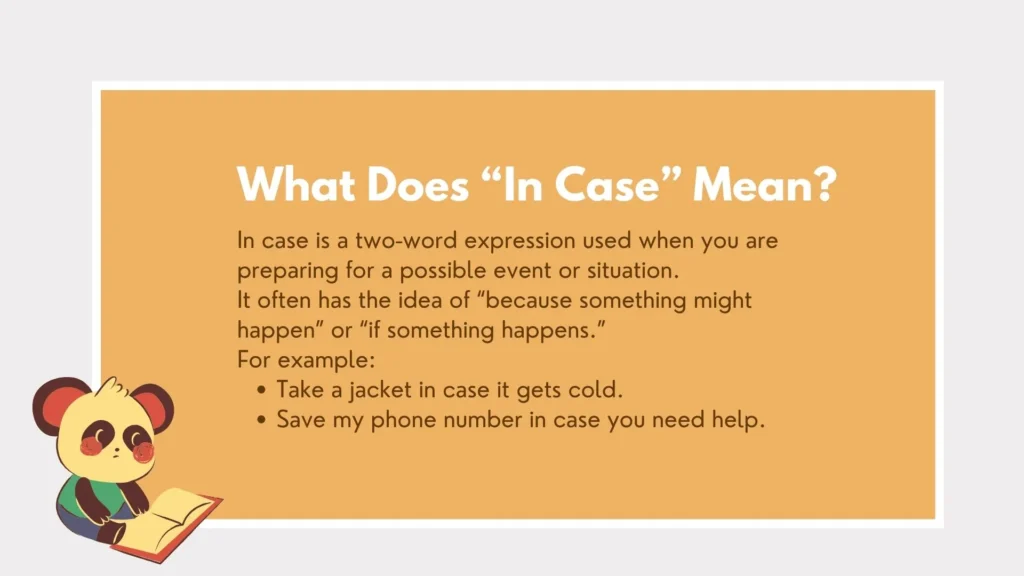
In case is a two-word expression used when you are preparing for a possible event or situation.
It often has the idea of “because something might happen” or “if something happens.”
For example:
- Take a jacket in case it gets cold.
- Save my phone number in case you need help.
- I brought some extra food in case we get hungry.
- Keep the receipt in case you need to return the item.
In these sentences, the action happens as a precaution.
You take the jacket because cold weather is possible. You save the number because you might need help.
“In Case” as a Conjunction
In case can introduce a clause containing a possible future situation.
For example:
I will leave the door unlocked in case you arrive late.
Here, in case you arrive late explains why the door will be left unlocked.
Another example:
Bring your charger in case your phone battery runs out.
The possible event is the phone battery running out, and bringing the charger is the precaution.
“In Case” at the End of a Sentence
You will also see in case used by itself, especially in the expression just in case.
I don’t think we’ll need extra chairs, but I’ll bring two just in case.
The missing information is understood from the context. The meaning is roughly “because they might be needed.”
This is extremely common in everyday English.
What Does “Incase” Mean?
This is where the confusion becomes interesting.
Incase can be a legitimate English word when it is used as a verb meaning to enclose something in or as if in a case. Collins lists incase as a variant of encase.
For example:
The fragile item was incased in protective material.
Here, incased is a verb form. It does not mean “if something happens.”
You might also encounter:
The machine was incased in a protective shell.
However, encased is generally the more familiar choice in modern everyday writing.
Incase as a Verb
The verb forms can be built in the normal way:
- incase
- incases
- incased
- incasing
For example:
Workers incased the equipment in a protective covering.
The word is functioning as a verb here.
This is completely different from:
Take extra batteries in case the power goes out.
In the second sentence, in case is a two-word expression introducing a possible situation.
In Case vs Incase: The Key Difference
The easiest way to understand the difference is to look at the job the words are doing in the sentence.
Use “in case” for a possible event
If you mean “if something happens” or “because something might happen,” write in case.
Take an umbrella in case it rains.
Keep some cash in case the card machine doesn’t work.
I saved the document twice in case my computer crashed.
Use “incase” only as a verb meaning “enclose”
If you mean put something inside a case or surround it with a protective covering, incase can function as a verb.
The designer decided to incase the device in metal.
In many situations, however, encase will sound more natural:
The designer decided to encase the device in metal.
So if you are writing ordinary emails, school assignments, articles, messages, or business documents, in case is almost certainly the form you need when talking about a possible situation.
When Should You Use “In Case”?
In Everyday Conversation
In case is very common when people prepare for something that might happen.
Bring a sweater in case it gets chilly.
I’ll text you in case I get there first.
Take some water in case the store is closed.
These sentences sound natural because the speaker is preparing for a possibility.
In Emails and Work
The expression is also perfectly normal in professional writing.
Please keep a copy of the invoice in case we need it later.
I have attached the original file in case you need to make changes.
We should arrive early in case there is heavy traffic.
There is nothing informal or incorrect about using in case in business communication.
In Formal Writing
You can also use in case in formal and academic writing when the meaning requires it.
The researchers stored additional samples in case further testing was required.
The procedure should be repeated in case the initial result is unclear.
The expression itself is not grammatically casual.
With “Just”
One of the most common expressions is just in case.
It means that something is being done as a precaution.
I’ll take my charger just in case.
She packed an extra shirt just in case.
Write down the address just in case you lose your phone.
This phrase should be written as just in case, with spaces between all three words.
When Should You Use “Incase”?
Use incase only when it is functioning as the verb meaning to enclose or cover something.
For example:
The manufacturer planned to incase the wiring in a protective material.
The historical object was incased for protection.
That said, encase is usually the clearer and more familiar verb.
For most readers, this sentence will feel more natural:
The artifact was encased in glass.
Rather than:
The artifact was incased in glass.
So while incase can be a legitimate verb, it should not be used as a one-word replacement for in case.
When Should You NOT Use “Incase”?
Do not write incase when you mean:
- if something happens
- because something might happen
- as a precaution
- just in case
- in the event that
- if something is needed
For example:
❌ Take an umbrella incase it rains.
✅ Take an umbrella in case it rains.
The problem is not the meaning of the sentence. The problem is that the expression is incorrectly joined into one word.
Common Sentence Variations
In Case or Incase for Rain?
Use in case.
Take an umbrella in case it rains.
Not:
Take an umbrella incase it rains.
Here, you are preparing for a possible event, so the two-word expression is required.
In Case or Incase for an Emergency?
Use in case.
Keep this number nearby in case of an emergency.
The standard phrase is in case of, meaning roughly “if something happens” or “in the event of something.”
In Case or Incase for Safety?
Use in case when describing preparation for a possible problem.
Carry a flashlight in case the power goes out.
In Case or Incase in an Email?
Use in case when you are talking about a possible need or situation.
I am sending the file again in case the first attachment did not arrive.
Is “Just Incase” Correct?
No, not when you mean “as a precaution.”
The standard expression is:
just in case
For example:
I’ll bring some extra money just in case.
Common Phrases With “In Case”
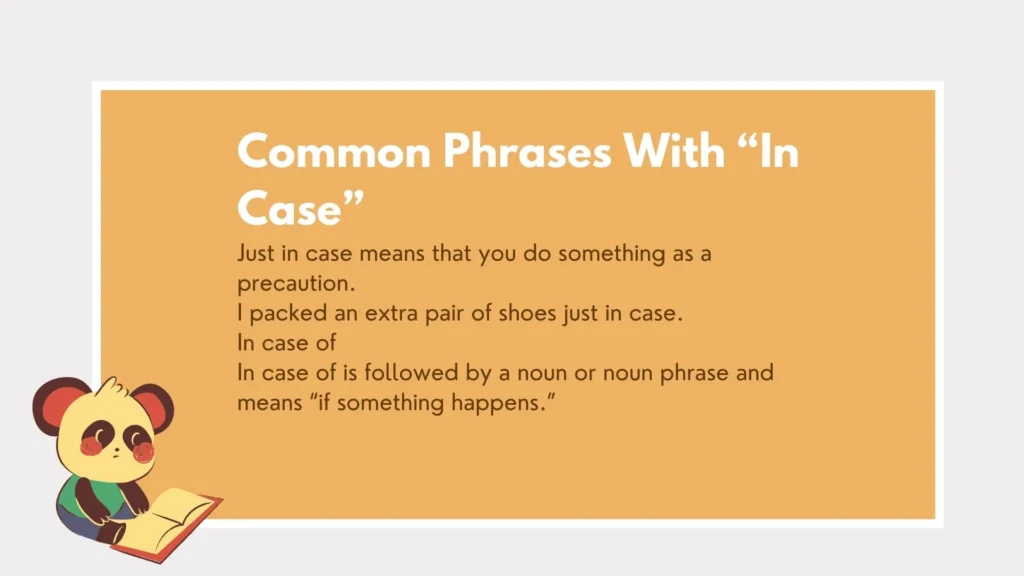
Just in case
Just in case means that you do something as a precaution.
I packed an extra pair of shoes just in case.
In case of
In case of is followed by a noun or noun phrase and means “if something happens.”
In case of fire, use the nearest exit.
In case of an emergency, contact the supervisor.
In any case
In any case means that something remains true regardless of other circumstances.
We may be late, but in any case, we should call them.
It does not mean “as a precaution.” It has a different meaning.
In that case
In that case means “if that is the situation.”
If you have already finished, in that case, you can leave.
It is another separate expression containing the word case.
In which case
In which case refers back to a situation just mentioned.
The store may close early, in which case we’ll come back tomorrow.
This phrase is especially useful in formal and professional writing.
Common Mistakes
Mistake 1: Writing “incase” before a possible event
❌ Take an umbrella incase it rains.
✅ Take an umbrella in case it rains.
Why? In case is the two-word expression used for a possibility or precaution.
Mistake 2: Writing “just incase”
❌ I’ll save the photo just incase.
✅ I’ll save the photo just in case.
Why? The standard expression is just in case.
Mistake 3: Writing “incase of”
❌ Incase of fire, leave the building.
✅ In case of fire, leave the building.
Why? The standard phrase is in case of.
Mistake 4: Treating “incase” as an ordinary spelling variation
❌ I’ll bring extra money incase I need it.
✅ I’ll bring extra money in case I need it.
Why? Incase can exist as a verb, but that does not make it an alternative spelling of the conjunction in case.
Mistake 5: Using “incase” in a formal email
❌ Please keep the receipt incase you need a refund.
✅ Please keep the receipt in case you need a refund.
Why? The sentence expresses a possible future need, so in case is correct.
Mistake 6: Confusing “incase” with “encase”
❌ The glass was in case around the object.
✅ The object was encased in glass.
Why? When you mean “surrounded or enclosed,” encase/encased is the clearer verb choice.
Why Do People Get “In Case” and “Incase” Wrong?
The confusion mainly comes from the way in case sounds when spoken.
When people say the expression quickly, the two words can sound closely connected. That can make it tempting to write them as one word.
Another reason is that English contains many words that began as separate combinations and later became single words. Learners may therefore assume that in case works the same way.
There is also a genuine source of confusion: incase is not completely imaginary. It can be found as a verb meaning to enclose or put something in a case.
The important thing is that incase does not have the same grammatical role as in case.
Can Both Forms Be Correct?
Yes, but not in the same way.
In case is correct when it means something like “if something happens” or “as a precaution.”
Take an umbrella in case it rains.
Incase can be correct as a verb meaning “to enclose.”
The equipment was incased in a protective shell.
This distinction means that saying simply “incase is always wrong” would be too broad. Dictionaries recognize incase as a variant of encase, although encase is generally the more familiar form for modern readers.
Does “Incase” Mean the Same as “In Case”?
No.
Compare these:
Bring a coat in case it gets cold.
Here, in case introduces a possible situation.
The machine was incased in steel.
Here, incased is a verb describing something being enclosed.
The meanings and grammatical functions are different.
British vs American English
There is no major British-versus-American spelling rule that turns in case into incase.
For the precautionary expression, standard English uses:
in case
This is not a situation where American writers normally use incase and British writers normally use in case.
The less common verb incase is recognized in dictionary sources as a variant of encase, including in both British and American dictionary information.
Therefore, if you see someone writing incase in a sentence such as “Take your phone incase I call,” it should not be explained as an American or British spelling difference. It is simply the wrong form for that meaning.
Pronunciation
In case is pronounced approximately:
in KAYS
The verb incase is also pronounced approximately:
in-KAYS
This similarity in sound helps explain why the written forms can be confused.
The safest approach is to focus on the meaning and grammatical role, rather than pronunciation alone.
Simple Memory Trick
Use this rule:
If you’re preparing for something that might happen, use “in case” — two words.
Think:
Possible event → in case
Take an umbrella in case it rains.
Save the file in case you need it later.
If you mean put something inside or surround it with a case, think of encase or the less common incase as a verb.
The object was encased in glass.
Quick Decision Guide
Are you talking about something that might happen?
→ Use in case.
Bring water in case you’re thirsty.
Are you saying “as a precaution”?
→ Use in case or just in case.
I’ll keep the receipt just in case.
Are you using “of” after it?
→ Use in case of.
In case of fire, use the stairs.
Are you talking about enclosing something?
→ Use encase or, less commonly, incase.
The object was encased in glass.
Are you writing “incase” in an ordinary sentence about a possibility?
→ Change it to in case.
Mini Quiz
1. Which sentence is correct?
A. Take a jacket in case it gets cold.
B. Take a jacket incase it gets cold.
Answer: A — in case.
The expression is written as two words when it introduces a possible situation.
2. Which phrase is correct?
A. just incase
B. just in case
Answer: B — just in case.
This common expression means “as a precaution.”
3. Which sentence is correct?
A. Incase of fire, use the emergency exit.
B. In case of fire, use the emergency exit.
Answer: B — in case of fire.
In case of is the standard phrase for an event that might occur.
4. Which sentence uses “incase” as a possible verb?
A. The device was incased in a protective shell.
B. I’ll bring a charger incased my phone dies.
Answer: A — incased.
Here, incased is being used as a verb meaning enclosed.
5. Which sentence is best for an everyday email?
A. I am sending another copy in case you did not receive the first one.
B. I am sending another copy incase you did not receive the first one.
Answer: A — in case.
The sentence describes a possible situation, so the two-word expression is needed.
6. Which sentence is correct?
A. Save the address just in case you need it.
B. Save the address just incase you need it.
Answer: A — just in case.
The standard spelling keeps all three words separate.
7. Which form means “enclose”?
A. in case
B. incase
Answer: B — incase.
Incase can be used as a verb meaning to enclose, although encase is the more familiar form.
FAQ
Is “in case” or “incase” correct?
Both forms can be correct, but they have different uses. In case is the standard two-word expression used for a possible situation or precaution. Incase can be a verb meaning to enclose something, but it is much less common in everyday writing.
Is “incase” a real word?
Yes. Incase is recognized as a verb meaning to enclose or put something in a case, and dictionaries list it as a variant of encase. It should not, however, be used as a one-word spelling of in case.
Should I write “just in case” or “just incase”?
Write just in case. It is the standard expression meaning “as a precaution.”
I’ll take some cash just in case.
Is “incase of” correct?
Not when you mean “if something happens.” The standard phrase is in case of.
In case of emergency, call for help.
Is “in case” one word or two words?
When it means “if something happens” or “as a precaution,” it is two words: in case.
Is “in case” formal or informal?
It works in both everyday and formal English. You can use it in conversations, school writing, professional emails, reports, and other formal contexts when the meaning fits.
What is the difference between “in case” and “if”?
They can sometimes introduce similar situations, but they do not always express exactly the same idea.
If often describes a condition:
If it rains, we will stay home.
In case often explains a precaution:
Take an umbrella in case it rains.
The second sentence suggests taking the umbrella now because rain is a possibility.
Is “in case of” correct English?
Yes. In case of is a standard phrase meaning roughly “if something happens” or “in the event of something.”
In case of fire, leave the building immediately.
Is “incase” the same as “encase”?
They can have the same basic verb meaning. Incase is recognized as a variant of encase, while encase is generally the more familiar word. Both can describe enclosing or surrounding something.
Which is more common: “incase” or “in case”?
For the meaning “if something happens” or “as a precaution,” in case is the correct and overwhelmingly safer choice. Incase should not be used as its replacement.
Is “in case” correct in a sentence like “I saved it in case I need it”?
Yes.
I saved the document in case I need it later.
The sentence means that you saved it because you might need it.
Final Takeaway
The simplest rule is this:
Use “in case” when you mean “if something happens,” “because something might happen,” or “as a precaution.”
For example:
Take an umbrella in case it rains.
I’ll bring some extra money just in case.
In case of emergency, call for help.
Incase is not simply a one-word version of in case. It can exist as a less common verb meaning to enclose, similar to encase. So when you are talking about a possibility, preparation, or precaution, keep the words separate: in case.
Discover More Topics:
- Mam or Ma’am | Which Is Correct? The Simple Answer You’ve Been Looking For
- Learned or Learnt? The Simple Answer That Clears Up the Confusion

My name is Michael Turner, and I have always been fascinated by animals and the unique relationships people build with them. I enjoy researching naming ideas from different cultures, languages, and traditions to help pet owners discover names that truly stand out. At Meanixo, I write informative articles designed to make pet naming fun, simple, and stress-free. I believe reliable information and creativity should always go hand in hand.
Books:
- The Ultimate Pet Name Collection
- Living Better with Pets
 Sophia Mitchell
 Daniel Brooks