I’ve often seen people pause over “benefiting or benefitting” because both spellings look right at first glance. From my experience, the confusion usually comes down to British vs. American English and how the word benefit changes when adding -ing.
So, which spelling should you use in your writing? This guide makes the difference simple and helps you choose the correct form with confidence.
Quick Answer
Both “benefiting” and “benefitting” are correct spellings. They are the present participle forms of the verb benefit, and they have the same meaning. The main difference is spelling preference: benefiting is especially common in American English, while benefitting is especially common in British English. However, both forms can be found in both varieties.
So, if you are writing “The students are benefiting from the new program,” the spelling with one t is correct. “The students are benefitting from the new program” is also correct.
The important point is that this is mainly a spelling variation, not a difference in meaning or grammar.
Quick Comparison Table
| Form | Main Use | Example |
| benefiting | Standard spelling, especially common in American English | The children are benefiting from the program. |
| benefitting | Standard spelling, especially common in British English | The children are benefitting from the program. |
| benefit | Base form of the verb | Many people benefit from exercise. |
| benefited | Past tense/past participle; common spelling | She benefited from the advice. |
| benefitted | Alternative past tense/past participle spelling | She benefitted from the advice. |
Oxford lists both benefiting and benefitting, as well as both benefited and benefitted, as verb forms of benefit.
What Does “Benefiting” Mean?
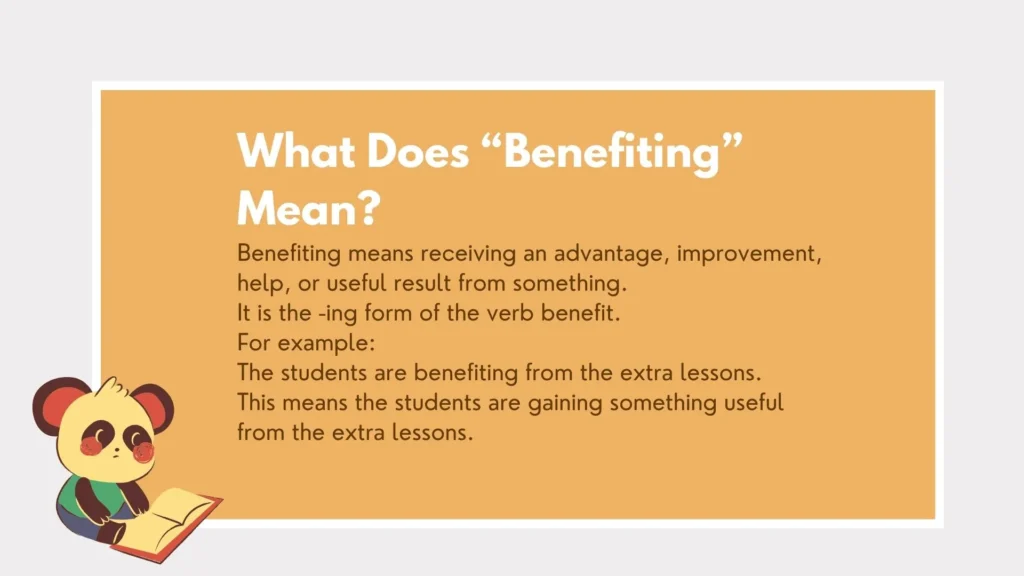
Benefiting means receiving an advantage, improvement, help, or useful result from something.
It is the -ing form of the verb benefit.
For example:
The students are benefiting from the extra lessons.
This means the students are gaining something useful from the extra lessons.
Another example:
Small businesses are benefiting from the new technology.
Here, the businesses are gaining an advantage because of the technology.
The verb benefit can be used when something helps a person, group, organization, or situation. It can also be used with from when someone gains an advantage because of something.
Examples of “Benefiting”
- The company is benefiting from higher sales.
- She is benefiting from regular practice.
- Many families are benefiting from the new service.
- The community is benefiting from the improved roads.
- Students are benefiting from smaller classes.
- The team is benefiting from its new training system.
In every example, benefiting describes an ongoing process of gaining an advantage.
What Does “Benefitting” Mean?
Benefitting has the same meaning as benefiting.
It is also the -ing form of benefit, but it contains a doubled t:
benefit → benefitting
For example:
The students are benefitting from the new program.
This means exactly the same thing as:
The students are benefiting from the new program.
There is no difference in meaning between the two forms.
Oxford’s learner dictionary gives both spellings as accepted -ing forms of benefit.
Examples of “Benefitting”
- The company is benefitting from the changes.
- She is benefitting from the experience.
- The local community is benefitting from the project.
- Employees are benefitting from flexible working hours.
- The students are benefitting from additional support.
The choice between benefiting and benefitting is therefore primarily a matter of spelling convention and regional preference.
Benefiting vs Benefitting: What Is the Difference?
The simplest answer is:
There is no difference in meaning.
Both words mean gaining an advantage or receiving a helpful result.
The difference is the spelling of the final t.
Benefiting
Benefit + ing → benefiting
This spelling uses one t before -ing.
It is particularly common in American English.
Benefitting
Benefit + ing → benefitting
This spelling doubles the final t.
It is particularly common in British English.
However, the distinction is not absolute. British writers may use benefiting, and American writers may use benefitting. Both forms are recognized English spellings.
When Should You Use “Benefiting”?
Use benefiting when you need the -ing form of benefit and your preferred spelling convention uses one t.
It works naturally in everyday English, academic writing, business writing, emails, reports, and professional communication.
In Everyday Conversation
I’m really benefiting from these lessons.
This sounds natural when someone is talking about getting value from an activity.
Another example:
We’re all benefiting from the extra practice.
In School or Academic Writing
Students are benefiting from access to digital learning tools.
The word works well in formal educational writing.
In Business Writing
The company is benefiting from its investment in employee training.
This describes an organization gaining an advantage.
In Emails and Professional Communication
The team is benefiting from the new scheduling system.
The spelling is completely appropriate in professional communication.
When Should You Use “Benefitting”?
Use benefitting when you prefer or are expected to follow a spelling convention that doubles the final t, particularly in British English.
For example:
The business is benefitting from increased customer demand.
This is grammatically and spelling-wise acceptable.
In British English
British English commonly uses doubled consonants in certain verb forms where American English may use a single consonant. Benefitting is one accepted spelling found in British usage.
For example:
The project is benefitting the local community.
However, it is important not to turn this into an absolute rule. Benefiting is also found in British English.
In Formal Writing
If your school, employer, publisher, or style guide follows British spelling, benefitting may be the preferred form.
The key is consistency. If you are following a particular spelling system, keep your spelling choices consistent throughout the document.
When Should You NOT Use “Benefiting” or “Benefitting”?
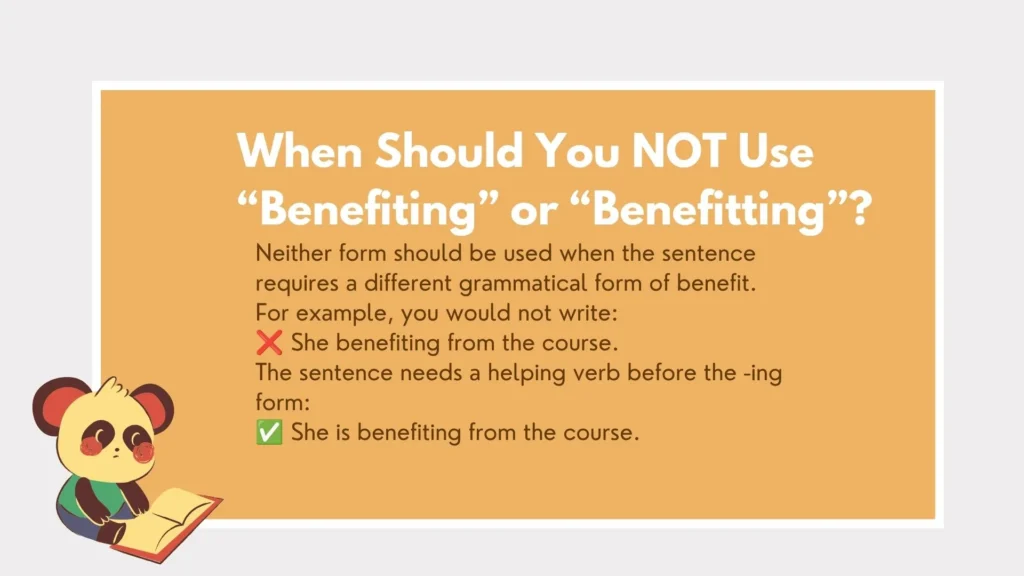
Neither form should be used when the sentence requires a different grammatical form of benefit.
For example, you would not write:
❌ She benefiting from the course.
The sentence needs a helping verb before the -ing form:
✅ She is benefiting from the course.
You also should not automatically use an -ing form when you are talking about a completed event.
❌ She benefiting from the advice yesterday.
Better:
✅ She benefited from the advice yesterday.
The correct form depends on the grammar of the sentence, not simply on which spelling you prefer.
Common Sentence Variations
Benefiting or Benefitting From Something?
Both are correct.
The students are benefiting from the new program.
The students are benefitting from the new program.
The phrase benefit from means to gain an advantage or useful result from something. Oxford gives benefit from something as a normal construction.
Benefiting or Benefitting From the Experience?
Both spellings work:
She is benefiting from her work experience.
She is benefitting from her work experience.
The meaning does not change.
Benefiting or Benefitting the Community?
Again, both are possible:
The project is benefiting the community.
The project is benefitting the community.
Here, benefit is being used as a transitive verb, meaning that the project is helping or improving the community.
Is “Benefiting From” Correct?
Yes.
Benefiting from is one of the most common and useful constructions with this verb.
Employees are benefiting from the new policy.
Children can benefit from regular reading.
The company is benefiting from increased demand.
When the subject receives an advantage because of something, benefit from is a natural choice.
Is “Benefitting From” Correct?
Yes.
Benefitting from is also correct.
Employees are benefitting from the new policy.
It means exactly the same thing as benefiting from.
Benefiting or Benefitted?
These forms belong to different grammatical forms of the verb.
Benefiting is the -ing form:
The company is benefiting from the change.
Benefitted is an alternative past-tense or past-participle spelling:
The company benefitted from the change.
The spelling benefited is also correct:
The company benefited from the change.
Oxford lists both benefited and benefitted as past forms, just as it lists both benefiting and benefitting.
Benefiting or Benefiting From?
There is no spelling difference here—the important issue is sentence structure.
Compare:
The new policy is benefiting employees.
and:
Employees are benefiting from the new policy.
Both are grammatical, but their structures are different.
In the first sentence, employees receive the benefit directly.
In the second, employees are the ones receiving the advantage, and from introduces its source.
Common Phrases With “Benefit”
The word benefit appears in several useful expressions.
Benefit From Something
This means to gain an advantage from something.
Many students benefit from regular revision.
Benefit Someone
This means to help someone or improve their situation.
The new program will benefit local families.
For the Benefit of Someone
This means for someone’s help, advantage, or interest.
The guide was written for the benefit of new employees.
To Someone’s Benefit
This means something is advantageous to a person.
Arriving early will be to your benefit.
Mutual Benefit
This describes a situation in which two or more people or groups gain something useful.
The agreement was designed for mutual benefit.
Health Benefits
This refers to positive effects on health.
Regular exercise can have several health benefits.
The noun benefit commonly refers to an advantage or helpful effect, while it can also refer to other things such as employee benefits or financial assistance, depending on context.
Common Mistakes
Mistake 1: Treating “Benefitting” as Always Wrong
❌ Benefitting is incorrect.
✅ Benefitting is a correct spelling of the -ing form of benefit.
It is not simply a spelling mistake. It is an accepted variant.
Mistake 2: Treating “Benefiting” as Always Wrong
❌ You must write benefitting because the t should be doubled.
✅ Both benefiting and benefitting are accepted.
The single-t form is especially common in American English.
Mistake 3: Mixing the Verb Form With the Past Tense
❌ She benefitting from the course last year.
✅ She benefited from the course last year.
The past-tense form is needed in the second sentence.
Mistake 4: Forgetting the Helping Verb
❌ The students benefiting from the lessons.
✅ The students are benefiting from the lessons.
The -ing form normally needs an appropriate auxiliary verb when it is being used in the present progressive construction.
Mistake 5: Assuming the Meaning Changes
❌ Benefitting means something different from benefiting.
✅ Benefitting and benefiting have the same meaning.
The extra t does not create a different word or a different meaning.
Mistake 6: Changing Spelling Randomly
❌ The report uses “benefiting,” but later uses “benefitting,” “benefited,” and “benefitted” without a reason.
✅ Choose a consistent spelling style appropriate for your audience.
Both variants are legitimate, but consistent usage makes formal writing cleaner.
Why Do People Get “Benefiting” and “Benefitting” Wrong?
The confusion comes mainly from English spelling rules about doubling a final consonant before endings such as -ing and -ed.
Many English verbs do double a final consonant in certain situations.
For example:
run → running
stop → stopping
This can make writers wonder whether benefit should become benefitting.
The complication is that spelling conventions do not work identically for every verb, and regional English has developed different preferences.
As a result, both benefiting and benefitting have become established spellings.
The safest approach is not to assume that every verb ending in t must follow exactly the same pattern.
Can Both Forms Be Correct?
Yes.
This is the most important point of the entire article.
Both:
benefiting
and:
benefitting
are correct forms of the verb benefit.
They do not represent different meanings, different tenses, or different grammatical functions.
The main difference is spelling preference.
Oxford’s dictionary entries explicitly include both forms.
When “Benefiting” Is Correct
The company is benefiting from the investment.
When “Benefitting” Is Correct
The company is benefitting from the investment.
Both sentences communicate the same idea.
Does the Extra “T” Change the Meaning?
No.
The additional t is a spelling difference, not a meaning difference.
If someone says:
The students are benefiting from the course.
and another person writes:
The students are benefitting from the course.
They are expressing the same idea.
British vs American English
The difference becomes particularly useful when considering regional spelling preferences.
American English
Benefiting is generally the more familiar spelling in American English.
For example:
The company is benefiting from strong sales.
The American Oxford dictionary lists both benefiting and benefitting, so the doubled form is not impossible in American English.
British English
Benefitting is a common British spelling preference.
For example:
The company is benefitting from strong sales.
But benefiting can also be found in British English.
Therefore, it would be inaccurate to say:
“Benefiting is American and benefitting is British, so each form can only be used in one country.”
The reality is more flexible.
Which One Should You Choose?
If you are writing specifically for an American audience, benefiting is a natural choice.
If you are following British English conventions, benefitting may be the preferred choice.
If you are writing for a general international audience, either form is acceptable. What matters most is consistency with the spelling style you are using.
Pronunciation
The pronunciation of benefiting and benefitting is essentially the same.
The extra t in the spelling does not create an additional syllable.
Both forms are pronounced with the same basic sound pattern:
BEN-uh-fit-ing
The spelling difference is therefore much more noticeable in writing than in speech.
This is one reason the two forms can cause confusion when someone hears the word first and later has to spell it.
Word Origin and Spelling History
The verb benefit has a long history in English and is connected to the idea of doing good or receiving an advantage. Oxford traces the word to Middle English, with roots involving Old French and Latin expressions associated with a good deed or favor.
However, you do not need to know the word’s history to choose the correct spelling today.
Modern dictionaries recognize both benefiting and benefitting, so current usage—not historical spelling alone—is the useful guide for everyday writing.
Simple Memory Trick
Use this easy rule:
Benefit can become either benefiting or benefitting.
If you want a simple regional reminder:
American English → benefiting is a common choice.
British English → benefitting is a common choice.
But remember: these are preferences, not strict boundaries.
Quick Decision Guide
Are you writing the -ing form of “benefit”?
→ Use benefiting or benefitting.
Do you want the spelling commonly preferred in American English?
→ Benefiting
Do you want a spelling commonly preferred in British English?
→ Benefitting
Are you wondering whether one changes the meaning?
→ No. Both mean the same thing.
Are you talking about a completed event?
→ Consider benefited or benefitted, depending on your spelling preference.
Are you writing for school, work, or publication?
→ Follow the spelling style required by your institution, employer, publisher, or style guide when one is specified.
Mini Quiz
1. Which sentence is correctly spelled?
A. The students are benefiting from the extra classes.
B. The students are benefitng from the extra classes.
Answer: A — benefiting
The word needs the complete -ing form.
2. Which spelling is also correct?
A. Benefitting
B. Benefiting
Answer: A and B
Both are accepted spellings of the -ing form of benefit.
3. Which sentence uses the past tense correctly?
A. She benefited from the training.
B. She benefiting from the training.
Answer: A — benefited
The sentence describes a completed experience, so a past-tense form is required.
4. Does “benefitting” have a different meaning from “benefiting”?
A. Yes
B. No
Answer: B — No
The two spellings have the same meaning.
5. Which spelling is commonly preferred in American English?
A. Benefiting
B. Benefitting
Answer: A — benefiting
The single-t form is a common American spelling preference.
6. Which spelling can be used in British English?
A. Only benefiting
B. Only benefitting
C. Both benefiting and benefitting
Answer: C — Both benefiting and benefitting
British English commonly uses benefitting, but benefiting is also an accepted form.
7. Which sentence is correct?
A. Employees are benefitting from the new policy.
B. Employees are benefitting the new policy.
Answer: A — Employees are benefitting from the new policy.
When people gain an advantage because of something, benefit from is a natural construction.
FAQ
Is “benefiting” or “benefitting” correct?
Both are correct. They are alternative spellings of the -ing form of benefit. Benefiting is particularly common in American English, while benefitting is particularly common in British English.
Is “benefitting” a real word?
Yes. Benefitting is an accepted spelling of the present participle of benefit. It is not simply a misspelling of benefiting.
Is “benefiting” American English?
Benefiting is a common American English spelling, but it is not restricted to American English. It can also be used in British and other varieties of English.
Is “benefitting” British English?
Benefitting is commonly associated with British English, but it is not exclusively British. Both major English varieties recognize the spelling.
Does benefiting mean the same as benefitting?
Yes. There is no difference in meaning. Both mean gaining an advantage, receiving help, or getting a useful result from something.
Should I write “benefiting from” or “benefitting from”?
Either is correct.
The company is benefiting from the changes.
and
The company is benefitting from the changes.
Both sentences have the same meaning.
Is “benefited” or “benefitted” correct?
Both spellings are accepted. Benefited is widely used, while benefitted is also established, particularly in British English. Oxford lists both as past forms of benefit.
Is “benefiting the community” correct?
Yes.
The new project is benefiting the community.
Here, benefiting means helping or improving the community. The verb benefit can be used directly with an object in this way.
Is “benefiting from” grammatically correct?
Yes. Benefit from is a standard construction used when someone or something gains an advantage because of another thing.
Students are benefiting from the new resources.
Which spelling should I use in formal writing?
Either can be correct, but follow the spelling convention required by your audience or style guide. If you use American English, benefiting is a straightforward choice. If you use British English, benefitting is a common choice.
Is there a pronunciation difference between benefiting and benefitting?
No meaningful pronunciation difference is created by the extra t. The two spellings are pronounced essentially the same way.
Final Takeaway
Benefiting and benefitting are both correct.
They are two accepted spellings of the -ing form of benefit, and they have the same meaning. Benefiting is especially common in American English, while benefitting is especially common in British English, although neither spelling is strictly limited to one variety.
The easiest rule to remember is:
If you mean “gaining an advantage,” both benefiting and benefitting work. Choose the spelling that matches your preferred English style and use it consistently.
Discover More Topics:
- Mam or Ma’am | Which Is Correct? The Simple Answer You’ve Been Looking For
- Learned or Learnt? The Simple Answer That Clears Up the Confusion

Hi, I’m Sophia Mitchell, and I’ve always been fascinated by the stories behind names. My passion for animals inspired me to help pet owners find names that feel personal, memorable, and full of meaning. As a writer for Meanixo, I create pet naming resources that combine creativity, research, and practical ideas for every type of pet.
I enjoy exploring global naming traditions, personality-based names, and trending pet names to help readers confidently choose the perfect name for their beloved companions.
Books:
- Meaningful Names for Every Pet
- The Joy of Naming Your Best Friend
 Michael Turner
 Daniel Brooks