
Have you ever wondered whether to write in person or in-person? Both forms look correct, and you’ll often see them used in emails, meeting invitations, job advertisements, and everyday conversations. However, there is a small grammatical difference that determines which form you should choose.
The good news is that both in person and in-person are correct English expressions. The difference isn’t related to British or American spelling. It depends on how the phrase functions in a sentence.
Use in person as a two-word adverbial phrase when describing how someone does something. For example, you might say, “I want to meet you in person.”Use in-person with a hyphen when it comes before a noun and describes that noun. For example, “We have an in-person meeting tomorrow.”
In this guide, I’ll explain the meaning, grammar rules, hyphenation, pronunciation, and correct usage of both forms. You’ll also find practical examples to help you choose the right spelling confidently.
In Person or In-Person: What’s the Difference?
The main difference between these forms is their grammatical function. One is an open phrase consisting of two separate words, while the other is a hyphenated compound adjective.
| Form | Grammatical function | When to use it | Example |
| In person | Adverbial phrase | Describes how an action happens | I met her in person. |
| In-person | Compound adjective | Describes a noun | We arranged an in-person meeting. |
Both forms communicate the idea of being physically present with another person rather than communicating remotely.
However, their positions in a sentence usually determine which spelling you need.
When to Use In Person
Use in person as two separate words when it describes an action or explains how someone participates in an activity.
It functions as an adverbial phrase because it provides information about the manner in which something happens.
For example:
- I would like to speak with the manager in person.
- She came to the office in person.
- We finally met in person after months of online conversations.
- You must submit your application in person.
- The doctor wants to examine you in person.
In each sentence, the phrase explains how the action takes place.
It doesn’t directly describe a noun. Instead, it modifies an action such as speaking, coming, meeting, submitting, or examining.
More examples of the two-word form:
- I prefer discussing important matters in person.
- Can we talk about this in person?
- He collected his documents in person.
- The students attended the workshop in person.
- I hope to meet your family in person someday.
Remember: When you use the phrase after a verb to describe how an action happens, write it as two separate words.
When to Use In-Person
Use in-person with a hyphen when it appears before a noun and describes that noun.
In this position, it functions as a compound adjective. It tells readers that an activity, meeting, appointment, or event involves people being physically present together.
For example:
- We scheduled an in-person meeting.
- She has an in-person interview tomorrow.
- The university offers in-person classes.
- I received an invitation to an in-person event.
- They arranged an in-person appointment.
In these examples, the hyphen connects the words so they work together as one descriptive unit.
Here are more examples:
- The company organized an in-person training session.
- Our school introduced an in-person learning program.
- The manager requested an in-person discussion.
- I prefer in-person communication for important decisions.
- The conference includes several in-person workshops.
- We are planning an in-person consultation.
- The hospital provides in-person medical services.
- The organization announced an in-person recruitment event.
- Students can choose between online and in-person education.
- The team arranged an in-person presentation.
Remember: When the expression directly describes a noun, use the hyphenated form.
In Person or In-Person Meeting: Which Is Correct?

Both expressions can be correct, but their grammatical structures are different.
The choice depends on whether you’re describing the meeting itself or explaining how people attend it.
Use “in-person meeting” when the expression comes before the noun meeting and describes the type of meeting.
Example:
– We have an in-person meeting on Monday.
Here, in-person describes the meeting.
Use “meet in person” when you’re explaining how two or more people will meet.
Example:
– We will meet in person on Monday.
Here, in person describes the action of meeting.
Compare these sentences:
| Sentence | Correct form | Reason |
| We arranged an ___ meeting. | In-person | Describes meeting |
| We will meet ___. | In person | Describes the action |
| She requested an ___ discussion. | In-person | Describes discussion |
| We discussed the matter ___. | In person | Describes how it happened |
| The company announced an ___ event. | In-person | Describes event |
| Employees attended the event ___. | In person | Describes attendance |
The easiest way to remember the distinction is to look at the word that follows the expression.
If it directly describes a noun, the hyphenated form is generally appropriate. If it describes an action, use the two-word form.
In-Person or In Person Interview: Which Spelling Should You Choose?
The correct expression is in-person interview when you use it before the noun interview.
An in-person interview is a meeting in which an interviewer and candidate meet physically at the same location rather than conducting the interview through a video call or telephone.
For example:
- I have an in-person interview scheduled for Friday.
- The company requires an in-person interview for this position.
- She successfully completed her first in-person interview.
- The recruiter invited three candidates to an in-person interview.
However, when describing the action of attending or conducting the interview, use in person.
For example:
- I will attend the interview in person.
- The manager wants to interview all candidates in person.
- She prefers conducting interviews in person.
Both forms are correct because they perform different grammatical functions.
Quick tip: Write “in-person interview” but “attend the interview in person.”
In Person or In-Person Event: Understanding the Correct Form
When describing an event, use in-person event because the hyphenated expression functions as an adjective before the noun.
An in-person event is an organized gathering where participants physically attend the same location.
Examples:
- Our company is hosting an in-person event next month.
- The university announced an in-person graduation ceremony.
- I received an invitation to an in-person networking event.
- The organization is planning an in-person conference.
- This year’s program includes both virtual and in-person events.
However, when you describe someone’s attendance, use the two-word phrase.
Examples:
- I attended the event in person.
- She will participate in the conference in person.
- We met several business owners in person.
- The director appeared in person to welcome the guests.
The grammatical difference remains the same: in-person describes the event, while in person describes the way someone participates.
Is In-Person Always Hyphenated?
No. In-person is not always hyphenated. The hyphen is generally used when the expression functions as a compound adjective before a noun.
Consider these examples:
| Correct expression | Why it is correct |
| An in-person meeting | Describes a meeting |
| An in-person interview | Describes an interview |
| An in-person appointment | Describes an appointment |
| Attend in person | Describes an action |
| Meet in person | Describes an action |
| Speak in person | Describes an action |
| Apply in person | Describes an action |
| Participate in person | Describes an action |
There is an important distinction between an adjective and an adverbial phrase.
An adjective gives information about a noun. An adverbial phrase provides information about an action, such as how, where, or under what circumstances it happens.
For instance:
- Adjective: We organized an in-person discussion.
- Adverbial phrase: We discussed the proposal in person.
The first expression describes the discussion. The second explains how the discussion happened.
What About In-Person After a Linking Verb?
You may also encounter sentences such as:
- The meeting will be in person.
- The classes are in person.
- The consultation is in person.
In standard usage, the hyphen is generally omitted here because the expression follows the linking verb rather than directly modifying a noun before it.
Compare:
- Before a noun: This is an in-person class.
- After a linking verb: This class is in person.
This is a useful distinction because some writers mistakenly assume that every occurrence of the expression needs a hyphen.
Is Inperson One Word?
No. Inperson is not the standard spelling of this expression.
The accepted forms are:
- In person: Two separate words, used as an adverbial phrase.
- In-person: Two words connected by a hyphen, used as a compound adjective.
Writing inperson as one word is a common spelling mistake.
Examples:
Incorrect
- I want to meet you inperson.
- We arranged an inperson interview.
- She prefers inperson classes.
Correct
- I want to meet you in person.
- We arranged an in-person interview.
- She prefers in-person classes.
The expression should not be joined into one word, regardless of whether you’re using it as an adjective or an adverbial phrase.
Why Does In Person Have Two Different Spellings?
The difference comes from English compound-word and hyphenation rules.
English sometimes combines two or more words to create a single descriptive expression. A hyphen can show readers that those words work together to modify a noun.
In the expression in-person, the words in and person combine to describe an activity or arrangement involving physical presence.
For example:
- An in-person appointment.
- An in-person examination.
- An in-person consultation.
Without the hyphen, readers might initially process the words separately. The hyphen makes their combined descriptive function clearer.
However, when the expression describes an action, there is no need to connect the words.
For example:
- I attended the appointment in person.
- She completed the examination in person.
- We discussed the matter in person.
Here, the phrase works naturally as an adverbial expression.
What Is a Compound Adjective?
A compound adjective consists of two or more words that work together to describe a noun.
Some common examples include:
| Compound adjective | Example |
| Face-to-face | A face-to-face conversation |
| Well-known | A well-known author |
| Full-time | A full-time employee |
| Long-term | A long-term agreement |
| Up-to-date | An up-to-date report |
| In-person | An in-person appointment |
The hyphen connects the words and helps readers understand that they form one descriptive unit.
In in-person appointment, for example, the expression describes the type of appointment rather than the action of attending it.
What Is an Adverbial Phrase?
An adverbial phrase is a group of words that performs the function of an adverb. It provides additional information about an action or another part of a sentence.
The phrase in person can tell readers that someone is physically present rather than communicating through a digital or remote method.
Examples:
- I met the new employee in person.
- They prefer speaking in person.
- We completed the registration in person.
- The principal welcomed the students in person.
In each sentence, the phrase adds information about the action.
This explains why the two-word form is appropriate.
In Person vs. Face-to-Face: Are They the Same?
The expressions in person and face-to-face are closely related, but they aren’t always interchangeable.
Both can describe direct, physical interaction between people. However, they can emphasize slightly different things.
In person emphasizes someone’s physical presence rather than communication through technology or another person.
Face-to-face emphasizes direct interaction between people who are physically facing or meeting one another.
Compare the following examples:
- I want to meet the author in person.
- I want to have a face-to-face conversation with the author.
The first sentence emphasizes meeting the author physically. The second focuses on direct interaction.
Here is a closer comparison:
| Expression | Meaning | Example |
| In person | Physically present yourself | I submitted the form in person. |
| Face-to-face | Direct interaction between people | We had a face-to-face discussion. |
| Online | Using an internet connection | We attended an online seminar. |
| Virtually | Through digital technology | The team met virtually. |
| Remotely | From a different physical location | She works remotely. |
You can often use in person and face-to-face in similar situations, but their meanings are not identical in every context.
For example, someone might visit a government office in person to submit documents without having a face-to-face conversation with anyone.
Similarly, a face-to-face conversation might happen during an in-person meeting, but the two expressions emphasize different aspects of the situation.
In-Person vs. Online: What Is the Difference?
The difference between in-person and online activities is mainly physical presence.
An in-person activity requires participants to be physically present at the same location. An online activity takes place through internet-based communication or digital platforms.
For example, a company might offer two types of training:
- In-person training: Employees attend a physical training session at an office or training center.
- Online training: Employees participate through a website, video platform, or learning management system.
Both arrangements have their own practical uses.
| Feature | In-person | Online |
| Physical presence | Required | Usually not required |
| Communication | Direct, face-to-face | Through digital tools |
| Location | Shared physical location | Different locations possible |
| Interaction | Often immediate and personal | Depends on the platform |
| Flexibility | Usually tied to a place and schedule | Often more flexible |
| Technology | May be used as support | Essential for participation |
The distinction is useful when writing about meetings, interviews, education, healthcare appointments, conferences, and professional communication.
For example:
- The company offers in-person and online interviews.
- Students can choose between in-person and online classes.
- Our organization provides both virtual and in-person consultations.
These sentences use the hyphenated form correctly because in-person describes the nouns that follow.
In-Person Meeting vs. Meeting in Person
These expressions are both grammatically correct, but their sentence structures are different.
In-person meeting is a noun phrase in which the compound adjective describes the meeting.
Meeting in person uses an action followed by an adverbial phrase explaining how the meeting happens.
Compare:
- We scheduled an in-person meeting.
- We are meeting in person tomorrow.
In the first example, in-person describes the meeting as a type of meeting.
In the second example, in person describes the way the participants will meet.
Here are additional comparisons:
| With a noun | With an action |
| An in-person interview | Interview someone in person |
| An in-person appointment | Attend an appointment in person |
| An in-person event | Attend an event in person |
| An in-person consultation | Consult someone in person |
| An in-person discussion | Discuss something in person |
| An in-person class | Study in person |
This pattern works across many everyday and professional situations.
Is In-Person Formal or Informal?
Both forms are acceptable in formal and informal English.
You can use in-person in professional emails, business reports, academic writing, job descriptions, meeting invitations, and official announcements.
Similarly, in person is appropriate in everyday conversations and formal communication.
Examples of formal usage:
- We would like to arrange an in-person consultation.
- Candidates must attend the final interview in person.
- The organization will conduct an in-person assessment.
- Please visit our office in person to complete the verification process.
Examples of informal usage:
- I’d love to see you in person.
- We should meet in person sometime.
- It was nice finally meeting you in person.
- Let’s talk about it in person.
The choice between the forms is grammatical, not a matter of formality.
You should not use a hyphenated form simply because you’re writing a professional email. Likewise, you don’t need to remove the hyphen just because you’re writing casually.
In Person or In-Person in Professional Emails?
Both expressions are common in professional communication. The correct choice depends on the sentence.
Use in-person when describing an appointment, meeting, interview, or other professional activity.
Examples:
- We would like to schedule an in-person meeting next week.
- Your in-person interview is confirmed for Tuesday.
- The company is offering in-person training.
- Please attend the in-person orientation session.
Use in person when describing what someone should do.
Examples:
- Please attend the meeting in person.
- We would like to discuss the proposal in person.
- You must verify your documents in person.
- I would appreciate the opportunity to speak with you in person.
How to Use It in a Meeting Invitation
Here is an example of a professional meeting invitation:
Hello,
We would like to invite you to an in-person meeting to discuss the upcoming project and review the next steps.
The meeting is scheduled for Monday at 10:00 a.m. at our main office.
Please confirm your availability. We look forward to meeting you in person.
Best regards,
[Your Name]
Notice that both forms appear in the same email:
- In-person meeting describes the meeting.
- Meeting you in person describes the action.
This is a practical example of using both forms correctly in professional writing.
In Person or In-Person: British vs. American English
There is no significant British-versus-American spelling difference between these expressions.
Both British English and American English generally use:
- In person as a two-word adverbial phrase.
- In-person as a hyphenated adjective before a noun.
For example:
| British English | American English |
| I want to meet you in person. | I want to meet you in person. |
| We arranged an in-person meeting. | We arranged an in-person meeting. |
| She attended the interview in person. | She attended the interview in person. |
| They offer in-person classes. | They offer in-person classes. |
The spelling remains the same in both varieties.
You might encounter differences in punctuation or editorial preferences between publications, but the basic distinction between the two forms is widely recognized.
If you’re writing for an international audience, you can confidently use these standard forms.
In-Person According to AP, Chicago, and APA Style
Writers sometimes wonder whether the hyphenation rule changes depending on the style guide they’re following.
Major editorial styles provide guidance on compound modifiers and hyphenation. The general principle is to make the relationship between words clear.
AP Style
The Associated Press Stylebook is widely used in journalism, newspapers, and news-related publications.
For professional writing that follows AP conventions, use the standard distinction between a hyphenated compound modifier and an open phrase.
Examples:
- An in-person interview.
- An in-person event.
- The candidates appeared in person.
If you’re writing for a newspaper or news organization, follow its current AP-based house style when it provides a specific instruction.
Chicago Manual of Style
The Chicago Manual of Style provides detailed guidance on compound words, hyphenation, and punctuation.
Its general approach is to use hyphens when they help readers understand a compound modifier, particularly when multiple words work together before a noun.
For example:
- An in-person appointment.
- An in-person training program.
When the phrase is used adverbially, the words remain separate:
- The appointment will take place in person.
- The employees completed their training in person.
Chicago’s broader guidance also emphasizes avoiding unnecessary hyphens when they don’t improve clarity.
The Chicago Manual of Style Online+2
APA Style
The Publication Manual of the American Psychological Association is commonly used in academic papers, psychology, education, and social sciences.
When writing in APA style, pay attention to the grammatical function of the expression and apply the appropriate hyphenation convention.
Examples:
- Participants attended an in-person workshop.
- Researchers conducted interviews in person.
For academic work, also follow any additional formatting and editorial instructions provided by your university, journal, or instructor.
Practical advice: Whichever style guide you follow, be consistent throughout your document. Don’t switch between in person and in-person when the grammatical function hasn’t changed.
How to Pronounce In Person and In-Person
Both expressions are pronounced almost identically. The hyphen changes the written form, not the basic pronunciation.
According to the Cambridge Dictionary, the pronunciation of in-person is:
- American English: /ˌɪnˈpɝː.sən/
- British English: /ˌɪnˈpɜː.sən/
A simple pronunciation guide is:
In-PER-suhn
The expression has three syllables:
- In
- Per
- Son
The primary stress falls on the second syllable, per.
Is There a Pronunciation Difference Between In Person and In-Person?
No. There is generally no pronunciation difference between the two written forms.
For example:
- I met her in person.
- We arranged an in-person meeting.
The pronunciation of the expression remains essentially the same in both sentences.
The difference is grammatical and written rather than phonetic.
Capitalization: Should You Write In Person or In-Person?
The capitalization of these expressions depends on their position in a sentence and the capitalization style used in headings and titles.
In ordinary sentences, both forms are written in lowercase unless they begin a sentence or appear in a proper name.
Examples:
- I would like to meet you in person.
- We arranged an in-person meeting.
- She prefers in-person communication.
If the expression begins a sentence, capitalize the first word:
- In person, the discussion was much easier.
- In-person meetings can encourage direct communication.
In-Person in Title Case
When using the expression in a heading or title, follow the capitalization rules of your chosen style guide.
For example:
- In Person or In-Person: Which Is Correct?
- The Benefits of In-Person Meetings
- How to Prepare for an In-Person Interview
In title case, the first word of a hyphenated compound is capitalized. The second element is handled according to the applicable title-case convention.
In sentence case, capitalize only the first word and proper nouns:
- In person or in-person: Which is correct?
- How to prepare for an in-person interview
The key point is that capitalization doesn’t change the grammatical distinction or the hyphenation rule.
10 Examples of In Person in Sentences
Use in person when describing how someone performs an action or participates in an activity.
Here are 10 natural examples:
- I would love to meet your family in person.
- The manager asked me to visit the office in person.
- We discussed the project in person yesterday.
- She prefers talking to customers in person.
- You must collect your certificate in person.
- They finally met in person after communicating online for several months.
- The doctor wants to examine the patient in person.
- I attended the university orientation in person.
- He apologized to his colleague in person.
- We can discuss the details in person next week.
In all these sentences, the expression explains how someone does something.
10 Examples of In-Person in Sentences
Use in-person when describing a noun, particularly when the expression comes directly before it.
Here are 10 examples:
- We have an in-person meeting tomorrow.
- She received an invitation to an in-person interview.
- The school offers in-person classes.
- The company organized an in-person training session.
- I booked an in-person appointment with the dentist.
- The university hosted an in-person graduation ceremony.
- Our team attended an in-person conference.
- The hospital provides in-person consultations.
- They announced an in-person networking event.
- The organization introduced an in-person assessment program.
In these sentences, the hyphen connects the two words because they work together as a compound adjective.
Common Mistakes When Using In Person and In-Person
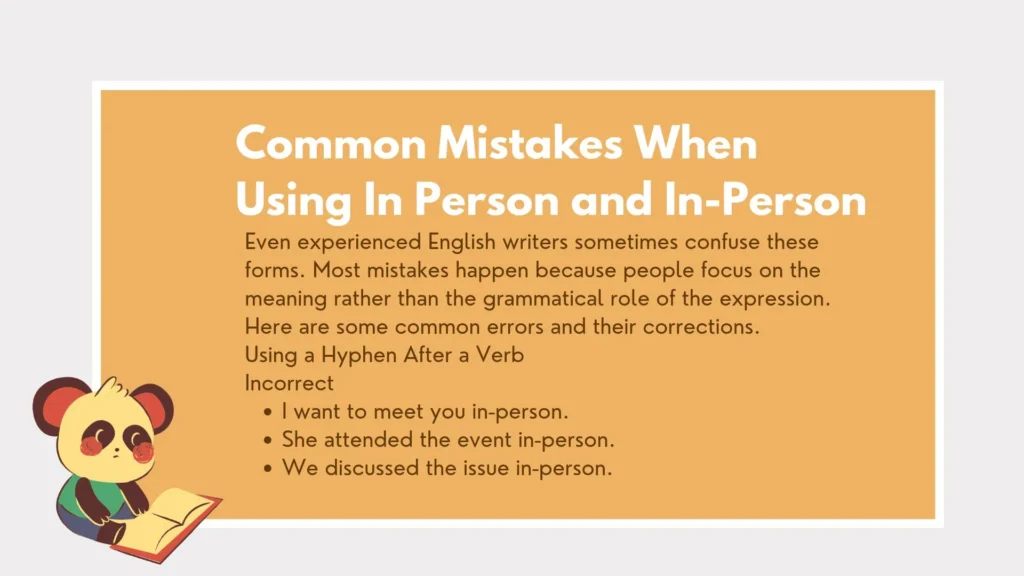
Even experienced English writers sometimes confuse these forms. Most mistakes happen because people focus on the meaning rather than the grammatical role of the expression.
Here are some common errors and their corrections.
Using a Hyphen After a Verb
Incorrect
- I want to meet you in-person.
- She attended the event in-person.
- We discussed the issue in-person.
Correct
- I want to meet you in person.
- She attended the event in person.
- We discussed the issue in person.
Why? The expression describes the action rather than a noun placed after it.
Forgetting the Hyphen Before a Noun
Not the standard compound-adjective form
- We arranged an in person meeting.
- She has an in person interview.
- They organized an in person event.
Correct
- We arranged an in-person meeting.
- She has an in-person interview.
- They organized an in-person event.
Why? The expression functions as a compound adjective directly before the noun.
Writing Inperson as One Word
Incorrect
- I prefer inperson communication.
- We need an inperson consultation.
Correct
- I prefer in-person communication.
- We need an in-person consultation.
Why? The standard spelling uses either two separate words or a hyphen, depending on the grammatical function.
Using In-Person in Every Situation
Some writers assume that in-person is always the correct choice because they frequently see it in business communication.
However, the two forms are not interchangeable.
Compare:
- Correct: We scheduled an in-person meeting.
- Correct: We scheduled the meeting in person.
The first describes the meeting. The second describes how the scheduling took place.
Both are grammatically possible, but they communicate slightly different things.
Confusing In-Person With Face-to-Face
These expressions have related meanings, but they aren’t identical.
For example:
- We need an in-person appointment.
- We need a face-to-face discussion.
The first emphasizes physical attendance. The second emphasizes direct interaction.
Understanding this distinction can make your professional and everyday writing more precise.
Frequently Asked Questions
Is it in person or in-person?
Both forms are correct, but they have different grammatical functions. Use in person as a two-word adverbial phrase when describing an action. Use in-person as a compound adjective before a noun, such as an in-person meeting or in-person interview.
Is in-person one word or two words?
In-person consists of two words connected by a hyphen. In person also consists of two separate words but doesn’t have a hyphen. Writing inperson as one word is incorrect in standard English.
Should I write in-person meeting or in person meeting?
The standard form is in-person meeting because the expression describes the noun meeting. The hyphen connects the words to show that they function together as a compound adjective.
Is it correct to say meet in-person?
The standard spelling is meet in person because the expression describes the action of meeting.
Example: “I’d like to meet you in person.”
Is in-person grammatically correct?
Yes. In-person is grammatically correct when used as a compound adjective before a noun.
Example: “We are organizing an in-person workshop.”
Should I hyphenate in-person after a verb?
Generally, no. When the expression describes an action after a verb, write it as two separate words.
Correct: “She attended the conference in person.”
Incorrect: “She attended the conference in-person.”
Is in person formal English?
Yes. Both in person and in-person are acceptable in formal and informal English. You can use them in business emails, academic writing, professional documents, and everyday conversations.
Is in-person American or British English?
Both American and British English use in-person and in person. The distinction is grammatical rather than regional.
What is the difference between in-person and face-to-face?
In-person emphasizes physical presence, while face-to-face emphasizes direct interaction between people. For example, an in-person appointment involves attending physically, whereas a face-to-face conversation focuses on direct communication.
How do you pronounce in-person?
The expression is pronounced in-PER-suhn. It has three syllables, with the main stress on the second syllable. Its pronunciation is essentially the same whether written with or without a hyphen.
Conclusion
The choice between in person or in-person depends on how you use the expression in a sentence. Both forms are correct, but they aren’t interchangeable in every grammatical position.
Remember these two simple rules:
- In person: Use two separate words when describing an action. Example: “I want to meet you in person.”
- In-person: Use a hyphen when the expression describes a noun. Example: “We arranged an in-person meeting.”
Also, remember that inperson is not the standard spelling, and there is no major British-versus-American spelling difference.
Once you understand the difference between an adverbial phrase and a compound adjective, choosing the correct form becomes much easier.

Hi, I’m Sophia Mitchell, and I’ve always been fascinated by the stories behind names. My passion for animals inspired me to help pet owners find names that feel personal, memorable, and full of meaning. As a writer for Meanixo, I create pet naming resources that combine creativity, research, and practical ideas for every type of pet.
I enjoy exploring global naming traditions, personality-based names, and trending pet names to help readers confidently choose the perfect name for their beloved companions.
Books:
- Meaningful Names for Every Pet
- The Joy of Naming Your Best Friend
 Michael Turner