
Have you ever typed realise and wondered whether you should have written realize instead? I’ve noticed that these two spellings can be confusing, especially when you’re switching between British and American English.
The good news is that both realise and realize are correct English spellings. They have the same meaning, perform the same grammatical function, and are pronounced the same way. The main difference is where they’re commonly used.
In this article, I’ll explain the difference between realise and realize, which spelling to use in different countries, and how to use both correctly in everyday sentences.
Realise or Realize: Which Is Correct?
Both “realise” and “realize” are correct. “Realise” is more common in British English, while “realize” is the standard spelling in American English. British English also accepts “realize,” particularly in Oxford spelling.
Neither spelling changes the meaning of the word. Your choice mainly depends on the variety of English you’re writing and the spelling conventions you’re following.
Here’s a quick comparison:
| Feature | Realise | Realize |
| Correct spelling | Yes | Yes |
| Common usage | British English | American English |
| Part of speech | Verb | Verb |
| Meaning | To understand or become aware | To understand or become aware |
| Pronunciation | /ˈrɪəlaɪz/ | /ˈrɪəlaɪz/ |
| Example | I realise my mistake. | I realize my mistake. |
For most writers, the easiest rule is to use realise in everyday British English and realize in American English.
What Does Realise Mean?
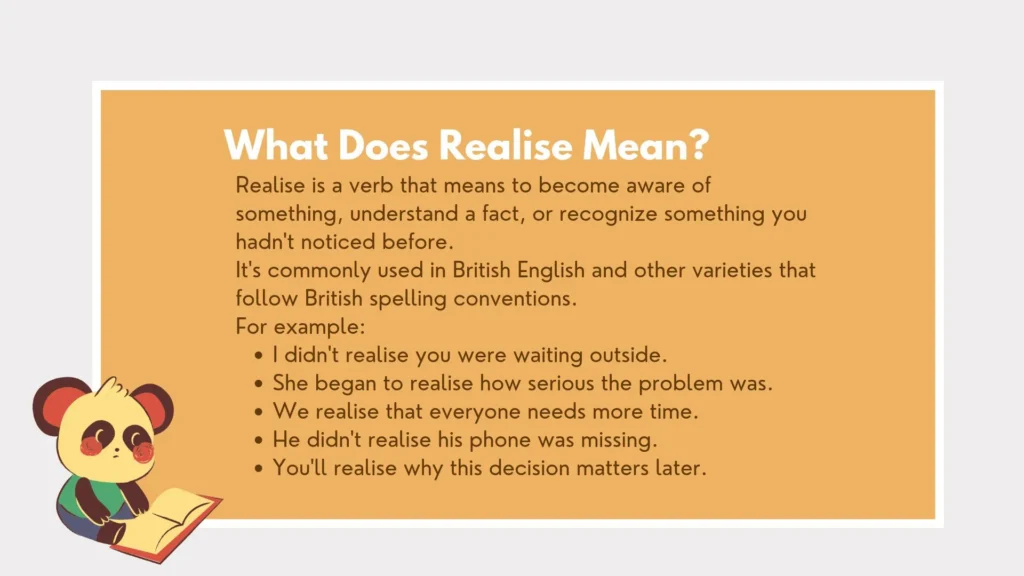
Realise is a verb that means to become aware of something, understand a fact, or recognize something you hadn’t noticed before.
It’s commonly used in British English and other varieties that follow British spelling conventions.
For example:
- I didn’t realise you were waiting outside.
- She began to realise how serious the problem was.
- We realise that everyone needs more time.
- He didn’t realise his phone was missing.
- You’ll realise why this decision matters later.
The word can also mean making something real or achieving a goal.
For example:
After years of hard work, she finally realised her dream of opening a bakery.
Here, realised means achieved or made a dream come true.
Is Realise a Correct English Word?
Yes, realise is a standard English word, not a misspelling. It’s especially common in British English, Australian English, and New Zealand English.
If you’re writing for a British audience, realise is a natural and widely accepted choice.
What Does Realize Mean?
Realize is the American English spelling of realise. It has exactly the same meanings and is also a verb.
You can use realize when you suddenly understand something, become aware of a situation, or achieve a goal.
For example:
- I didn’t realize the meeting had already started.
- She realized that she had forgotten her keys.
- We realize how difficult this situation is.
- He finally realized what his teacher meant.
- They worked hard to realize their ambitions.
In American English, realize is the spelling you’ll normally see in books, newspapers, school assignments, and professional writing.
Is Realize Correct in British English?
Yes. Although realise is more common in everyday British English, realize is also an accepted British spelling.
This is partly because of a spelling convention known as Oxford spelling, which prefers -ize endings for many verbs, including realize, organize, and recognize.
So, writing realize in British English isn’t automatically a mistake. However, you should follow the spelling style expected by your school, publisher, or organization.
Realise vs. Realize: British and American English
The difference between realise and realize comes down mainly to regional spelling conventions.
American English consistently prefers realize, while British English commonly uses realise but also permits realize.
This distinction is similar to other spelling pairs, such as organise/organize and recognise/recognize.
Realise or Realize in UK English?
In the United Kingdom, realise is the more familiar spelling in general writing.
For example:
I didn’t realise how late it was.
You’ll commonly encounter this spelling in British communication, schoolwork, and publications.
However, some British publishers and academic styles use realize instead. Oxford spelling is one well-known example.
Realise or Realize in US English?
In the United States, realize is the standard spelling.
For example:
I didn’t realize how late it was.
American dictionaries, schools, and publications generally use the -ize form.
If you’re writing for an American audience, realize is the safest choice.
Realise or Realize in Australia, New Zealand, Canada, and India?
Different English-speaking countries have their own spelling preferences.
| Country | Common or preferred spelling | Explanation |
| United Kingdom | Realise | Realize is also accepted |
| United States | Realize | Standard American spelling |
| Australia | Realise | Common Australian spelling |
| New Zealand | Realise | Common New Zealand spelling |
| Canada | Realize | Generally preferred in Canadian spelling |
| India | Realise | Common in British-influenced English; realize is also used |
Canadian English deserves special attention because it combines British and American spelling conventions. Although Canada often uses British forms in words such as colour, it generally prefers realize with a z.
In India, realise is familiar because of the influence of British English, but usage can vary by publication and style guide.
The important thing is to match the conventions of your intended audience.
Why Are Realise and Realize Spelled Differently?
The difference comes from the history of English spelling and the development of regional conventions.
Many English verbs have endings that can appear as either -ise or -ize.
In American English, -ize became the standard spelling for words such as realize, organize, and recognize.
British English developed a stronger preference for -ise in general usage, although -ize remained an accepted alternative for many words.
Interestingly, the -ize ending isn’t simply an American invention. It has a long history in English and is associated with Greek-derived verb endings.
That’s why Oxford spelling continues to use forms such as realize and organize.
However, not every British word ending in -ise can be changed to -ize. Words such as surprise, advise, and exercise have established spellings that should not be changed.
How to Pronounce Realise and Realize
Realise and realize are pronounced the same way. Changing the final spelling from s to z doesn’t change the sound.
PRONUNCIATION GUIDE
REE-uh-lyze
IPA: /ˈrɪəlaɪz/ (British) · /ˈriːəlaɪz/ (common American pronunciation)
Syllables
REE · uh · lyze
Syllable count
3
Stress
First syllable
Final sound
/z/, as in eyes
A common pronunciation mistake is to pronounce the final s in realise like the /s/ sound in see. In both spellings, the final sound is /z/.
You don’t need to change your pronunciation when switching between British and American spelling.
How to Use Realise and Realize in Sentences
Both spellings work in the same grammatical situations. The examples below show how you can use them naturally.
10 Example Sentences With Realise (British English)
- I didn’t realise you had already left.
- She didn’t realise how much the tickets would cost.
- We realise that the project needs more time.
- He began to realise that something was wrong.
- Do you realise how important this opportunity is?
- I suddenly realised that I’d forgotten my wallet.
- They didn’t realise the shop was closed.
- You’ll realise the value of this experience later.
- She finally realised her ambition of becoming a doctor.
- I now realise why you were upset yesterday.
10 Example Sentences With Realize (American English)
- I didn’t realize that today was a holiday.
- She realized her mistake after reading the email.
- We realize that the situation is complicated.
- He didn’t realize his friends were planning a surprise.
- Do you realize how much time we’ve saved?
- I finally realized what the instructions meant.
- They realized they had taken the wrong road.
- You’ll realize how useful this skill is with practice.
- She worked for years to realize her dream.
- I didn’t realize you were interested in photography.
Notice that the grammar and meaning stay the same in both groups. You could change the spelling in every sentence without changing what it means.
Didn’t Realise or Didn’t Realize: Which Should You Use?
Both didn’t realise and didn’t realize are grammatically correct.
Use didn’t realise when following common British spelling and didn’t realize when following American spelling.
For example:
British English: I didn’t realise you were coming today.
American English: I didn’t realize you were coming today.
Both sentences mean that the speaker wasn’t aware someone was coming.
There’s also a useful grammar rule here: after didn’t, use the base form of the verb.
Incorrect: I didn’t realised what happened.
Correct: I didn’t realise what happened.
Also correct: I didn’t realize what happened.
Because did already indicates the past tense, the main verb stays in its base form.
This rule applies to other verbs too, such as didn’t know, didn’t understand, and didn’t notice.
Grammar and Verb Forms of Realise and Realize
Realise and realize are both regular verbs. Their grammatical forms follow the same pattern, with only the spelling changing.
| Verb form | British spelling | American spelling |
| Base form | Realise | Realize |
| Third-person singular | Realises | Realizes |
| Past tense | Realised | Realized |
| Past participle | Realised | Realized |
| -ing form | Realising | Realizing |
Here are a few examples:
Present tense: She realises that the plan won’t work.
Past tense: She realized that the plan wouldn’t work.
Present continuous: I’m realising how much I still need to learn.
Present perfect: I’ve realized that I need a better routine.
The present continuous form is grammatically possible, although the simple present is often more natural when describing a state of understanding.
For example, I realize what you mean is generally more natural than I’m realizing what you mean when you already understand something.
Realise and Realize: Different Meanings in Context

Although the spelling doesn’t affect the meaning, the verb itself has several related uses.
1. To Understand Something
This is the most common everyday meaning.
I didn’t realise that the deadline was tomorrow.
The speaker has just become aware of a fact.
2. To Become Aware of Something
You can use the verb when you notice something you previously overlooked.
She realized that someone had left the window open.
Here, the verb describes becoming aware of a situation.
3. To Achieve a Goal or Dream
Realise and realize can also mean bringing a plan, ambition, or dream into reality.
After years of preparation, he finally realised his dream of running a marathon.
This meaning is especially common with words such as dream, goal, ambition, and potential.
4. To Convert an Asset Into Money
In financial contexts, the verb can mean obtaining money from selling an asset.
The company realised a substantial profit from the sale of the property.
In American English, the same sentence would normally use realized.
The meaning depends on context, not on whether you spell the word with an s or a z.
Synonyms for Realise and Realize
The best synonym depends on how the verb is being used.
| Meaning | Useful synonyms |
| Become aware | Notice, recognize, discover |
| Understand | Comprehend, grasp, appreciate |
| Achieve a goal | Accomplish, fulfill, achieve |
| Make something real | Bring about, actualize |
| Obtain money from an asset | Convert into cash, obtain, receive |
For example:
I suddenly realised my mistake.
You could also say:
I suddenly noticed my mistake.
Or:
I suddenly recognized my mistake.
However, not every synonym works in every situation. For example, achieve is suitable for realizing a dream, but it wouldn’t replace realize naturally in I realize what you mean.
Common Mistakes With Realise and Realize
The spellings themselves are both valid, but a few common mistakes can make your writing less consistent or grammatically incorrect.
Mistake 1: Mixing Regional Spellings Without a Reason
Inconsistent: I realise the problem, and she realizes it too.
Consistent British English: I realise the problem, and she realises it too.
Consistent American English: I realize the problem, and she realizes it too.
Mixing spelling conventions isn’t necessarily a grammar error, but it can make your writing look inconsistent.
Mistake 2: Using the Past Tense After Didn’t
Incorrect: I didn’t realized the answer.
Correct: I didn’t realize the answer.
Also correct: I didn’t realise the answer.
Always use the base verb after didn’t.
Mistake 3: Using the Wrong Verb Form
Incorrect: She realize the problem now.
Correct: She realizes the problem now.
Also correct: She realises the problem now.
With he, she, or it in the simple present tense, the verb normally takes the third-person singular ending.
Mistake 4: Assuming Realise Is Incorrect Because of Spellcheck
If your spellchecker is set to American English, it may flag realise as an error.
That doesn’t make realise incorrect. It simply means the spelling doesn’t match your selected language setting.
Switching your spellchecker to British English can help you maintain consistent spelling.
How to Choose Between Realise and Realize
If you’re still unsure which spelling to use, follow these simple guidelines:
- Writing for an American audience: Use realize.
- Writing for a general British audience: Use realise, unless a style guide prefers realize.
- Writing for an Australian or New Zealand audience: Realise is generally the natural choice.
- Writing for a Canadian audience: Realize is generally preferred.
- Writing for an Indian audience: Realise is common, but follow your institution’s or publisher’s style.
- Writing for an international audience: Choose one recognized spelling convention and use it consistently.
If you’re completing a school assignment, editing a professional document, or writing for a publication, always check the required style guide.
Consistency matters more than treating one accepted spelling as universally superior.
Frequently Asked Questions
1. Does the Oxford Dictionary Use Realise or Realize?
Oxford spelling traditionally prefers realize with a z, even in British English. However, Oxford dictionaries recognize realise as an accepted variant.
The spelling realize is therefore not exclusively American.
2. Is Realise or Realize More Formal?
Neither spelling is inherently more formal. Both are appropriate in academic, professional, and everyday writing.
Formality depends on the context and the style guide, not on the final s or z.
3. Is It “I Realise” or “I Realize”?
Both are correct.
I realise is common in British English, while I realize is standard in American English.
For example, I realise you’re busy and I realize you’re busy communicate exactly the same idea.
4. Can I Use Realize in a British English Essay?
Yes, particularly if your school or institution accepts Oxford spelling. However, many British schools and style guides prefer realise.
Check the requirements before choosing.
5. Is Realise or Realize Correct on Reddit?
Both are correct on Reddit, just as they are elsewhere. American users generally write realize, while many British, Australian, and New Zealand users write realise.
The spelling alone doesn’t determine whether a comment is grammatically correct.
6. Is It Realisation or Realization?
Both are correct noun forms.
Realisation is common in British English, while realization is standard in American English.
For example:
British: The realisation came too late.
American: The realization came too late.
7. Is It “To Realise” or “To Realize”?
Both are correct infinitive forms.
For example:
It took me a while to realise the truth.
It took me a while to realize the truth.
The word to doesn’t affect the spelling choice.
8. Can Realise and Realize Be Used Interchangeably?
Yes, in terms of meaning and grammar. You can replace one spelling with the other without changing the sentence’s meaning.
However, you should match the spelling conventions of your audience or publication.
Conclusion
The difference between realise and realize is much simpler than it first appears. Both are correct verbs with the same meaning, pronunciation, and grammatical uses.
Realise is more common in British, Australian, and New Zealand English, while realize is standard in American English and generally preferred in Canadian English. British English also accepts realize, particularly under Oxford spelling conventions.
My advice is to choose the spelling that matches your audience and stick with it throughout your writing. You don’t need to worry about which word has the correct meaning because both mean exactly the same thing.

Hi, I’m Emma Richardson, a pet writer and animal lover who enjoys helping people find meaningful names for their furry, feathered, and scaled companions. I believe every pet has a unique personality, and I love researching names inspired by history, nature, mythology, and modern trends. At Meanixo, I share carefully researched articles that make choosing the perfect pet name simple and enjoyable. My goal is to provide reliable, easy-to-understand information that helps pet owners make confident decisions while celebrating the special bond they share with their animals.
Books:
- The Complete Guide to Creative Pet Names
- Happy Pets, Happy Homes
 Sophia Mitchell
 Michael Turner