
I’ve often seen people pause over learned or learnt, especially when they want their English to sound natural and correct. After working with English usage, I know this small difference can feel confusing but the answer is actually simple once you understand where each form is commonly used.
So, which one should you choose? In this guide, I’ll explain learned vs. learnt, their meaning, usage, and the easiest way to remember the difference.
Quick Answer
Both “learned” and “learnt” are correct past-tense and past-participle forms of the verb “learn.” The main difference is regional usage. Learned is the usual form in American English and is also widely used in British English. Learnt is especially common in British English and other varieties influenced by British usage. In ordinary writing, neither form is grammatically wrong simply because of the spelling.
Quick Comparison Table
| Form | Main Use | Example |
| learned | Past tense and past participle; especially common in American English | I learned a lot from that experience. |
| learnt | Past tense and past participle; especially common in British English | I learnt a lot from that experience. |
The meaning is essentially the same when learned and learnt are used as forms of the verb learn. The choice is usually a matter of regional preference and consistency.
What Does “Learned” Mean?
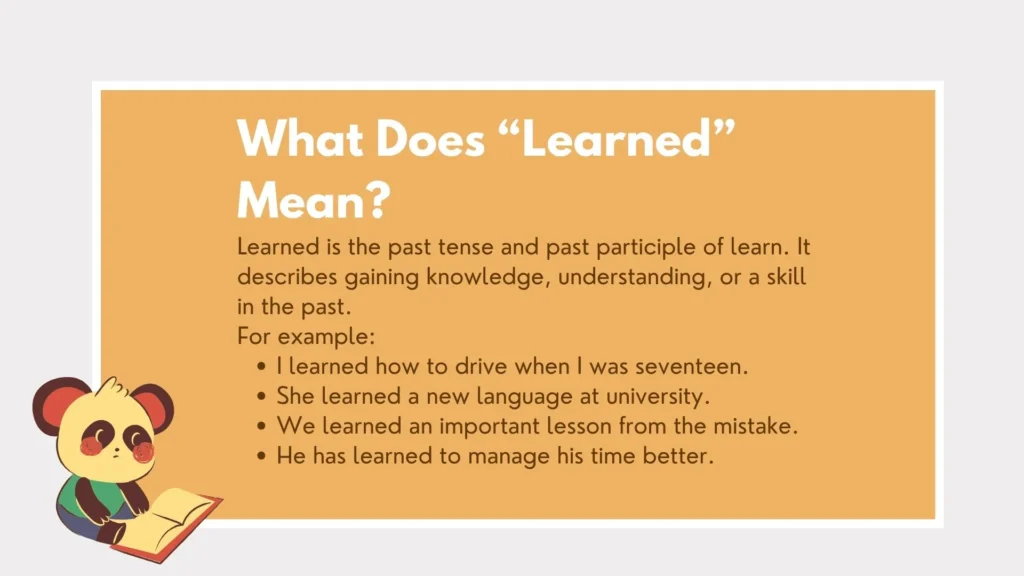
Learned is the past tense and past participle of learn. It describes gaining knowledge, understanding, or a skill in the past.
For example:
- I learned how to drive when I was seventeen.
- She learned a new language at university.
- We learned an important lesson from the mistake.
- He has learned to manage his time better.
The word can be used in several common grammatical structures.
Learned as a past-tense verb
Use learned when talking about something that happened in the past.
I learned about the new policy yesterday.
Here, the learning happened yesterday.
Learned as a past participle
It can also appear after auxiliary verbs such as have, has, or had.
She has learned a great deal from her teachers.
They had learned the rules before the competition started.
It can also be used in passive constructions:
The skill was learned through practice.
Learned as an adjective
There is another important use of learned. It can be an adjective meaning highly educated or knowledgeable.
She is a learned professor.
In this meaning, learned is pronounced differently from the normal past-tense form. The adjective is commonly pronounced with two syllables, roughly like LUR-nid, while the verb form is normally pronounced with one syllable, roughly like lurnd.
So:
- learned = past tense of learn → “I learned something.”
- learned = knowledgeable or scholarly → “a learned professor”
This adjective meaning is separate from the learned/learnt spelling choice for the verb.
What Does “Learnt” Mean?
Learnt is also a past-tense and past-participle form of learn.
I learnt something important today.
She has learnt how to use the software.
It carries the same basic meaning as learned when used as the verb form.
Cambridge lists learnt as the past simple and past participle of learn and identifies it as a UK form, while Merriam-Webster describes it as chiefly British.
The important point is that learnt is not simply a misspelling of learned.
If you are writing in British English, learnt is a normal and established choice.
Learned vs Learnt: The Key Difference
The main difference is regional preference, not meaning.
Consider these two sentences:
I learned something new today.
I learnt something new today.
Both are grammatically correct.
The first is particularly natural in American English. The second is particularly associated with British English. However, learned is also used in British English, so British writers are not required to use learnt.
This is similar to other cases where English has more than one accepted form.
The easiest rule
If you normally write American English, learned is the safest everyday choice.
If you normally write British English, learned and learnt can both be correct, with learnt being a common British choice.
If you are writing for an international audience, learned is widely understood and is a perfectly standard form.
When Should You Use “Learned”?
In American English
Learned is the normal choice for the past tense and past participle of learn in American English.
I learned Spanish in high school.
She learned the truth last week.
We have learned a lot from this project.
For American academic, professional, and everyday writing, learned is generally the natural choice.
In British English
You can also use learned in British English.
I learned a valuable lesson from the experience.
So it would be inaccurate to say that British English uses only learnt.
In formal writing
If you are writing an essay, report, application, email, or business document in American English, learned is a straightforward choice.
The researchers learned that the original method was unreliable.
In British English, either learned or learnt may be appropriate depending on the writer’s preferred variety and style.
In everyday conversation
Both forms can appear naturally depending on the speaker’s variety of English.
I learned that yesterday.
or:
I learnt that yesterday.
Neither sentence changes its basic meaning.
When Should You Use “Learnt”?
Use learnt when it fits the variety of English you are writing or speaking.
It is especially common in British English.
In British-style writing
We learnt how to solve the problem.
She learnt the rules quickly.
I learnt a valuable lesson.
In British-style school or educational contexts
The children learnt about different cultures.
We learnt how to use the new equipment.
In British-style personal writing
I learnt a lot during my first year at university.
The important thing is consistency. If your document otherwise follows British spelling and usage, learnt may fit naturally.
Learned or Learnt in Common Sentences
Many readers are not really asking about the words in isolation. They are asking, “Which one belongs in my sentence?”
Here are some common situations.
Learned or learnt from experience?
Both are correct.
I learned from experience that patience matters.
I learnt from experience that patience matters.
The choice depends mainly on the variety of English.
Learned or learnt from mistakes?
Again, both are correct.
We learned from our mistakes.
We learnt from our mistakes.
The expression learn from your mistakes is common in English, and either past-tense form can be used when you are describing a past experience.
Learned or learnt a lesson?
Both work.
He learned a lesson from the incident.
He learnt a lesson from the incident.
Learned or learnt how to do something?
Both are grammatical.
She learned how to cook from her grandmother.
She learnt how to cook from her grandmother.
Learned or learnt something new?
Both are correct.
I learned something new today.
I learnt something new today.
Learned or Learnt in “Lessons Learned”
One particularly common phrase is:
Lessons learned
This phrase is widely used in American English and international professional writing.
It refers to useful knowledge or conclusions gained from an experience or project.
The team reviewed the lessons learned after the project ended.
In British English, you may also encounter:
Lessons learnt
This is grammatically valid because learnt is a standard past participle in British usage. Cambridge’s examples include the phrase “lessons learnt.”
So neither spelling automatically makes the phrase wrong.
Learned or Learnt in “I Have Learned/Learnt”
Both are correct.
I have learned a lot this year.
I have learnt a lot this year.
The grammatical structure is:
have/has + past participle
Since both learned and learnt can function as the past participle of learn, either can complete the structure.
Learned or Learnt in “I Learned/Learnt”
For simple past tense:
I learned the answer yesterday.
or:
I learnt the answer yesterday.
Both are grammatical.
The choice is not determined by whether the sentence is past tense. Both forms can serve as the simple past.
Common Phrases With Learned and Learnt
Learned/Learnt from experience
This means gaining knowledge because of something you experienced.
She learned from experience and became more careful.
Learned/Learnt from mistakes
This means gaining useful knowledge after making an error.
I learned from my mistakes and changed my approach.
Learned/Learnt a lesson
This means gaining an important understanding from an event, often after something went wrong.
He learned a lesson about the importance of preparation.
Learned/Learnt by heart
This means memorizing something.
The students learned the poem by heart.
In British usage, learnt can replace learned:
The students learnt the poem by heart.
Learned/Learnt how to
This means acquiring the ability to do something.
She learned how to swim.
She learnt how to swim.
Common Mistakes
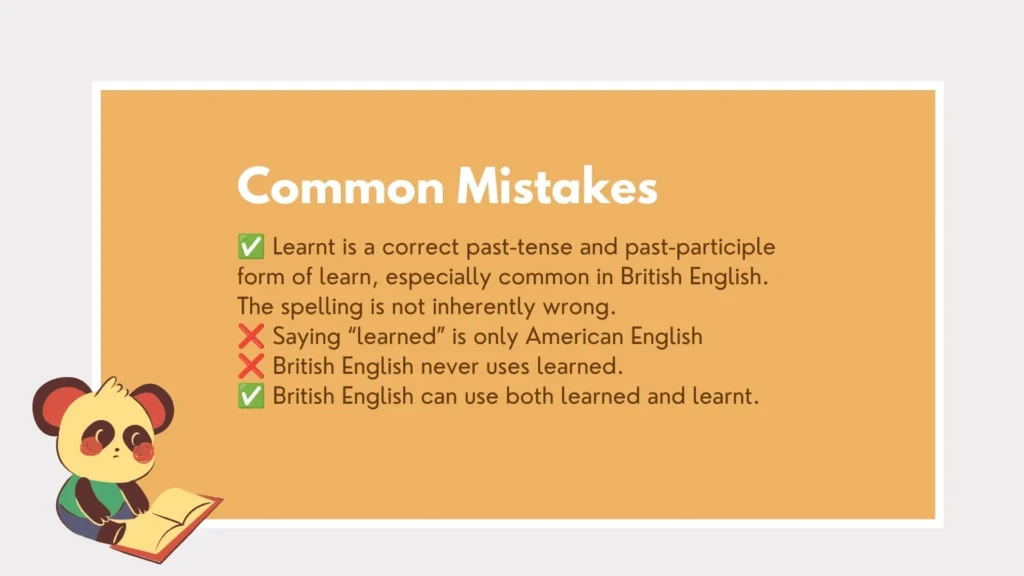
❌ Treating “learnt” as always incorrect
❌ Learnt is wrong English.
✅ Learnt is a correct past-tense and past-participle form of learn, especially common in British English.
The spelling is not inherently wrong.
❌ Saying “learned” is only American English
❌ British English never uses learned.
✅ British English can use both learned and learnt.
Learnt is especially common in British usage, but learned is also established.
❌ Mixing regional styles without a reason
❌ The report uses American spelling throughout, but suddenly says “learnt” without any style reason.
✅ The report consistently uses “learned.”
This is not a grammar error in the strictest sense, but consistency makes formal writing cleaner.
❌ Using “learnt” because it looks more formal
❌ Learnt is always more formal than learned.
✅ Learnt is mainly a regional variant, not automatically a more formal form.
The difference is primarily connected with English variety rather than formality.
❌ Assuming “learned” and “learnt” have different meanings
❌ Learned means gaining knowledge, while learnt means something else.
✅ As verb forms, learned and learnt have the same basic meaning.
❌ Using “learned” incorrectly as an adjective
❌ The learned of the professor was impressive.
✅ The professor was highly learned.
As an adjective, learned can describe someone who is highly educated or knowledgeable. It can also describe something acquired through learning, such as learned behavior.
Why Do People Get “Learned” and “Learnt” Wrong?
The confusion usually comes from the fact that English allows two established past forms for learn.
Many English learners expect every regular verb to have one standard -ed form. That expectation makes learnt look unusual.
There is also a regional issue. Someone accustomed to American English may see learnt and assume it is an error. Someone accustomed to British English may naturally use learnt and see learned as less familiar.
Neither reaction tells the whole story.
The two forms are accepted, but their frequency differs across English varieties.
Can Both Forms Be Correct?
Yes. Absolutely.
For the verb learn, both learned and learnt can be correct past-tense and past-participle forms.
Compare:
She learned the skill at school.
She learnt the skill at school.
Both sentences mean that she acquired the skill in the past.
The major distinction is regional preference:
- Learned is the usual form in American English.
- Learnt is especially common in British English.
- Learned is also used in British English.
- Other English varieties may show preferences influenced by British or American usage.
So the question is usually not “Which one is grammatically correct?”
It is:
“Which form fits the English variety I am using?”
British vs American English
This is where the distinction becomes most useful.
American English
Learned is the normal past-tense and past-participle form.
I learned something important today.
She has learned to be more patient.
British English
Both forms are possible.
I learnt something important today.
I learned something important today.
Learnt is particularly characteristic of British usage, but it is not the only acceptable form. Cambridge explicitly gives learned or UK also learnt, while Merriam-Webster labels learnt chiefly British.
Which should you choose?
If your audience expects American English, choose learned.
If you are following British English, learnt is perfectly natural, but learned is not wrong.
If you are writing a formal document, the best approach is usually to follow the style of English used throughout the document.
Pronunciation: Learned vs Learnt
As verb forms, learned and learnt are normally pronounced similarly.
In ordinary speech, learned as the past tense is commonly pronounced as one syllable, while learnt is also one syllable.
The interesting pronunciation difference appears when learned is an adjective meaning highly educated or scholarly.
Compare:
She learned the answer.
Here, learned is the past tense of learn.
He is a learned scholar.
Here, learned is an adjective and is commonly pronounced with two syllables.
That distinction can help explain why learned sometimes sounds different even though the spelling is identical.
A Useful Memory Trick
Think of learned as the broad, internationally familiar choice.
Learned = the default choice
Then remember:
Learnt = a traditional and especially British alternative
This does not mean that learned is wrong in British English. It simply gives you an easy starting point when you are unsure.
If you are writing American English and need one answer, choose learned.
Quick Decision Guide
Are you writing American English?
→ Use learned.
Are you writing British English?
→ Learned and learnt are both possible; learnt is especially common.
Are you writing “I have ___”?
→ Both learned and learnt can work.
Are you writing “I ___ something yesterday”?
→ Both learned and learnt can work.
Do you mean “highly educated” or “scholarly”?
→ Use learned, not learnt.
Are you unsure which form to choose for general international writing?
→ Learned is a safe, widely recognized choice.
Mini Quiz
1. Which sentence is correct in American English?
A. I learnt something new yesterday.
B. I learned something new yesterday.
Answer: B — learned.
Learned is the usual American English form.
2. Which sentence is acceptable in British English?
A. I learnt how to swim.
B. I learned how to swim.
Answer: Both A and B.
British English allows both forms, although learnt is especially common.
3. Which sentence uses “learned” as an adjective?
A. I learned the answer.
B. He was a learned scholar.
Answer: B — He was a learned scholar.
Here, learned describes someone who is highly educated or knowledgeable.
4. Which sentence uses a past participle correctly?
A. She has learnt a lot.
B. She has learn a lot.
Answer: A — She has learnt a lot.
Learnt can function as the past participle of learn.
5. Which sentence is correct?
A. We learned from our mistakes.
B. We learnt from our mistakes.
Answer: Both A and B.
The appropriate choice depends mainly on the variety of English.
6. Which is the safest choice for standard American English?
A. learned
B. learnt
Answer: A — learned.
7. Is “learnt” automatically a spelling mistake?
A. Yes.
B. No.
Answer: B — No.
Learnt is an established form of learn, particularly common in British English.
FAQ
Is “learned” or “learnt” correct?
Both are correct when they are used as past-tense or past-participle forms of learn. Learned is especially standard in American English, while learnt is particularly common in British English.
Is “learnt” proper English?
Yes. Learnt is proper standard English, especially in British English. It should not automatically be treated as a spelling error.
Is “learned” British or American?
It is used in both British and American English. It is the normal choice in American English, while British English commonly uses either learned or learnt.
Is “learnt” more British than “learned”?
Yes. Learnt is strongly associated with British English, although learned is also normal in British English.
Can I say “I learnt”?
Yes. “I learnt” is grammatically correct, particularly in British English.
I learnt something valuable from the experience.
In American English, “I learned” would normally be preferred.
Can I say “I have learnt”?
Yes. “I have learnt” is grammatically correct because learnt can function as the past participle of learn.
I have learnt a great deal this year.
Is “I have learned” correct?
Yes. “I have learned” is completely standard.
I have learned a lot from this experience.
It is especially natural in American English, but it is also used in British English.
Which is more common: learned or learnt?
Usage varies by region. Learned is the dominant everyday choice in American English, while learnt is especially common in British English. British English also uses learned, so there is no absolute British-versus-American rule.
Is “lessons learnt” correct?
Yes. “Lessons learnt” is correct, particularly in British English. “Lessons learned” is also correct and is very common in American English and international professional writing.
Does “learned” have another meaning?
Yes. Learned can also be an adjective meaning highly educated or knowledgeable.
She is a learned historian.
It can also describe something acquired through learning, as in learned behavior. Should I use “learned” or “learnt” in formal writing?
Follow the English variety used by your document or organization. For American English, learned is the natural choice. For British English, either can be appropriate, with learnt being a common option.
Final Takeaway
Learned and learnt are both correct forms of the verb “learn.” The main difference is regional rather than grammatical.
If you write American English, use learned as your normal choice. If you write British English, you can use learned or learnt, with learnt being especially common.
One simple rule to remember:
Learned = standard and widely used, especially in American English. Learnt = also correct, especially in British English.
So if you write “I learned something new” or “I learnt something new,” the sentence can be correct. Your choice mainly depends on the variety of English you are using.
Discover More Topics:
- In To or Into | Which Is Correct? Meaning, Difference & Examples
- Repass or Repast | Which Word Is Correct? Meaning, Spelling & Usage

My name is Michael Turner, and I have always been fascinated by animals and the unique relationships people build with them. I enjoy researching naming ideas from different cultures, languages, and traditions to help pet owners discover names that truly stand out. At Meanixo, I write informative articles designed to make pet naming fun, simple, and stress-free. I believe reliable information and creativity should always go hand in hand.
Books:
- The Ultimate Pet Name Collection
- Living Better with Pets
 Daniel Brooks
 Sophia Mitchell