I’ve seen how easily lie and lay can get mixed up, even in everyday writing. I’ve learned that one simple rule can make the difference much clearer, and I’ll break it down in a way that feels easy to remember. So, should you say “lie down” or “lay down”? Keep reading, because this guide will help you choose the right word with confidence.
Quick Answer
Lie and lay can both be correct, but they do different jobs. Use lie when the person or thing is resting or moving into a flat position by itself: “I need to lie down.” Use lay when someone places something or someone somewhere: “Please lay the book on the table.” The confusing part is that lay is also the past tense of lie: “Yesterday, I lay on the sofa.”
Quick Comparison Table
| Word/Form | Main Use | Example |
| lie | To rest or be in a flat position | I want to lie down. |
| lay | To put or place something somewhere | Lay the phone on the desk. |
| lay | Past tense of lie | I lay on the beach yesterday. |
| laid | Past tense and past participle of lay | She laid the keys on the table. |
| lain | Past participle of lie | He had lain there for an hour. |
| lying | -ing form of lie | She is lying on the sofa. |
| laying | -ing form of lay | He is laying the tiles. |
| lied | Past tense of lie meaning “to tell an untruth” | He lied about his age. |
What Does “Lie” Mean?
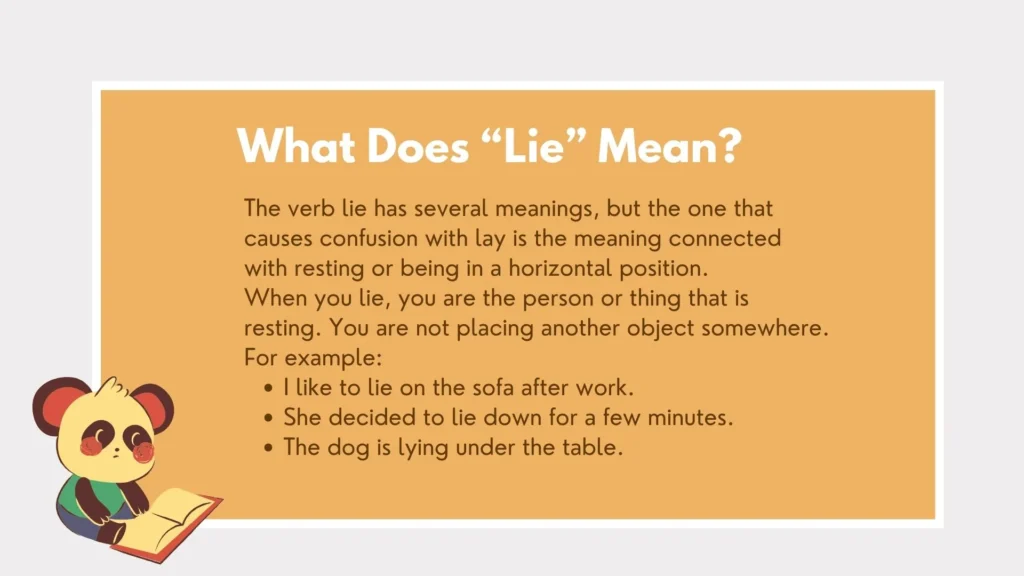
The verb lie has several meanings, but the one that causes confusion with lay is the meaning connected with resting or being in a horizontal position.
When you lie, you are the person or thing that is resting. You are not placing another object somewhere.
For example:
- I like to lie on the sofa after work.
- She decided to lie down for a few minutes.
- The dog is lying under the table.
- The book lies open on the desk.
The important grammar point is that this meaning of lie does not normally take a direct object.
You can say:
I want to lie on the bed.
But you do not normally say:
I want to lie the book on the bed.
If you are putting the book there, you need lay:
I want to lay the book on the bed.
The Forms of “Lie”
The forms of this verb are irregular:
- Present: lie
- Past: lay
- Past participle: lain
- -ing form: lying
Examples:
I lie down when I feel tired.
Yesterday, I lay on the sofa all afternoon.
I have lain here for an hour.
She is lying on the grass.
This is one of the biggest reasons people struggle with lie or lay. The word lay is not always the verb “lay.” It can also be the past tense of lie.
What Does “Lay” Mean?
The verb lay usually means to put, place, or set something or someone somewhere.
Unlike the resting verb lie, this lay normally needs an object.
For example:
Please lay the book on the table.
The object is the book. Someone is placing the book on the table.
More examples include:
- Lay the papers on my desk.
- She laid the baby in the crib.
- He laid his jacket on the chair.
- They are laying new carpet in the office.
- Please lay the cards face down.
The Forms of “Lay”
The verb lay is regular:
- Present: lay
- Past: laid
- Past participle: laid
- -ing form: laying
Examples:
I lay the documents on the desk every morning.
She laid the documents on the desk yesterday.
We have laid the foundation.
They are laying the floor today.
Notice something important: the past tense of lay is laid, not “layed.”
“Layed” is not the standard form of this verb.
Lie vs. Lay: The Key Difference
The easiest way to understand the difference is to ask:
Is someone or something resting, or is someone placing something somewhere?
If the subject is resting or moving into a resting position, use lie.
I need to lie down.
If someone is putting something somewhere, use lay.
I need to lay the blanket on the bed.
The object test is extremely useful.
If There Is an Object, Think “Lay”
Lay the phone on the table.
She laid the baby in the crib.
He is laying the books on the shelf.
The words after the verb tell you what is being placed.
If There Is No Direct Object, Think “Lie”
I need to lie down.
The cat is lying on the floor.
She lay on the beach.
There is no object being placed by the subject.
The Biggest Trap: “Lay” Is the Past of “Lie”
This is where the rule gets confusing.
In the present:
I lie on the sofa every evening.
In the past:
Yesterday, I lay on the sofa.
So this sentence is correct:
Yesterday, I lay in bed all morning.
It does not mean that you placed something in bed. Here, lay is simply the past tense of lie.
When Should You Use “Lie”?
In Everyday Conversation
Use lie when talking about resting or getting into a horizontal position.
I’m tired. I’m going to lie down.
You can lie on the sofa.
The baby likes to lie on her back.
I usually lie in bed and read before sleeping.
This is the form you want when you are talking about what you, another person, an animal, or an object is doing while resting.
In Formal Writing
The same distinction applies in formal English.
The documents were lying on the desk.
The patient was lying quietly in bed.
The village lies near the river.
Here, lie can also describe where something is located, not only where a person rests.
In Business and Professional Writing
You may see lie used to describe the location or position of something:
The main challenge lies in the lack of funding.
The responsibility lies with the department manager.
In these examples, lie does not mean “rest on a bed.” It can mean that something exists in, belongs to, or is located in a particular place or situation.
When Should You Use “Lay”?
When You Place an Object
Use lay when you put something down or position it somewhere.
Lay the papers on the desk.
She laid her phone beside the laptop.
Please lay the package near the door.
When You Put a Person or Animal Somewhere
You can also use lay when someone places another person or animal in a particular position.
She laid the sleeping baby in the crib.
The nurse laid the patient on the bed.
The person doing the placing is the subject, and the person or thing being placed is the object.
When Talking About Eggs
Lay is also used when an animal produces or deposits an egg.
The hen laid three eggs.
The turtle lays its eggs in the sand.
This is a separate meaning of lay, but it follows its own normal verb forms:
The hen laid an egg yesterday.
The hens have laid several eggs.
Common Sentence Variations
Lie or Lay Down?
If you mean that you are going into a resting position, the standard choice is lie down.
I’m tired, so I’m going to lie down.
You should lie down and rest.
Use lay down when you are placing something down:
Lay down the tools before you leave.
Here, the tools are the object being placed.
There is also a common informal use of lay down for a person meaning “lie down.” You may hear it in everyday speech, but lie down is the standard choice when the person is simply resting.
Lie or Lay on the Bed?
Use lie when you are resting on the bed.
I want to lie on the bed.
She is lying on the bed.
Use lay when you place something on the bed.
Lay the clothes on the bed.
The same distinction works with a sofa, floor, beach, grass, or any other surface.
Lie or Lay on the Couch?
I’m going to lie on the couch.
This means you will rest there.
But:
Lay the blanket on the couch.
This means you will place the blanket there.
Lie or Lay in Bed?
For the present tense:
I like to lie in bed on Sunday mornings.
For the past tense:
I lay in bed all morning yesterday.
For placing something in the bed:
She laid the baby in bed.
The tense changes the form, which is why these sentences can look surprisingly different.
Lay or Lain?
Use lain as the past participle of lie.
She had lain there for hours.
The book had lain unopened on the shelf.
Lain is less common in everyday conversation than lay, but it is a standard grammatical form.
Do not use laid simply because the sentence refers to something that happened in the past.
Incorrect:
She had laid on the sofa all day.
Correct:
She had lain on the sofa all day.
Common Phrases
Lie Down
Lie down means to move into a resting position.
I’m exhausted, so I’m going to lie down for a while.
Lie in Bed
This means to remain resting in bed.
She likes to lie in bed and read.
Lie on the Sofa
After dinner, I usually lie on the sofa and watch TV.
Lay the Table
Lay the table means to arrange plates, glasses, cutlery, and other items for a meal.
Could you lay the table before our guests arrive?
Lay the Foundation
This expression can mean physically creating a foundation or establishing the basic conditions for something.
The training program laid the foundation for future success.
Lay the Blame
This means to assign responsibility for a problem.
The report laid the blame on poor planning.
Lay Something Down
This means to put something down or establish something.
Please lay the documents down carefully.
Common Mistakes
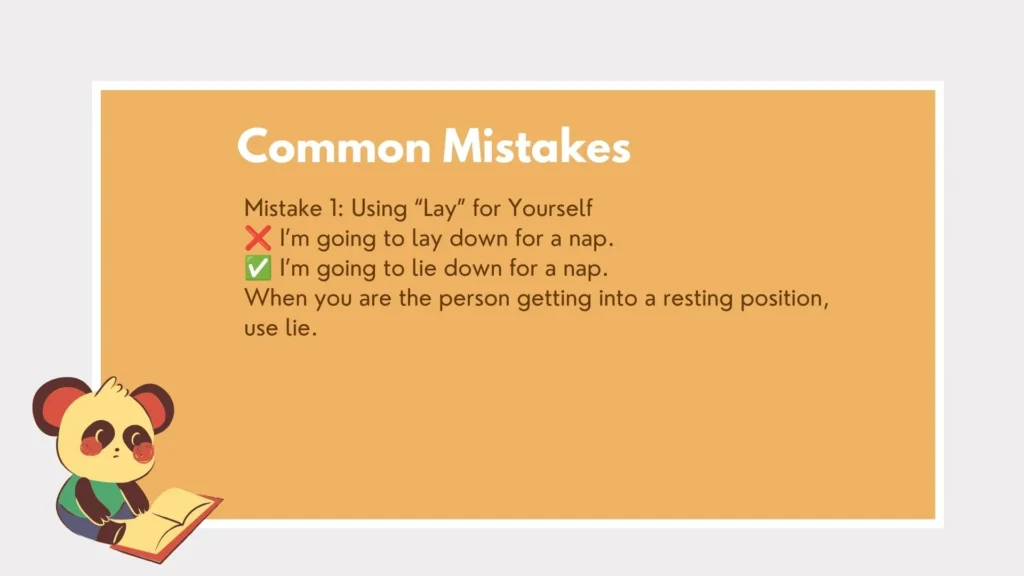
Mistake 1: Using “Lay” for Yourself
❌ I’m going to lay down for a nap.
✅ I’m going to lie down for a nap.
When you are the person getting into a resting position, use lie.
Mistake 2: Using “Lie” to Place Something
❌ Lie the book on the table.
✅ Lay the book on the table.
The book is being placed somewhere, so lay is required.
Mistake 3: Using “Layed”
❌ She layed the papers on the desk.
✅ She laid the papers on the desk.
The past tense of the verb lay is laid.
Mistake 4: Forgetting That “Lay” Is the Past of “Lie”
❌ Yesterday, I lied on the sofa.
✅ Yesterday, I lay on the sofa.
Here, lied would mean that you told an untruth. The past tense of the resting verb lie is lay.
Mistake 5: Using “Laid” as the Past of “Lie”
❌ I had laid there for two hours.
✅ I had lain there for two hours.
The past participle of the resting verb lie is lain.
Mistake 6: Using “Laying” for Resting
❌ She is laying on the beach.
✅ She is lying on the beach.
If she is resting on the beach, use lying.
Mistake 7: Confusing “Lying” With “Laying”
❌ The dog is laying under the table.
✅ The dog is lying under the table.
The dog is already in the resting position; nobody is placing it there.
Mistake 8: Using “Lie” When an Object Is Being Placed
❌ Please lie the keys on the desk.
✅ Please lay the keys on the desk.
The keys are the object being placed.
Why Do People Get This Wrong?
The confusion exists for a very good reason: the forms overlap.
The present tense of the resting verb is lie, but its past tense is lay.
At the same time, lay is a completely separate verb meaning “put or place,” and its past tense is laid.
That creates this unusual pattern:
lie → lay → lain → lying
but:
lay → laid → laid → laying
Then there is another lie, meaning “to tell an untruth”:
lie → lied → lied → lying
So the three verbs can look like this:
| Meaning | Present | Past | Past Participle | -ing Form |
| Rest/be in a position | lie | lay | lain | lying |
| Put/place | lay | laid | laid | laying |
| Tell an untruth | lie | lied | lied | lying |
Once these three patterns are separated, the confusion becomes much easier to manage.
Can Both Forms Be Correct?
Yes. Lie and lay are both standard English verbs.
The important point is that they are not interchangeable in the present tense when they have their ordinary meanings.
Compare:
I lie on the sofa.
This means I rest on the sofa.
I lay the blanket on the sofa.
This means I place the blanket there.
But there is an important exception to the simple present-tense rule: lay is the past tense of lie.
Today I lie on the sofa.
Yesterday I lay on the sofa.
So if you see lay in a sentence about resting, do not automatically assume it is wrong. Check the tense first.
British vs. American English
The basic distinction between lie and lay is standard in both British and American English.
However, informal speech sometimes uses lay where traditional standard grammar would use lie, especially in expressions such as “lay down.”
For careful formal writing, lie down is the safer standard form when the subject is resting.
There are also regional differences in some related expressions. For example, British English commonly uses the lie of the land, while North American English commonly uses the lay of the land. This is a separate expression and should not be used as a reason to change the basic verb rule.
Pronunciation
Pronunciation adds another layer to the confusion.
Lie is pronounced like “lye.”
Lay rhymes with words such as day and say.
Lain sounds like “lane.”
Laid also sounds like “lade.”
The two present-tense words therefore sound different:
lie → /laɪ/
lay → /leɪ/
The past tense makes things more confusing because lay becomes the past form of lie.
Word History
The confusing relationship between lie and lay is not a modern accident. They are old English verbs with closely connected histories.
The verb lie, meaning to be in a resting or horizontal position, has roots in Old English. The verb lay, meaning to put or place something, also comes from an old English verb related to the same family of words.
Their forms developed differently over time, leaving modern English with a set of verbs that are closely related but grammatically distinct.
That long history helps explain why the forms do not follow the simple patterns learners might expect.
Simple Memory Trick
Use this rule:
If you put it somewhere, LAY it there. If you are there, LIE there.
Think about the object.
Lay = place something.
Lay the phone on the desk.
Lie = rest yourself.
Lie on the bed.
Then remember the special past-tense rule:
Today I lie. Yesterday I lay.
And for the other verb:
Today I lay the book down. Yesterday I laid the book down.
That small four-part pattern can solve most everyday lie or lay questions.
Quick Decision Guide
Are you resting or getting into a flat position?
→ Use lie.
I need to lie down.
Are you putting something or someone somewhere?
→ Use lay.
Lay the book on the desk.
Are you talking about resting in the past?
→ Use lay.
I lay on the sofa yesterday.
Are you talking about putting something somewhere in the past?
→ Use laid.
I laid the book on the desk yesterday.
Do you need the past participle of the resting verb?
→ Use lain.
She has lain there since noon.
Are you talking about telling an untruth?
→ Use lie → lied.
He lied to his teacher.
Mini Quiz
1. I need to ___ down for a few minutes.
A. lie
B. lay
Answer: A — lie
You are moving yourself into a resting position, so lie is correct.
2. Please ___ the keys on the table.
A. lie
B. lay
Answer: B — lay
The keys are being placed on the table, so lay takes the object “the keys.”
3. Yesterday, I ___ on the beach for three hours.
A. lay
B. laid
Answer: A — lay
Lay is the past tense of lie when the meaning is resting.
4. She ___ the baby in the crib last night.
A. lay
B. laid
Answer: B — laid
She placed the baby in the crib, so the verb is lay, whose past tense is laid.
5. The dog is ___ under the table.
A. lying
B. laying
Answer: A — lying
The dog is resting there rather than placing something there.
6. He had ___ on the floor for an hour.
A. laid
B. lain
Answer: B — lain
Lain is the past participle of the resting verb lie.
7. She ___ about where she had been.
A. lay
B. lied
Answer: B — lied
Here lie means “tell an untruth,” and its past tense is lied.
8. They are ___ new tiles in the kitchen.
A. lying
B. laying
Answer: B — laying
They are placing the tiles, so laying is correct.
FAQ
Is “lie or lay” the correct way to ask the question?
Yes. Lie or lay is a natural way to describe the common grammar choice between these two forms.
The answer depends on the meaning and tense of the sentence.
Is “lay down” grammatically correct?
It can be correct when an object is being put down.
Lay the bag down.
When a person is simply moving into a resting position, lie down is the standard form.
I need to lie down.
Is “I lay down” correct?
Yes. I lay down is correct when you are talking about the past.
It means that you moved into a resting position at some point in the past.
Last night, I lay down early.
Is “I laid down” ever correct?
It can be correct when an object is understood or explicitly stated.
I laid the blanket down.
For the simple act of resting yourself, traditional standard English uses I lay down for the past.
What is the past tense of “lie”?
For the verb meaning “rest,” the past tense is lay.
Present: I lie on the bed.
Past: I lay on the bed.
Do not confuse this with lie meaning “tell an untruth,” whose past tense is lied.
What is the past tense of “lay”?
The past tense of lay meaning “put or place” is laid.
I lay the book on the table every morning.
Yesterday, I laid the book on the table.
Is “layed” a word?
Layed is not the standard past tense of the ordinary verb lay meaning “put or place.”
The standard form is laid.
She laid the papers on the desk.
Should I say “lying” or “laying” on the bed?
If you mean that you are resting on the bed, use lying.
I am lying on the bed.
Use laying when you are placing something somewhere.
I am laying the clothes on the bed.
Is “I am laying on the couch” correct?
In standard English, when you mean that you are resting on the couch, I am lying on the couch is the preferred form.
Laying normally needs an object, such as:
I am laying the blanket on the couch.
What is the difference between “lain” and “laid”?
Lain is the past participle of lie, meaning to rest or be in a position.
She had lain on the sofa all afternoon.
Laid is the past tense and past participle of lay, meaning to put or place.
She had laid the book on the sofa.
Is “lie” only used for people?
No. Lie can describe people, animals, and things.
The dog is lying on the floor.
The book lies open on the desk.
It can also describe location or position in a broader sense:
The problem lies in the lack of communication.
Is there a difference between “lie down” and “lay down”?
Yes. In standard grammar, lie down means to move yourself into a resting position.
Lay down means to put something down.
I will lie down for a while.
I will lay the bag down.
Informal speech sometimes uses lay down for a person’s resting action, but lie down is the standard choice for careful writing.
Final Takeaway
The easiest rule is:
If you are resting, use LIE. If you are putting something somewhere, use LAY.
But remember the important past-tense twist:
lie → lay → lain
lay → laid → laid
So:
I lie down today.
I lay down yesterday.
I laid the book down yesterday.
Once you remember that lay can be both a present-tense verb meaning “place” and the past tense of lie, the whole lie or lay problem becomes much easier.
Discover More Topics:
- Mam or Ma’am | Which Is Correct? The Simple Answer You’ve Been Looking For
- Learned or Learnt? The Simple Answer That Clears Up the Confusion

Hi, I’m Emma Richardson, a pet writer and animal lover who enjoys helping people find meaningful names for their furry, feathered, and scaled companions. I believe every pet has a unique personality, and I love researching names inspired by history, nature, mythology, and modern trends. At Meanixo, I share carefully researched articles that make choosing the perfect pet name simple and enjoyable. My goal is to provide reliable, easy-to-understand information that helps pet owners make confident decisions while celebrating the special bond they share with their animals.
Books:
- The Complete Guide to Creative Pet Names
- Happy Pets, Happy Homes
 Sophia Mitchell
 Michael Turner
 Daniel Brooks