Should you write worst or worse? Both words are correct, but they have different grammatical uses. The right choice depends on whether you’re comparing something with another thing or describing the most unfavorable degree of a situation.
Use worse to make a comparison or describe a decline. Use worst to identify the most unfavorable option, experience, or possible outcome.
For example:
- Worse: My internet connection is worse today than it was yesterday.
- Worst: This is the worst internet connection I’ve ever had.
In the first sentence, worse compares the connection’s current condition with its earlier condition. In the second, worst describes the most unfavorable experience the speaker has had.
The difference becomes easier to understand when you learn the grammar rule, see how each word works in everyday sentences, and recognize common expressions such as “getting worse,” “prepare for the worst,” and “if worse comes to worst.”
Worst vs. Worse: What’s the Difference?
Worse and worst are the irregular comparative and superlative forms of bad. They can also function as the comparative and superlative forms of badly when describing how an action is performed.
| Word | Grammatical form | Main meaning | Example |
| Bad | Positive form | An unfavorable condition or quality | The weather is bad. |
| Worse | Comparative | Less good, more unpleasant, or less favorable | The weather is worse today. |
| Worst | Superlative | The least favorable or most unpleasant | This is the worst weather of the week. |
The main distinction is the degree of comparison.
Worse is useful when comparing two things, two situations, or two points in time. You can also use it without naming the comparison when the context makes the meaning clear.
Worst identifies the lowest or most unfavorable degree within a comparison or describes an extreme negative outcome. You don’t have to list every alternative to use it.
For instance, “My performance is worse than last month” describes a decline. “That was the worst performance of my career” identifies an extreme negative experience.
A quick way to remember the difference
Think of the words as a three-step pattern:
Bad → Worse → Worst
- Bad: The food is bad.
- Worse: The food tastes worse than it did yesterday.
- Worst: This is the worst meal I’ve had all year.
The pattern is irregular because standard English uses worse and worst, not badder and baddest, for ordinary comparisons involving bad.
When Should You Use Worse?
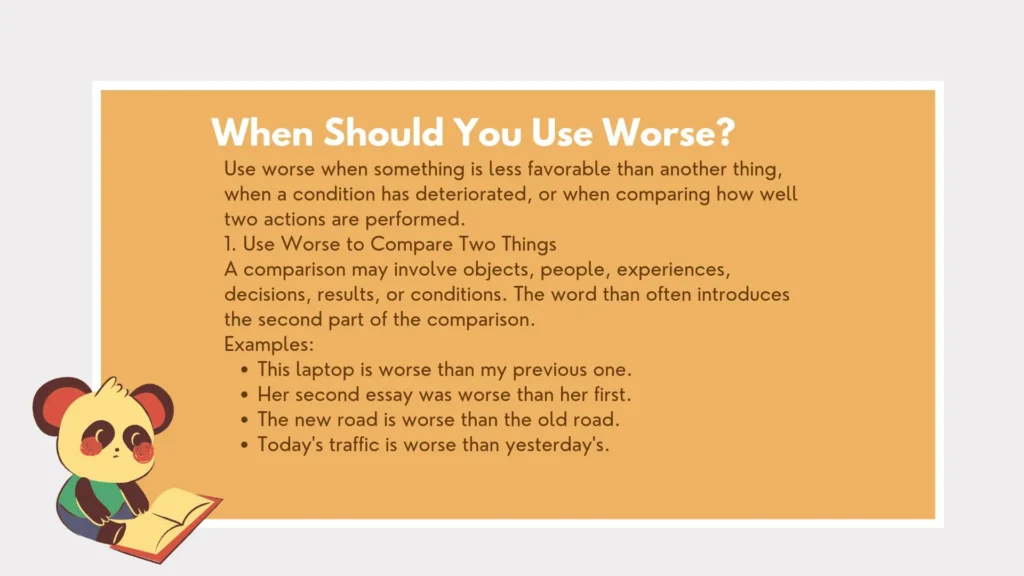
Use worse when something is less favorable than another thing, when a condition has deteriorated, or when comparing how well two actions are performed.
1. Use Worse to Compare Two Things
A comparison may involve objects, people, experiences, decisions, results, or conditions. The word than often introduces the second part of the comparison.
Examples:
- This laptop is worse than my previous one.
- Her second essay was worse than her first.
- The new road is worse than the old road.
- Today’s traffic is worse than yesterday’s.
- His presentation was worse than I expected.
A common sentence pattern is:
Subject + verb + worse + than + comparison
For example: “This option is worse than the alternative.”
However, you don’t always need than. In “This option is getting worse,” the comparison is implied by the change in condition.
2. Use Worse to Describe a Change Over Time
When something becomes less favorable than it was previously, worse is usually the correct choice.
Examples:
- My handwriting is getting worse because I rarely practice.
- The weather became worse during the afternoon.
- The company’s financial position is worse than it was last year.
- My phone battery seems to be performing worse lately.
- The traffic situation has become worse since the roadworks began.
In these sentences, worse communicates deterioration. It doesn’t necessarily mean that the situation has reached its most unfavorable possible state; it simply means that the condition has declined.
Compare these examples:
- “My situation is getting worse” means it is deteriorating.
- “My situation is at its worst” means it has reached an extremely unfavorable point.
The first describes a change. The second describes a degree or condition.
3. Use Worse in Comparisons Between Two Options
When comparing exactly two alternatives, worse can identify the less favorable of the pair. In this construction, the worse is often natural.
Examples:
- Of the two plans, this is the worse option.
- The blue shirt is the worse choice for the formal event.
- Between these two routes, the northern road is worse.
- This is the worse of the two possible solutions.
The phrase the worse of the two is useful when choosing between two alternatives.
Compare:
- The worse of the two: the less favorable of two choices.
- The worst of the three: the least favorable of three choices.
This is a helpful rule, but the number of items alone doesn’t determine every use. Context and the intended degree of comparison matter.
4. Use Worse as an Adverb
An adjective describes a noun, while an adverb can describe a verb or an action. Worse can perform either function.
Consider these examples:
- Adjective: The weather is worse today.
- Adverb: She performed worse in the final round.
- Adjective: His condition became worse overnight.
- Adverb: The team played worse after halftime.
In “The team played worse,” the word worse describes how the team played. It doesn’t directly describe the team itself.
You can also use worse with verbs such as perform, play, behave, and fare when describing a less successful action or result.
When Should You Use Worst?
Use worst to identify the least favorable option in a group, describe an extreme negative experience, or refer to the most unfavorable possible outcome.
1. Use Worst to Identify the Most Unfavorable Option
Worst commonly appears when ranking several choices, results, experiences, or performances.
Examples:
- This is the worst restaurant I’ve visited this year.
- She received the worst score in her study group.
- That was the worst decision we made during the project.
- Of all the available routes, this one is the worst.
- This was the worst performance of the competition.
The word the commonly appears before worst when identifying a particular option. Other constructions are also correct, such as “Prepare for the worst” and “Things went from bad to worse.”
2. Use Worst to Describe an Extreme Experience
You can use worst even when you don’t explicitly list or rank several alternatives.
Examples:
- That was the worst day of my life.
- This is the worst headache I’ve ever experienced.
- Missing the final train was the worst part of the trip.
- It was the worst mistake I could have made.
- That was the worst news I had received in years.
In these examples, worst emphasizes the extreme nature of the experience. The comparison may be understood from the speaker’s past experiences or from the context.
3. Use Worst to Describe the Most Unfavorable Possible Outcome
Worst frequently appears in discussions about risks, plans, uncertainty, and possible consequences.
Examples:
- We should prepare for the worst.
- The worst possible outcome would be losing the entire project.
- In the worst case, we may need to postpone the event.
- The worst is yet to come, according to the forecast.
- Even in the worst circumstances, a careful plan can help.
The word can describe a realistic possibility, a feared outcome, or an imagined extreme. It doesn’t necessarily mean that the outcome will happen.
4. Use Worst as an Adverb
Just as worse can function as an adverb, worst can describe the least successful performance or action within a comparison.
Examples:
- Of all the contestants, he performed worst.
- She played worst when the pressure was highest.
- The team fared worst during the final stage.
In everyday conversation, people may prefer expressions such as “He performed the least successfully.” However, performed worst is a standard grammatical construction.
Worse or Worst? Compare These Sentence Patterns
The following examples show how a small change in wording can affect the meaning.
| Sentence | Why it is correct |
| My work is worse than before. | Worse compares the current state with an earlier state. |
| My work is at its worst. | Worst describes an extreme or lowest point. |
| This is the worse of the two options. | Worse identifies the less favorable of two alternatives. |
| This is the worst option available. | Worst identifies the least favorable option in the full set. |
| Things are getting worse. | Worse describes deterioration. |
| The worst is over. | Worst refers to the most difficult part of the situation. |
| She performed worse than her teammate. | Worse compares performance. |
| She performed worst of all the competitors. | Worst identifies the least successful performance in the group. |
Remember that worse doesn’t always need than, and worst doesn’t always need an explicitly named group.
The most reliable question to ask is: Am I comparing degrees, or am I identifying the extreme?
Common Expressions With Worse and Worst
Both words appear in everyday expressions. Learning these phrases helps you recognize correct usage without having to reconstruct the grammar rule every time.
1. Getting Worse
Meaning: Becoming less favorable or more serious.
Examples:
- The weather is getting worse.
- My internet connection keeps getting worse.
- The delay made an already difficult situation worse.
Don’t write “getting worst” when you mean that a situation is deteriorating.
2. To Make Matters Worse
Meaning: To add another problem to an already difficult situation.
Examples:
- I missed the bus and, to make matters worse, my phone battery died.
- The deadline was moved forward; to make matters worse, two team members were absent.
- She forgot the documents and, to make matters worse, arrived late.
The phrase uses worse because the new event makes the situation less favorable.
3. A Turn for the Worse
Meaning: A change that makes a situation less favorable.
Examples:
- The negotiations took a turn for the worse.
- The weather took a turn for the worse just before the match.
- Their financial situation took a turn for the worse after the unexpected expense.
The standard expression is “a turn for the worse,” not “a turn for the worst.”
4. Prepare for the Worst
Meaning: Get ready for the most unfavorable possible outcome.
Examples:
- We should prepare for the worst but hope for a better result.
- The travelers prepared for the worst when the storm warning arrived.
- It’s sensible to prepare for the worst when making a risk-management plan.
Here, worst refers to the most unfavorable possibility.
5. The Worst Is Over
Meaning: The most difficult or unpleasant part of a situation has passed.
Examples:
- The examination was stressful, but the worst is over.
- Once the repairs were completed, we felt the worst was over.
- She believes the worst is over after several difficult weeks.
6. Worst of All
Meaning: Used to introduce the most unfavorable item or problem in a list.
Examples:
- The room was small, the lights were dim, and worst of all, there was no heating.
- He missed the deadline, lost the files, and worst of all, failed to inform his manager.
- The journey was long and uncomfortable; worst of all, we arrived after the event had ended.
7. If Worse Comes to Worst
Meaning: If a situation deteriorates to its most unfavorable point, or if the most difficult possibility becomes reality.
Example: “If worse comes to worst, we’ll postpone the event until next month.”
This is the standard expression. Worse refers to the deteriorating situation, while worst refers to its most unfavorable possible outcome.
Common Mistakes With Worse and Worst
Knowing the definitions is only part of using these words correctly. You should also recognize forms and phrases that are commonly confused.
Mistake 1: Using Worst Instead of Worse in a Comparison
Incorrect: My headache is worst than it was yesterday.
Correct: My headache is worse than it was yesterday.
Why: The sentence compares the current headache with an earlier condition. The comparative form worse is required.
Mistake 2: Using Worse Instead of Worst for an Extreme
Incorrect: This is the worse film I’ve ever watched.
Correct: This is the worst film I’ve ever watched.
Why: The sentence identifies the most unfavorable film across the speaker’s viewing experience, so worst is the appropriate superlative.
Mistake 3: Writing More Worse
Incorrect: The traffic is more worse today.
Correct: The traffic is worse today.
Why: Worse already expresses a comparative degree. Adding more creates a redundant comparative in standard English.
For emphasis, use much worse, far worse, or even worse.
Examples:
- The traffic is much worse today.
- The new problem is far worse than the original one.
- Even worse, we forgot to save our work.
Mistake 4: Writing Most Worst
Incorrect: That was the most worst decision I could have made.
Correct: That was the worst decision I could have made.
Why: Worst already expresses the superlative degree, so most is unnecessary in this ordinary construction.
For emphasis, you could write, “That was by far the worst decision I could have made.”
Mistake 5: Confusing Getting Worse With Getting Worst
Incorrect: My English is getting worst.
Correct: My English is getting worse.
Why: The sentence describes a change in ability or condition. Worse indicates that the condition is deteriorating.
Use worst when referring to an extreme point, as in “My performance was at its worst during the first week.”
Mistake 6: Confusing Worse With Worsened
Worse and worsened are related, but they do not perform the same grammatical function.
- Worse: The situation is worse today.
- Worsened: The situation worsened overnight.
- Worst: This was the worst situation imaginable.
Worsened is the past tense and past participle of the verb worsen, meaning “to become worse” or “to make something worse.”
Use worsened to describe the change itself, worse to compare conditions, and worst to describe an extreme degree.
Mistake 7: Confusing Worse-Case With Worst-Case
Incorrect: We need to prepare a worse-case scenario.
Correct: We need to prepare a worst-case scenario.
Why: The standard expression is worst-case scenario. It refers to the most unfavorable outcome being considered.
Examples:
- Let’s calculate the costs in a worst-case scenario.
- The worst-case outcome would be a complete project delay.
- We prepared a backup plan in case the worst-case scenario occurred.
By contrast, worse case can be grammatical when worse genuinely compares two cases, but it is not the standard expression for the most unfavorable possible scenario.
Mistake 8: Using Worst When Comparing Only Two Options
Less precise: Of the two proposals, this is the worst one.
More precise: Of the two proposals, this is the worse one.
Why: When comparing exactly two alternatives, the worse is generally the natural comparative construction. In casual speech, people may use worst more loosely, but the worse of the two is the clearest choice in careful writing.
Compare:
- The worse of the two proposals.
- The worst of all the proposals.
Mistake 9: Using Worser
Nonstandard in ordinary contemporary English: This result is worser than the previous one.
Standard: This result is worse than the previous one.
Why: Worse is already the standard comparative form of bad. Adding -er to create worser is unnecessary.
You may encounter worser in historical writing, dialect, or deliberately playful speech, but it is not the appropriate choice for standard academic or professional writing.
Is It “Worse Than Worst” or “Worse Than the Worst”?
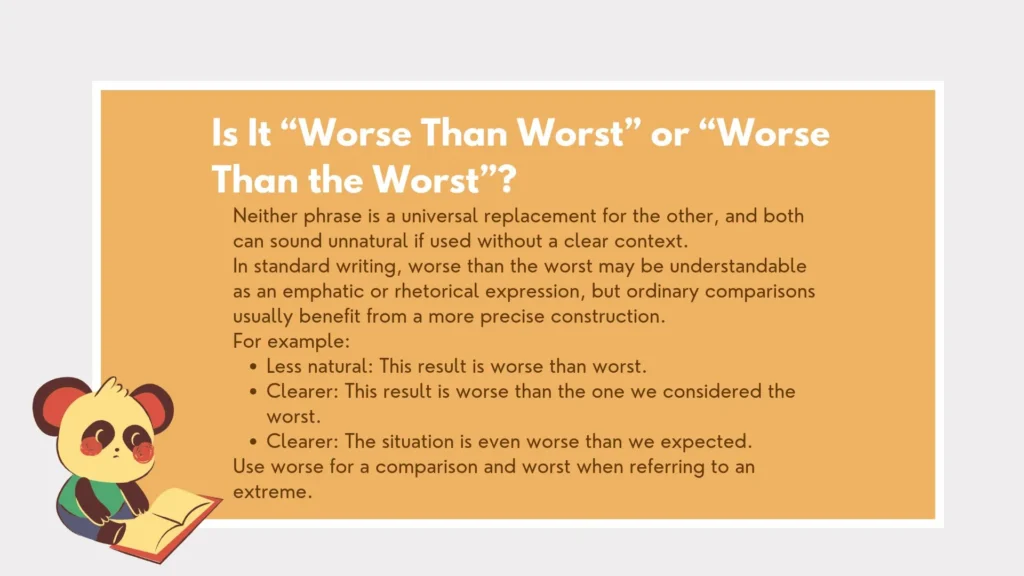
Neither phrase is a universal replacement for the other, and both can sound unnatural if used without a clear context.
In standard writing, worse than the worst may be understandable as an emphatic or rhetorical expression, but ordinary comparisons usually benefit from a more precise construction.
For example:
- Less natural: This result is worse than worst.
- Clearer: This result is worse than the one we considered the worst.
- Clearer: The situation is even worse than we expected.
Use worse for a comparison and worst when referring to an extreme. If you want to say that something has exceeded an already terrible expectation, explain the comparison rather than relying on an awkward phrase.
Is It “For the Worse” or “For the Worst”?
The standard expression is “for the worse.” It means that something has changed in a negative direction.
Examples:
- The decision changed everything for the worse.
- The situation turned for the worse after the announcement.
- His financial position changed for the worse during the year.
Use worst in different expressions, such as “prepare for the worst” or “expect the worst.”
The difference is between a negative change and the most unfavorable possible outcome.
Is It “The Worst Is Yet to Come” or “The Worse Is Yet to Come”?
The standard expression is “the worst is yet to come.” It means that a more difficult or unpleasant part of a situation may still lie ahead.
Examples:
- We thought the delays were finished, but the worst is yet to come.
- The storm has weakened, although the worst may still be ahead.
- She believes the worst is yet to come unless the team changes its approach.
Use worst because the expression refers to the most unfavorable part of a situation, not simply a comparison between two conditions.
Is It “One of the Worse” or “One of the Worst”?
Both expressions can be grammatical in different contexts, but “one of the worst” is usually correct when identifying a member of a group of the least favorable things.
Examples:
- This is one of the worst books I’ve read.
- She had one of the worst experiences of her life.
- That was one of the worst decisions the company made.
The phrase one of the worse can work when the context specifically identifies a comparative subset, but it is less common and often requires a clear comparison.
For example: “Of the six proposals, the committee first removed the four worse options, leaving the two better ones.” Even here, the exact wording depends on what is being compared and how the group is divided.
For everyday writing, use one of the worst when you mean that something belongs to the group of least favorable options.
How Do You Pronounce Worse and Worst?
Both worse and worst have one syllable. Their vowel sounds vary by accent, but the clearest difference is the final consonant.
| Word | British English IPA | American English IPA | Syllables |
| Worse | /wɜːs/ | /wɝːs/ | One |
| Worst | /wɜːst/ | /wɝːst/ | One |
In many British accents, the vowel is represented by /ɜː/. In many American accents, it is represented by /ɝː/, which includes an r-colored vowel.
The word worst ends with the /st/ consonant cluster, while worse ends with /s/. The /t/ at the end of worst is the main additional sound.
Try saying the words slowly:
- Worse: /wɜːs/
- Worst: /wɜːst/
You don’t need to exaggerate the final sound in ordinary conversation. Focus on keeping the words distinct and pronouncing them naturally in your accent.
Quick Practice: Choose Worse or Worst
Test your understanding by completing the following sentences. Think about whether each sentence compares a condition or identifies an extreme.
- My internet connection is getting ___ every evening.
- This is the ___ result our team has received this year.
- Of the two routes, the southern road is the ___ option.
- To make matters ___, we missed the final bus.
- She performed ___ in the second round than in the first.
- We should prepare for the ___ before making our final decision.
- This is one of the ___ mistakes I’ve made at work.
- The situation took a turn for the ___ after the announcement.
Answers and Explanations
- Worse — The connection is deteriorating.
- Worst — The sentence identifies the most unfavorable result in the relevant group.
- Worse — It compares two routes.
- Worse — “To make matters worse” is a fixed expression.
- Worse — The sentence compares two performances using than.
- Worst — “Prepare for the worst” refers to the most unfavorable possible outcome.
- Worst — “One of the worst” identifies a member of a group of particularly unfavorable mistakes.
- Worse — “A turn for the worse” is the standard expression for a negative change.
If you missed any answers, revisit the distinction between comparative degree and superlative degree. That rule explains most everyday uses of these words.
Frequently Asked Questions About Worst or Worse
Is worse or worst correct?
Both are correct words. Use worse for comparisons or deterioration, and use worst to describe the most unfavorable degree or outcome.
Examples:
- The weather is worse than yesterday.
- This is the worst weather we’ve had all month.
Is it getting worse or getting worst?
The standard expression is “getting worse.” It describes a condition that is deteriorating.
Example: “My computer has been getting worse since the last update.”
Use worst when referring to the most unfavorable point, as in “The computer’s performance was at its worst after the update.”
Is it the worse of the two or the worst of the two?
When comparing exactly two alternatives, “the worse of the two” is generally the more precise choice.
Example: “Of the two proposals, this is the worse one.”
Use the worst when identifying the least favorable option in a broader group.
Example: “Of all the proposals, this is the worst one.”
Is it for the worse or for the worst?
The standard expression is “for the worse.” It describes a negative change.
Example: “The situation changed for the worse.”
By contrast, “prepare for the worst” means getting ready for the most unfavorable possible outcome.
Is it worse-case or worst-case scenario?
The standard expression is “worst-case scenario.” It refers to the most unfavorable possible outcome under consideration.
Example: “We need a plan for the worst-case scenario.”
Is it one of the worse or one of the worst?
Use “one of the worst” when identifying a member of a group of particularly unfavorable options, experiences, or results.
Example: “That was one of the worst days of my life.”
One of the worse may be possible in a specific comparative context, but it is not the usual choice when expressing a superlative judgment.
What is the difference between bad, worse, and worst?
Bad is the positive form, worse is the comparative form, and worst is the superlative form.
- Bad: This is a bad result.
- Worse: This result is worse than the previous one.
- Worst: This is the worst result of the year.
Can worse and worst be adverbs?
Yes. Both can describe how an action is performed.
Examples:
- She performed worse in the second round.
- Of all the contestants, he performed worst.
In the first sentence, worse compares two performances. In the second, worst identifies the least successful performance in the relevant group.
Is worser ever correct?
Worser appears in some historical, dialectal, and playful contexts, but it is nonstandard for ordinary contemporary English comparisons. Use worse in formal writing, academic assignments, and professional communication.
What is the opposite of worse and worst?
The usual positive comparison forms are better and best, which are the comparative and superlative forms of good.
- Worse → Better
- Worst → Best
For example, “This option is worse than the other” expresses a negative comparison, while “This option is better than the other” expresses a positive one.
Conclusion: Should You Use Worst or Worse?
The difference between worst and worse comes down to comparison and degree.
Use worse when comparing two conditions, describing deterioration, or indicating that something is less favorable than another option. Use worst when identifying the most unfavorable option, describing an extreme experience, or referring to the most difficult possible outcome.
Remember the pattern bad → worse → worst.
For example, “My performance is getting worse” describes a decline, while “That was my worst performance” identifies an extreme negative result.
When you’re uncertain, ask yourself whether you’re comparing something with another condition or describing the least favorable degree. That simple check will help you choose the right word in everyday conversations, academic assignments, emails, and professional writing.

My name is Michael Turner, and I have always been fascinated by animals and the unique relationships people build with them. I enjoy researching naming ideas from different cultures, languages, and traditions to help pet owners discover names that truly stand out. At Meanixo, I write informative articles designed to make pet naming fun, simple, and stress-free. I believe reliable information and creativity should always go hand in hand.
Books:
- The Ultimate Pet Name Collection
- Living Better with Pets
 Sophia Mitchell