
I’ve seen this spelling confuse even strong English writers, especially when writing about how quickly life seems to pass. If you’re wondering whether “time flies” or “time flys” is correct, you’re in the right place—I’ll make the difference simple and clear.Time flies is correct because flies is the third-person singular form of the verb fly.
Quick Answer
“Time flies” is correct. The word flies is the third-person singular form of the verb fly, so we write “Time flies when you are having fun.” “Time flys” is not standard English spelling when you mean that time passes quickly. The spelling rule changes fly to flies when adding -s to this verb.
Quick Comparison Table
| Form | Is It Correct? | Main Use | Example |
| time flies | ✅ Yes | Saying that time passes quickly | Time flies when you’re having fun. |
| time flys | ❌ No in standard English | Common spelling mistake | Time flys when you’re busy. ❌ |
| fly | ✅ Yes | Base form of the verb | Birds fly over the lake. |
| flies | ✅ Yes | Third-person singular verb form or plural noun | The bird flies quickly. |
What Does “Time Flies” Mean?
“Time flies” means that time seems to pass very quickly. People commonly use the expression when they are surprised by how quickly a period of time has ended.
For example:
Time flies when you’re having fun.
This means that enjoyable experiences can seem to end before you realize how much time has passed.
You might also say:
I can’t believe it’s already been a year. Time flies!
Here, the speaker is expressing surprise at how quickly a year seems to have passed.
The expression is common in everyday conversation, messages, social media posts, and informal writing.
What Does “Time Flys” Mean?
“Time flys” is not the standard spelling. If you want to say that time passes quickly, you should write “time flies.”
The mistake happens because some people assume that you simply add -s to fly:
- fly + s = flys ❌
- fly → flies ✅
The verb fly follows a spelling pattern in which a consonant followed by y changes to i before -es is added.
So:
- fly → flies
- try → tries
- cry → cries
- carry → carries
Therefore:
Time flies when you’re having fun. ✅
Not:
Time flys when you’re having fun. ❌
Time Flies vs Flys: Key Difference
The main difference is simple: flies is the standard third-person singular form of fly, while flys is not the normal spelling of that verb form.
The subject time is singular. When a singular subject uses the present-tense verb fly, the verb becomes flies.
Compare these sentences:
I fly to London every summer.
You fly to London every summer.
They fly to London every summer.
But:
Time flies quickly.
The subject time is singular, so the verb takes the third-person singular form flies.
Why “flies” Has -ies
When a verb ends in a consonant + y, the y usually changes to i before -es is added.
For example:
- fly → flies
- study → studies
- worry → worries
- hurry → hurries
This is why flys is not the correct standard spelling.
When Should You Use “Time Flies”?
Use “time flies” when you want to say that time appears to pass quickly.
In Everyday Conversation
Wow, it’s already Friday. Time flies!
This is a natural way to express surprise about how quickly the week passed.
When Talking About Memories
Time flies when I look at old family photos.
The sentence suggests that the years seem to have passed quickly.
When Talking About Children Growing Up
The kids are teenagers already. Time flies!
This is a common situation in which people notice how quickly years seem to pass.
In Informal Writing
Time flies when you’re busy doing something you love.
The phrase works naturally in emails, messages, captions, and personal writing.
In Formal Writing
“Time flies” is grammatically correct, but it has a conversational and idiomatic feel. In highly formal writing, you may prefer a more direct expression such as:
Time passes quickly.
However, there is nothing grammatically wrong with time flies.
When Should You Use “Flys”?
In ordinary standard English, you should not use “flys” as the present-tense form of the verb “fly.”
For example:
The airplane flys over the city. ❌
The correct sentence is:
The airplane flies over the city. ✅
Likewise:
Time flys so fast. ❌
Should be:
Time flies so fast. ✅
Flys can occasionally appear as a proper name, brand name, username, or other specialized spelling. In those cases, it is not functioning as the ordinary grammatical form of the verb fly. Such uses do not make “flys” correct in the sentence “Time flies.”
Common Sentence Variations
Is It “Time Flies” or “Time Flys”?
Use time flies.
Time flies when you’re having fun. ✅
“Time flys” is a spelling error in standard English when flies is intended.
Is It “Time Flies So Fast” or “Time Flys So Fast”?
Use:
Time flies so fast. ✅
The word flies is the correct verb form because time is a singular subject.
Is It “Time Flies When You’re Having Fun”?
Yes. “Time flies when you’re having fun” is a standard and widely used expression.
It means that enjoyable moments often seem to pass more quickly than expected.
Is “Time Flys When You’re Having Fun” Correct?
No. The standard spelling is:
Time flies when you’re having fun. ✅
The mistake is caused by treating fly like a regular verb that simply takes -s.
Is “Time Flies By” Correct?
Yes.
Time flies by when I’m with my family.
Here, flies is still the correct third-person singular form of fly, while by adds the idea of time passing.
Common Phrases With “Time Flies”
Time flies when you’re having fun
This means that enjoyable experiences can seem to pass very quickly.
We spent three hours talking, and it felt like ten minutes. Time flies when you’re having fun.
Time flies by
This emphasizes the quick passage of time.
Time flies by when you are busy.
How time flies!
This is an exclamation showing surprise about how quickly time has passed.
How time flies! It seems like yesterday that we moved here.
Time flies so fast
This is an informal expression used when someone feels that time is passing unusually quickly.
Time flies so fast when you’re traveling.
Time really flies
Adding really emphasizes the speaker’s feeling that time has passed quickly.
Time really flies when you’re raising a family.
Common Mistakes
Mistake 1
❌ Time flys when you’re having fun.
✅ Time flies when you’re having fun.
Why? The third-person singular form of fly is flies, not flys.
Mistake 2
❌ I can’t believe how fast time flys.
✅ I can’t believe how fast time flies.
The subject time is singular, so the present-tense verb is flies.
Mistake 3
❌ The plane flys every morning.
✅ The plane flies every morning.
The singular noun plane requires flies.
Mistake 4
❌ Time flys by so quickly.
✅ Time flies by so quickly.
The expression flies by uses the standard verb form.
Mistake 5
❌ She flys to New York every month.
✅ She flies to New York every month.
The subject she is third-person singular, so fly changes to flies.
Mistake 6
❌ He flys a plane for a living.
✅ He flies a plane for a living.
Again, fly becomes flies with a singular third-person subject.
Mistake 7
❌ My children grow up so fast. Time flys!
✅ My children grow up so fast. Time flies!
The correct expression is always time flies in standard English.
Why Do People Get This Wrong?
The confusion usually comes from a simple spelling assumption.
Many English verbs form their third-person singular present tense by adding -s:
- work → works
- play → plays
- read → reads
- run → runs
Because of this pattern, it may seem logical to write flys.
However, verbs ending in a consonant + y generally follow a different spelling pattern. The y changes to i, and -es is added:
- fly → flies
- try → tries
- study → studies
- carry → carries
There is an important contrast, though. When a word ends in a vowel + y, the y normally stays:
- play → plays
- enjoy → enjoys
- stay → stays
So fly → flies, but play → plays.
Can Both Forms Be Correct?
For the ordinary verb meaning “to move through the air”, flies is the standard third-person singular form.
The bird flies over the trees. ✅
Time flies quickly. ✅
Flys is not an alternative standard spelling of this verb form.
You may encounter Flys in a name, title, username, trademark, or another special context. In that situation, it may be intentionally spelled that way. That does not change the normal grammar rule for the verb fly.
British vs American English
There is no meaningful British-versus-American spelling difference between flies and flys in this context.
Both British and American standard English use:
Time flies when you’re having fun.
The spelling flies is standard in both varieties.
The difference is therefore grammatical rather than regional.
Pronunciation
Flies is pronounced like “flies” in the ordinary sense of the flying insect.
In time flies, the word is pronounced approximately like “flyz.”
The spelling may look different from the base verb fly, but the pronunciation remains closely related.
Word Origin and Spelling History
The spelling flies follows an established English pattern for verbs ending in a consonant + y.
English developed this spelling convention to represent the grammatical change clearly. As a result, forms such as tries, cries, studies, and flies use -ies rather than simply adding -s.
This is why the spelling flys does not normally represent the third-person singular form of fly.
Simple Memory Trick
Remember:
Fly changes its Y to I before the ending: fly → flies.
So when you see time, think:
Time flies. ✅
A quick rhyme can also help:
“If fly needs an -s, the Y takes a rest: flies is best.”
Quick Decision Guide
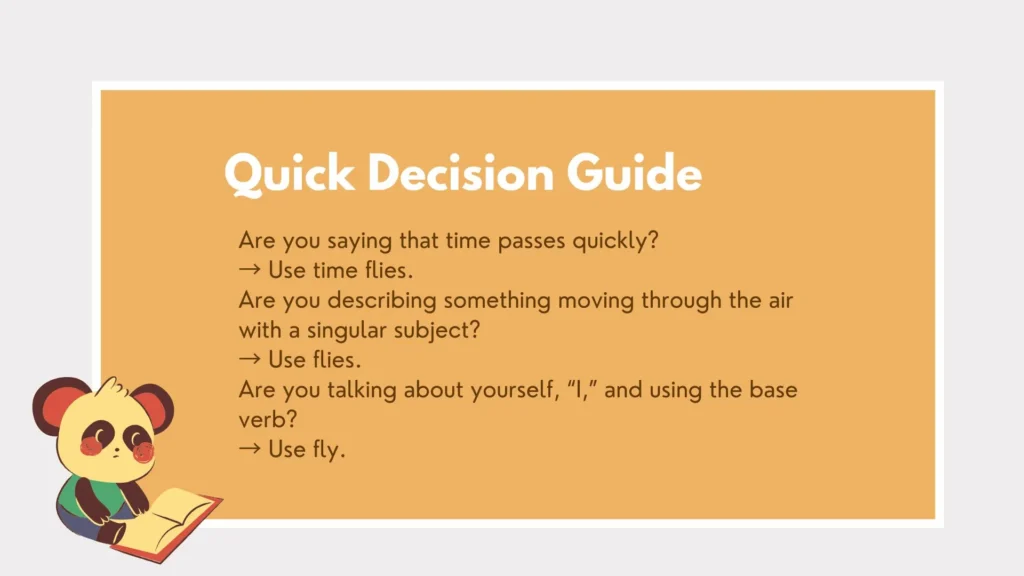
Are you saying that time passes quickly?
→ Use time flies.
Are you describing something moving through the air with a singular subject?
→ Use flies.
Are you talking about yourself, “I,” and using the base verb?
→ Use fly.
I fly to Chicago tomorrow.
Are you writing “flys” as the ordinary present-tense verb?
→ Do not use it. Choose flies.
Mini Quiz
1. Which sentence is correct?
A. Time flys when you’re having fun.
B. Time flies when you’re having fun.
Answer: B — Time flies when you’re having fun.
Flies is the correct third-person singular form of fly.
2. Choose the correct sentence.
A. The eagle flys over the mountain.
B. The eagle flies over the mountain.
Answer: B — The eagle flies over the mountain.
The singular subject eagle takes flies.
3. Which sentence is correct?
A. I flies to Boston every summer.
B. I fly to Boston every summer.
Answer: B — I fly to Boston every summer.
With I, use the base form fly, not flies.
4. Complete the sentence:
“Time ___ by so quickly.”
A. flys
B. flies
Answer: B — flies.
The standard expression is “time flies by.”
5. Which sentence uses the correct spelling?
A. She flies home every weekend.
B. She flys home every weekend.
Answer: A — She flies home every weekend.
Flies is the correct third-person singular form.
6. Which sentence is correct?
A. They fly to Paris every year.
B. They flies to Paris every year.
Answer: A — They fly to Paris every year.
The plural subject they takes the base form fly.
7. Which spelling belongs in the phrase?
“___ time flies!”
A. How
B. Howe
Answer: A — How time flies!
This is a common exclamation expressing surprise at how quickly time has passed.
8. Which form is standard in both American and British English?
A. time flys
B. time flies
Answer: B — time flies.
Both major varieties use flies in this expression.
FAQ
Is “time flies” grammatically correct?
Yes. “Time flies” is grammatically correct and means that time seems to pass quickly. The word flies is the third-person singular present form of fly.
Is “time flys” ever correct?
Not as the standard third-person singular form of the verb fly. You may see Flys in a proper name, brand, username, or another specialized context, but ordinary English uses flies.
Why is it “flies” instead of “flys”?
Because fly ends in a consonant followed by y. When forming the third-person singular present tense, the y changes to i and -es is added: fly → flies.
Is “time flies when you’re having fun” correct?
Yes. It is a common English expression meaning that enjoyable experiences can seem to pass very quickly.
Is “time flies by” correct?
Yes. “Time flies by” is grammatically correct and emphasizes the feeling that time is passing quickly.
Is “time flys so fast” correct?
No. The standard spelling is “time flies so fast.” The word flies is required because time is a singular subject.
Is “flies” only used for insects?
No. Flies can be a noun or a verb. As a noun, it can refer to more than one flying insect. As a verb, it is the third-person singular form of fly.
The flies are on the window.
The bird flies over the garden.
Is “fly” or “flies” correct after “time”?
Use flies when time is the subject in the present tense.
Time flies. ✅
But after certain helping verbs, use fly:
Time will fly by. ✅
Time can fly by. ✅
You do not say “Time will flies.”
Is there a British or American difference between “flies” and “flys”?
No. Flies is the standard spelling in both British and American English. Flys is not a standard regional alternative in this context.
What is the past tense of “fly”?
The past tense is flew, while the past participle is flown.
The plane flew over the city yesterday.
The plane has flown over the city many times.
These forms are different from the present-tense flies.
Final Takeaway
The correct expression is “time flies,” not “time flys.”
The reason is the spelling rule for verbs ending in a consonant + y: fly → flies when the subject is third-person singular.
So remember:
Time flies when you’re having fun.
Whenever you mean that time seems to pass quickly, flies is the standard and correct choice.
Discover More Topics:
- Ofcourse or Of Course | The Easy Rule That Finally Clears Up the Confusion
- All of a Sudden or All of the Sudden | A Clear Guide to the Right Choice

Hi, I’m Sophia Mitchell, and I’ve always been fascinated by the stories behind names. My passion for animals inspired me to help pet owners find names that feel personal, memorable, and full of meaning. As a writer for Meanixo, I create pet naming resources that combine creativity, research, and practical ideas for every type of pet.
I enjoy exploring global naming traditions, personality-based names, and trending pet names to help readers confidently choose the perfect name for their beloved companions.
Books:
- Meaningful Names for Every Pet
- The Joy of Naming Your Best Friend
 Daniel Brooks
 Michael Turner