I’ve seen how one small word can change the meaning of an entire sentence, and more then or more than is a perfect example. If you’ve ever paused while writing because you weren’t sure which one is correct, you’re definitely not alone. In this guide, I’ll make the difference simple, memorable, and practical so you can write with confidence every time.
More then or more than which one is correct?
More than is correct when you’re comparing amounts, numbers, people, or things; then is usually used for time or sequence.
Quick Answer
More than is the standard and correct expression when you are comparing amounts, numbers, people, things, or degrees. More then is normally a mistake because then refers to time, sequence, or what happens next, while than is used for comparisons. For example, write “more than 10 people,” not “more then 10 people.”
Quick Comparison Table
| Form | Main Use | Example |
| more than | Comparison, amount, degree, or quantity | I have more than $20. |
| more then | Usually an incorrect spelling when making a comparison | ❌ I have more then $20. |
| then | Time, sequence, or consequence | Finish your work, then go home. |
| than | Comparison | Sarah is taller than Mia. |
The key point is simple: use than when comparing and then when talking about time or sequence.
What Does “More Than” Mean?
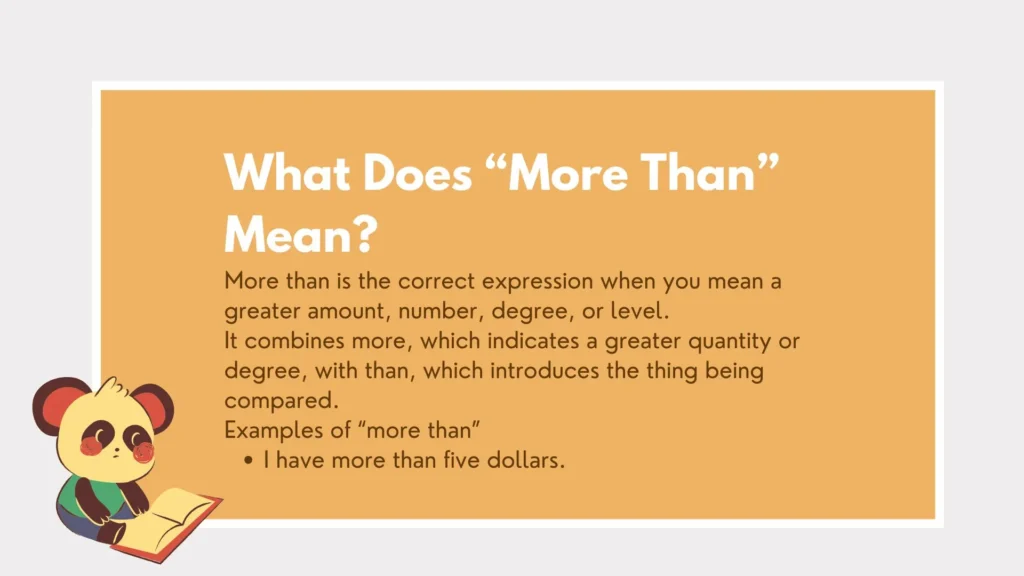
More than is the correct expression when you mean a greater amount, number, degree, or level.
It combines more, which indicates a greater quantity or degree, with than, which introduces the thing being compared.
Examples of “more than”
- I have more than five dollars.
- She owns more than 20 books.
- This job requires more than basic computer skills.
- The movie lasted more than two hours.
- He is more than ready to help.
The expression can be used with numbers, quantities, qualities, actions, and comparisons.
“More than” with numbers
When you want to say that an amount exceeds a particular number, use more than.
- More than 100 students attended the event.
- The bag costs more than $50.
- We waited for more than an hour.
- She has more than 10 years of experience.
“More than” with comparisons
You can also use more than to compare one thing with another.
- I enjoy reading more than watching television.
- He cares more about quality than speed.
- This task is more difficult than I expected.
“More than” meaning “very” or “extremely”
In some expressions, more than does not simply mean a larger quantity. It can emphasize a quality or feeling.
- I am more than happy to help.
- She was more than willing to participate.
- That explanation was more than enough.
- He is more than capable of doing the job.
Here, more than happy means very willing or pleased, rather than literally comparing two quantities of happiness.
What Does “More Then” Mean?
More then is not the standard form when you are trying to express a comparison or quantity.
For example:
❌ I have more then five books.
The correct sentence is:
✅ I have more than five books.
The confusion happens because than and then look and sound similar, especially in fast speech. However, they have different grammatical jobs.
What does “then” mean?
Then usually relates to time, sequence, or consequence.
For example:
- I lived there then.
- Finish your homework, then watch television.
- If you are tired, then take a break.
- First we went shopping, and then we went home.
Because then does not normally introduce a comparison, it should not replace than after more when you are comparing quantities or degrees.
More Than vs More Then: Key Difference
The easiest way to understand the difference is to focus on the job each word performs.
Than = comparison
Then = time, sequence, or result
Compare these examples:
My sister is older than me.
Here, than connects two things being compared.
I finished my work, then I went outside.
Here, then tells us what happened next.
Now look at a quantity:
We have more than enough food.
The phrase compares the amount of food with what is considered enough.
Using then would be incorrect:
❌ We have more then enough food.
So when you see more ___ 10, more ___ $100, more ___ enough, or another comparison, the missing word is normally than.
When Should You Use “More Than”?
For quantities and numbers
Use more than when an amount is greater than a stated number.
- The building has more than 50 rooms.
- More than 1,000 people entered the competition.
- I spent more than $30.
- The package weighs more than five kilograms.
For age
Use more than when stating that someone’s age exceeds a particular number.
- She is more than 18 years old.
- The company has existed for more than 50 years.
- He has been working there for more than a decade.
In everyday English, over can also be used in many of these contexts:
- She is over 18.
- The company has existed for over 50 years.
However, more than is completely standard.
For time and duration
Use more than when describing a period longer than a particular amount.
- The journey took more than three hours.
- I have been waiting for more than 20 minutes.
- The meeting lasted more than an hour.
For qualities and degrees
Use more than when comparing degrees of something.
- This problem is more complicated than I expected.
- She is more experienced than her colleague.
- The second option is more practical than the first.
In formal writing
More than works naturally in academic, professional, business, and formal writing.
- The survey included more than 500 participants.
- The project requires more than financial investment.
- The results were more significant than researchers initially expected.
When Should You Use “Then”?
Although more then is normally wrong as a replacement for more than, then itself is a perfectly correct English word.
To show sequence
Use then when one event follows another.
- First, read the instructions. Then, complete the form.
- She had breakfast and then went to work.
- We visited the museum and then had lunch.
To refer to a time
Then can refer to a particular time, especially a time in the past or a previously mentioned period.
- I was living in London then.
- Things were different then.
- The company was smaller then.
To show a result or consequence
Then can also introduce a result in certain sentence structures.
- If you agree, then we can begin.
- If the store is closed, then we will come back tomorrow.
So there is nothing wrong with then. The problem is using it where English requires than.
Common Sentence Variations
More Than 10 or More Then 10?
Use more than 10 when you mean a quantity greater than 10.
✅ More than 10 students joined the class.
❌ More then 10 students joined the class.
The word than introduces the comparison between the actual number and 10.
More Than 100 or More Then 100?
The correct form is more than 100.
✅ The website received more than 100 visitors.
❌ The website received more then 100 visitors.
The same rule applies to any number.
More Than Enough or More Then Enough?
Use more than enough.
✅ We have more than enough food.
❌ We have more then enough food.
More than enough means that there is a greater amount than is necessary.
More Than Ever or More Then Ever?
Use more than ever.
✅ I appreciate your help more than ever.
❌ I appreciate your help more then ever.
The expression more than ever means to a greater degree than at any previous time.
More Than Once or More Then Once?
Use more than once.
✅ I have visited that restaurant more than once.
❌ I have visited that restaurant more then once.
It means something happened two or more times.
More Than One or More Then One?
Use more than one.
✅ More than one person complained about the problem.
❌ More then one person complained about the problem.
Here, than introduces a comparison between one and a larger quantity.
More Than I or More Then I?
When more introduces a comparison, use than.
- She earns more than I do.
- He knows more than I expected.
- The course cost more than I thought it would.
In informal speech, you may also hear constructions such as “more than me”, depending on the sentence and intended meaning.
Common Phrases With “More Than”
More than enough
This means there is a larger amount than necessary.
We have more than enough time to finish the project.
More than once
This means something happened multiple times.
I have explained the instructions more than once.
More than ever
This means to a greater extent than before.
She values her family more than ever.
More than likely
This means very likely or probably.
It will more than likely rain tomorrow.
More than happy
This commonly means very willing or pleased.
I am more than happy to answer your questions.
More than anything
This means something is valued or desired above other things.
More than anything, I want my family to be safe.
More than meets the eye
This expression means something has hidden qualities, details, or complexity that are not immediately obvious.
There is more to the story than meets the eye.
Common Mistakes
1. Using “then” after a number
❌ The store has more then 50 employees.
✅ The store has more than 50 employees.
Why? The sentence compares the number of employees with 50, so than is required.
2. Writing “more then enough”
❌ We have more then enough supplies.
✅ We have more than enough supplies.
Why? More than enough is the standard expression.
3. Writing “more then ever”
❌ I need your support more then ever.
✅ I need your support more than ever.
Why? The sentence expresses a comparison of degree.
4. Using “then” in a comparison
❌ This option is better then the other one.
✅ This option is better than the other one.
Why? Comparisons use than, not then.
5. Using “than” for sequence
❌ First, save the file than close the program.
✅ First, save the file, then close the program.
Why? The sentence describes two actions in sequence, so then is appropriate.
6. Confusing “then” and “than” in emails
❌ We received more then 200 applications.
✅ We received more than 200 applications.
This mistake is especially easy to overlook during quick typing, so it is worth checking whenever more is followed by a quantity.
7. Writing “more then one”
❌ More then one employee reported the issue.
✅ More than one employee reported the issue.
Why? The sentence refers to a quantity greater than one.
Why Do People Get This Wrong?
The confusion mainly comes from the similar spelling and pronunciation of than and then.
Both words contain similar letters, and in ordinary conversation their unstressed pronunciation can sound quite close. This makes it easy to type the wrong word, especially when writing quickly.
There is also a simple association that can help:
- than → comparison
- then → time or sequence
Because more frequently appears in comparisons, the phrase more than is extremely common. That makes more then a particularly noticeable spelling mistake.
Can Both Forms Be Correct?
More than and then are both correct English words, but more then is not normally a correct substitute for more than.
The important distinction is grammatical:
More than = comparison or greater amount
Then = time, sequence, or consequence
For example:
✅ I have more than $100.
Here, than is part of a comparison.
✅ I had $100 then.
Here, then refers to a particular time.
The two words can therefore both appear in the same larger sentence, but they perform different jobs.
I had more than $100 then.
In this sentence, than handles the comparison, while then refers to the time.
This is an important point: then is not an incorrect word. It is simply the wrong word when the sentence requires a comparison.
British vs American English
There is no major British-versus-American spelling difference between than and then.
Both British English and American English use:
- more than for comparisons
- then for time and sequence
For example, both varieties use:
The company has more than 500 employees.
And both use:
We finished dinner, then went home.
The distinction is therefore a standard English grammar and usage issue rather than a regional spelling difference.
Pronunciation
Than and then are pronounced similarly, which can contribute to the confusion.
In careful pronunciation, than is commonly represented as /ðæn/, while then is commonly represented as /ðen/.
The exact vowel quality can vary in natural speech and across accents. However, pronunciation is not a reliable way to decide which spelling to use.
Instead, ask what the word is doing:
Is it making a comparison? → than
Is it referring to time or sequence? → then
Simple Memory Trick
Use this easy rule:
Than = comparison. Then = next.
Think of then as being connected with what happens next:
First this, then that.
For than, think about comparing two things:
More than five.
So remember:
More = more than.
Next = then.
If you are writing more ___ 10, more ___ enough, or more ___ ever, the answer is almost certainly than.
Quick Decision Guide
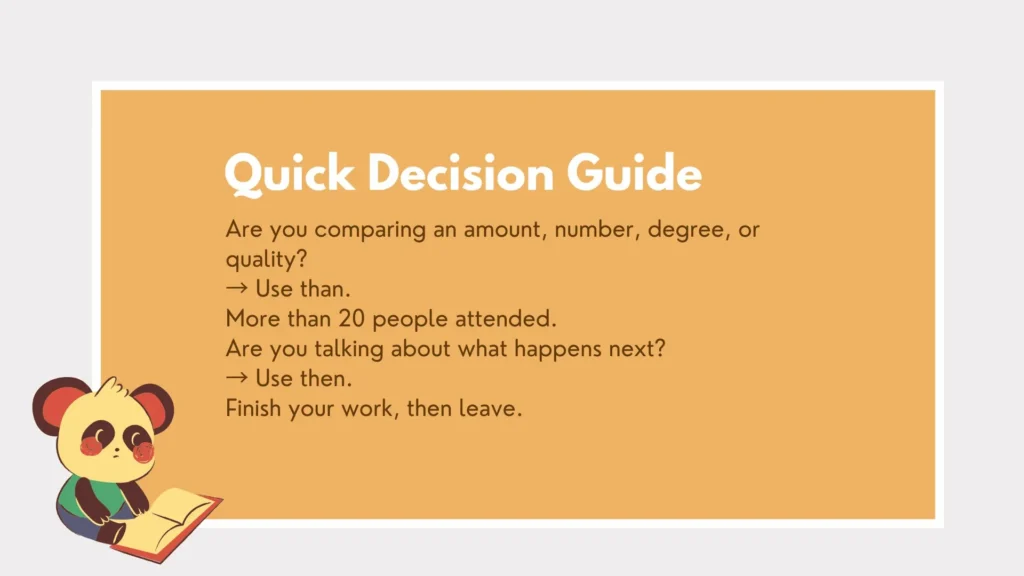
Are you comparing an amount, number, degree, or quality?
→ Use than.
More than 20 people attended.
Are you talking about what happens next?
→ Use then.
Finish your work, then leave.
Are you referring to a previous or particular time?
→ Use then.
I lived there then.
Does the sentence contain “more” followed by a comparison?
→ Usually use more than.
She has more than enough experience.
Mini Quiz
1. The company has more ___ 500 employees.
A. than
B. then
Answer: A — than
Use than because the sentence compares the number of employees with 500.
2. Finish your homework, ___ go outside.
A. than
B. then
Answer: B — then
Use then because it shows the next action.
3. I have waited for more ___ an hour.
A. than
B. then
Answer: A — than
The sentence describes a duration greater than one hour.
4. She understands the subject better ___ I do.
A. than
B. then
Answer: A — than
This is a direct comparison between her understanding and yours.
5. First, open the document and ___ save it.
A. than
B. then
Answer: B — then
The word then shows the order of the two actions.
6. We have more ___ enough food for everyone.
A. than
B. then
Answer: A — than
More than enough is the correct expression.
7. Things were different ___.
A. than
B. then
Answer: B — then
Here, then refers to a particular time.
8. I have visited that city more ___ once.
A. than
B. then
Answer: A — than
The expression is more than once, meaning multiple times.
FAQ
Is “more then” or “more than” correct?
More than is correct when you are comparing quantities, numbers, degrees, or amounts. More then is normally an error in this context.
Is “more then” ever correct?
Not as the normal spelling of the comparison more than. The word then itself is correct English, but it has a different function related mainly to time, sequence, or consequence.
What is the difference between “than” and “then”?
Than is generally used for comparisons, while then is generally used for time, sequence, or consequence. For example, “more than 10” uses than, while “first this, then that” uses then.
Should I write “more than 5” or “more then 5”?
Write more than 5. The sentence compares an amount with the number 5, so than is required.
Is “more than enough” correct?
Yes. More than enough is a standard expression meaning that there is a greater amount than necessary.
Is “more than ever” correct?
Yes. More than ever means to a greater extent than at any previous time.
Is “more than one” grammatically correct?
Yes. More than one is a standard expression meaning a quantity greater than one. For example, “More than one student answered correctly.”
Is “more then ever” correct?
No, not when you mean the common expression. The correct form is more than ever.
Is “more then once” correct?
No. The standard expression is more than once.
Is there a British English difference between “more than” and “more then”?
No. British and American English follow the same basic distinction: than is used for comparisons, while then is used for time and sequence.
How can I remember whether to use “than” or “then”?
Remember: than = comparison and then = next/time. If you are comparing something, choose than; if you are describing what happens next or referring to a time, choose then.
Final Takeaway
When you mean a greater amount, number, degree, or quantity, use more than.
✅ More than 20 people attended.
When you mean what happened next or a particular time, use then.
✅ We finished dinner, then went home.
The simplest rule is:
Than = comparison. Then = time or sequence.
So when you are choosing between more then or more than, the correct choice for a comparison is almost always more than.
Discover More Topics:
- Ofcourse or Of Course | The Easy Rule That Finally Clears Up the Confusion
- All of a Sudden or All of the Sudden | A Clear Guide to the Right Choice

I’m Daniel Brooks, and I enjoy helping pet owners discover names that perfectly fit their new companions. Whether it’s a playful puppy, a curious cat, a colorful bird, or an exotic pet, I believe every animal deserves a name with character and meaning. At Meanixo, I focus on creating well-organized, easy-to-read pet name collections that make the naming process enjoyable.
I constantly research naming trends, cultures, and language meanings so readers can find names they’ll love for years to come.
Books:
- Modern Pet Naming Guide
- The Ultimate Book of Animal Names
 Michael Turner
 Sophia Mitchell