If you’re wondering whether the plural of hero is heros or heroes, the standard answer is heroes. One hero becomes two heroes, not two heros. Major English dictionaries, including Cambridge and Oxford, list heroes as the plural form of hero.
There is a small exception that can cause confusion: in U.S. English, hero can also mean a type of long sandwich, and heroes is used for the plural of that food meaning as well.
So if you’re writing about brave people, fictional characters, superheroes, or admired individuals, use heroes.
Quick answer: hero → heroes.
Heros or Heroes: Which Is Correct?
Heroes is the correct standard plural of hero when you mean two or more people or characters.
Examples:
- One hero saved the child.
- Two heroes saved the child.
- The firefighters became local heroes.
- The story follows several heroes.
Heros is not the standard plural spelling for people or fictional characters.
| Form | Meaning | Example |
| hero | One person or character | He is a hero. |
| heroes | More than one hero | They are heroes. |
| hero’s | Belonging to one hero | The hero’s story was inspiring. |
| heroes’ | Belonging to several heroes | The heroes’ actions were remembered. |
| heros | Limited/specialized usage associated with the sandwich meaning | The deli serves heroes. |
Cambridge and Oxford both give heroes as the plural of hero.
The easiest rule to remember
If you mean more than one hero, write:
heroes
The spelling is:
hero + es = heroes
Not:
hero + s = heros
Why Is the Plural of Hero “Heroes”?
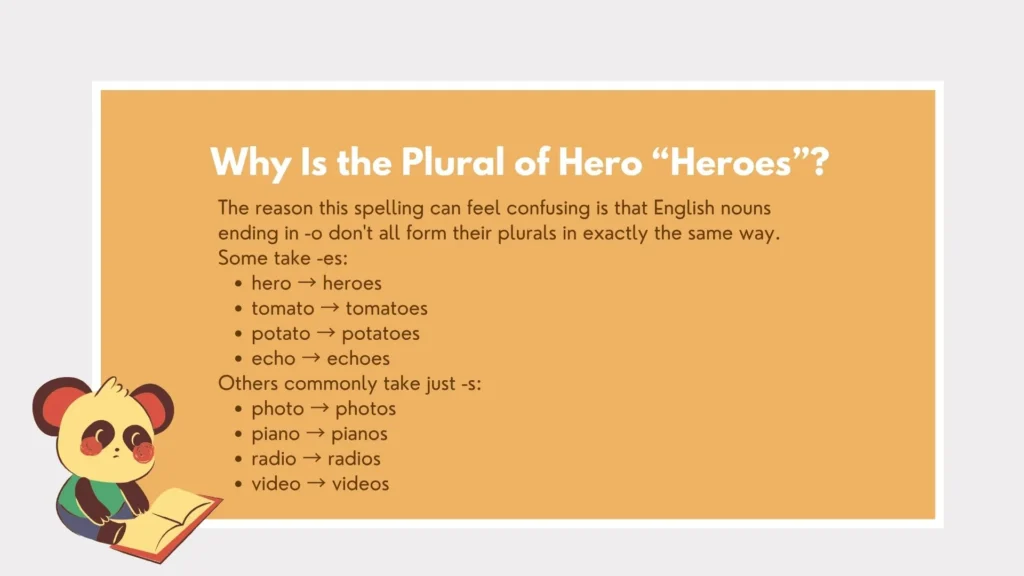
The reason this spelling can feel confusing is that English nouns ending in -o don’t all form their plurals in exactly the same way.
Some take -es:
- hero → heroes
- tomato → tomatoes
- potato → potatoes
- echo → echoes
Others commonly take just -s:
- photo → photos
- piano → pianos
- radio → radios
- video → videos
So it isn’t safe to assume that every noun ending in -o simply adds -s.
For hero, the established standard plural is heroes. Oxford and Cambridge both record this form.
Why “Heros” Looks Like It Could Be Correct
The spelling heros looks logical because English has many familiar nouns that form plurals by adding -s.
For example:
- photo → photos
- piano → pianos
- video → videos
A reader may therefore naturally assume:
- hero → heros
But English plural formation doesn’t work from one universal rule for every -o word. The standard plural of hero is an established form that uses -es:
hero → heroes
That is the form you should use in ordinary English writing.
What Does “Hero” Mean?
The word hero has several related meanings, so understanding the noun itself helps explain why heroes appears in many different contexts.
Hero as a brave or admired person
A hero can be someone admired for courage, an important achievement, or a good action.
For example:
- The firefighter was called a hero after the rescue.
- The volunteers were celebrated as heroes.
- She became a national hero after her actions.
Cambridge defines hero as a person admired for doing something very brave or achieving something great.
Hero as a character in a story
A hero can also be the main character, particularly the main male character, in a book, film, or other story.
For example:
- The hero of the novel faces an impossible choice.
- The film has several heroes.
- The story follows a group of unlikely heroes.
Cambridge and Oxford both include this literary or storytelling sense.
Hero as someone you admire
The word can also refer more broadly to someone you greatly admire because of their qualities, achievements, or abilities.
For example:
- My grandfather was my childhood hero.
- The athletes became national heroes.
- Many young players have famous sports heroes.
In all of these meanings, the plural is heroes.
Hero, Heroes, Hero’s, or Heroes’?
These four forms are easy to confuse because they look similar but perform different grammatical jobs.
Hero
Hero is the singular noun.
Use it when you are talking about one person or character.
Examples:
- He became a hero.
- The hero saved the village.
- She considers her mother a hero.
Heroes
Heroes is the standard plural noun.
Use it when you mean more than one hero.
Examples:
- The firefighters were heroes.
- The story has several heroes.
- These athletes became national heroes.
Hero’s
Hero’s is the singular possessive form.
It means something belongs to or is associated with one hero.
Examples:
- The hero’s decision changed everything.
- The hero’s costume was damaged.
- We learned about the hero’s childhood.
The apostrophe is important because hero’s does not mean “more than one hero.”
Heroes’
Heroes’ is the plural possessive form.
It means something belongs to or is associated with several heroes.
Examples:
- The heroes’ stories were inspiring.
- The museum displays the heroes’ uniforms.
- The heroes’ actions changed the town.
A useful way to remember the four forms is:
hero = one
heroes = more than one
hero’s = belonging to one
heroes’ = belonging to more than one
When Is “Heros” Correct?
For the ordinary meaning of hero, heros is not the standard plural.
However, there is a specialized food-related use that explains why you may sometimes encounter heros.
In U.S. English, a hero can mean a type of long sandwich. Cambridge lists the sandwich meaning as a regional U.S. usage and gives heroes as its plural.
That means the safest general rule remains:
Use “heroes” for the plural of hero.
Even when hero means a sandwich, heroes is an established plural form.
Why You May See “Heros” for Sandwiches
The spelling heros can appear in U.S. usage in connection with the sandwich meaning. This is a specialized usage and should not be confused with the standard plural of hero when referring to people.
For example, if you’re writing about people:
- The firefighters were heroes. ✓
- The firefighters were heros. ✗
If you’re discussing sandwiches, you may encounter variant usage, but heroes is also documented for the food sense. Cambridge explicitly gives heroes as the plural of hero in its sandwich entry.
Should You Use “Heros” in Normal Writing?
Generally, no.
If you’re writing an essay, article, school assignment, email, story, social-media post, or professional document and you mean multiple heroic people or characters, choose:
heroes
If a particular restaurant, brand, menu, publication, or title uses heros for sandwiches, that is a separate naming or usage issue.
Heros or Heroes in American English
American English uses heroes as the standard plural of hero.
For example:
- The firefighters were heroes.
- The players became national heroes.
- The comic introduces several heroes.
- The movie follows a group of heroes.
American English also has the food meaning of hero, referring to a long sandwich. Cambridge identifies that meaning as U.S. regional usage.
So American English does not generally change the spelling of the ordinary plural from heroes to heros.
Heros or Heroes in British English
In British English, the standard plural is also:
heroes
Cambridge’s British English entry lists heroes as the plural of hero.
Examples:
- The soldiers were remembered as heroes.
- The novel contains several heroes.
- The firefighters became local heroes.
Therefore, there is no standard British-English spelling heros for multiple heroic people.
Is “Heros” a UK Spelling?
No, not as the standard plural of hero.
If you’re writing for readers in the UK, use:
hero → heroes
The spelling does not change simply because the audience is British rather than American.
How Do You Pronounce “Hero” and “Heroes”?
The pronunciation of hero varies slightly between British and American English.
Cambridge gives:
- British English: /ˈhɪə.rəʊ/
- American English: /ˈhɪr.oʊ/
A simple learner-friendly approximation is:
- hero → HEE-roh
- heroes → HEE-rohz
The important point for this spelling question is that heroes is written with the extra e even though the pronunciation may not make that spelling difference obvious.
Because heros and heroes can sound very similar in normal speech, this is primarily a spelling and word-form issue.
Heros or Heroes for Superheroes?
The correct plural of superhero is:
superheroes
Not:
superheros
Examples:
- The movie features several superheroes.
- The two superheroes work together.
- Children often recognize famous superheroes.
- The comic introduces a new group of superheroes.
Oxford lists superheroes as the plural of superhero.
The same pattern applies to words built from hero, such as:
- superhero → superheroes
- antihero → antiheroes
This is useful because someone who has learned the spelling heroes can apply the same plural pattern to these related words.
Heros or Heroes: Example Sentences
The following examples use heroes in the standard plural sense.
Sentences About Real People
- The firefighters were honored as heroes.
- The rescuers became local heroes.
- The volunteers were treated as heroes after the disaster.
- Many people consider their parents everyday heroes.
- The athletes became national heroes after their achievement.
Sentences About Fictional Characters
- The novel has three main heroes.
- The film follows a group of unlikely heroes.
- The heroes must work together to save the city.
- The writer created several memorable heroes.
- The story contrasts its heroes with its villains.
Sentences With Related Forms
- One hero entered the building.
- Several heroes followed him.
- The hero’s decision changed the story.
- The heroes’ actions inspired the community.
- The comic introduced two new superheroes.
These examples show why context matters: hero, heroes, hero’s, and heroes’ are different forms, even though they are closely related.
Common Mistakes With Heros and Heroes
Mistake 1: Using “heros” as the plural of hero
Incorrect:
The firefighters were heros.
Correct:
The firefighters were heroes.
The standard plural is heroes.
Mistake 2: Writing “superheros”
Incorrect:
The movie has several superheros.
Correct:
The movie has several superheroes.
The plural keeps the -heroes spelling.
Mistake 3: Using “hero’s” for more than one hero
Incorrect:
The hero’s worked together.
Correct:
The heroes worked together.
The apostrophe in hero’s makes it possessive rather than plural.
Mistake 4: Confusing “heroes” with “heroes’”
Incorrect:
The heroes costumes were displayed.
Correct:
The heroes’ costumes were displayed.
Here, heroes’ is possessive because the costumes belong to the heroes.
Mistake 5: Assuming every -o word takes the same plural ending
It is tempting to apply one rule to every word ending in -o, but English has different plural patterns.
Compare:
- hero → heroes
- photo → photos
- piano → pianos
- tomato → tomatoes
The established spelling of each word needs to be learned individually.
Can “Heros” and “Heroes” Be Used Interchangeably?
No, not generally.
If you’re talking about multiple brave people, admired individuals, or fictional characters, use heroes.
For example:
The rescue workers were heroes.
Do not replace heroes with heros simply because the two spellings look similar.
The spelling heros may appear in specialized contexts related to the sandwich meaning, but that does not make it an interchangeable spelling of heroes for people. Cambridge’s dictionary entries distinguish the ordinary plural and the sandwich sense.
The safest everyday choice
If you’re unsure, use:
heroes
That is the standard plural readers will expect when hero refers to a person or character.
Heros or Heroes: What Is the Difference?
The simplest comparison is:
| Form | Use | Example |
| hero | Singular | He is a hero. |
| heroes | Standard plural | They are heroes. |
| hero’s | Singular possessive | The hero’s story was famous. |
| heroes’ | Plural possessive | The heroes’ stories were famous. |
| heros | Specialized/limited usage | May occur in U.S. sandwich-related usage |
For ordinary English, the key pair is:
hero → heroes
The difference is not British spelling versus American spelling. Both British and American English use heroes as the standard plural.
What Is “Heroes” the TV Show?
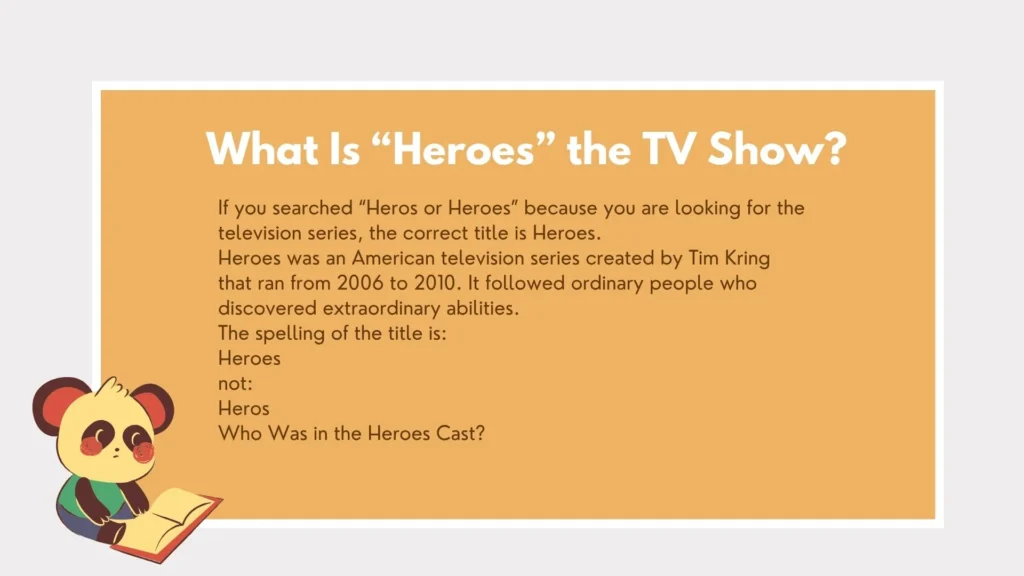
If you searched “Heros or Heroes” because you are looking for the television series, the correct title is Heroes.
Heroes was an American television series created by Tim Kring that ran from 2006 to 2010. It followed ordinary people who discovered extraordinary abilities.
The spelling of the title is:
Heroes
not:
Heros
Who Was in the Heroes Cast?
The series had a large ensemble cast. Major cast members included:
- Hayden Panettiere as Claire Bennet
- Milo Ventimiglia as Peter Petrelli
- Jack Coleman as Noah Bennet
- Masi Oka as Hiro Nakamura
- Zachary Quinto as Sylar
- Ali Larter in multiple roles
- Greg Grunberg as Matt Parkman
- Sendhil Ramamurthy as Mohinder Suresh
TV Guide and IMDb list these and other members of the show’s cast.
So if you’re searching for the show, its official title is Heroes.
Synonyms for Hero
If you’re looking for a synonym rather than the plural spelling, the best choice depends on the context.
Possible alternatives include:
- champion
- role model
- rescuer
- protagonist
- savior
- legend
- idol
- brave person
However, these words aren’t perfect replacements in every sentence.
For example, protagonist describes a main character in a story, while champion may emphasize achievement or support for a cause. Role model focuses on someone whose behavior others admire.
So when you specifically mean the plural of hero, use heroes rather than substituting a synonym.
What Is the Plural of Hero?
The standard plural of hero is:
heroes
The pattern is:
one hero → two heroes
Examples:
- one hero
- three heroes
- a national hero
- national heroes
- one superhero
- several superheroes
Both Cambridge and Oxford list heroes as the plural form.
Frequently Asked Questions
Is “heros” or “heroes” correct?
Heroes is the standard plural of hero when referring to people or characters. For example, “The firefighters were heroes.” Heros is not the standard plural for this meaning.
Is “heros” a misspelling?
When you mean multiple heroic people or characters, heros is not the standard spelling. The correct form is heroes. A specialized sandwich-related use of heros can occur, but it should not be treated as the normal plural of hero.
Is it “heros” or “heroes” in the UK?
It is heroes. British English uses heroes as the standard plural of hero.
Is “heros” or “heroes” grammatically correct?
Heroes is the standard plural form. The issue is primarily one of spelling and plural formation rather than a difference between two grammatical forms with the same meaning.
How do you spell the plural of hero?
Spell it heroes:
hero → heroes
Why isn’t the plural “heros”?
Although some English nouns ending in -o take only -s, hero traditionally forms its standard plural with -es. Therefore, the established spelling is heroes.
Is “heros” ever correct?
It can appear in specialized U.S. usage connected with the word hero meaning a type of long sandwich. However, heroes is also documented as the plural of the sandwich meaning.
What is the plural of “superhero”?
The plural is superheroes. Oxford lists superheroes as the plural of superhero.
What is the difference between “hero’s” and “heroes”?
Hero’s is the possessive form for one hero, while heroes is the plural of hero.
- hero’s = belonging to one hero
- heroes = more than one hero
For possession involving multiple heroes, use heroes’.
Is the TV show spelled “Heros” or “Heroes”?
The television series is titled Heroes. It was created by Tim Kring and originally ran from 2006 to 2010.
How do you pronounce “heroes”?
A simple pronunciation guide is HEE-rohz. The pronunciation of hero itself varies slightly between British and American English. Cambridge gives /ˈhɪə.rəʊ/ for British English and /ˈhɪr.oʊ/ for American English.
Conclusion
If you’re choosing between heros or heroes, the standard answer is heroes.
Use heroes when you’re talking about two or more brave people, admired individuals, fictional characters, or superheroes:
One hero, two heroes.
The spelling heros can appear in a specialized context connected with the U.S. sandwich meaning of hero, but it is not the standard plural spelling for people or characters. Cambridge specifically records heroes as the plural in both the ordinary and sandwich meanings.
Remember these four forms:
- hero = one person or character
- heroes = more than one
- hero’s = belonging to one hero
- heroes’ = belonging to multiple heroes
So if you’re writing “The firefighters were true ___,” the correct word is:
heroes

I’m Daniel Brooks, and I enjoy helping pet owners discover names that perfectly fit their new companions. Whether it’s a playful puppy, a curious cat, a colorful bird, or an exotic pet, I believe every animal deserves a name with character and meaning. At Meanixo, I focus on creating well-organized, easy-to-read pet name collections that make the naming process enjoyable.
I constantly research naming trends, cultures, and language meanings so readers can find names they’ll love for years to come.
Books:
- Modern Pet Naming Guide
- The Ultimate Book of Animal Names
 Michael Turner
 Sophia Mitchell