If you are confused about s’ or s’s, the answer depends on whether the word is singular, plural, or a name ending in s. I find the easiest way to solve this is to identify the noun first and only then decide where the apostrophe belongs.
In this guide, you’ll learn exactly when to use ’s, s’, and s’s, why students’ is correct but students’s is not, and how to handle tricky forms such as class’s, James’s, children’s, and parents’.
Quick Answer: s’ or s’s?
For ordinary possessive nouns, these are the main patterns:
- Singular noun → ’s
student → student’s - Plural noun ending in s → s’
students → students’ - Plural noun not ending in s → ’s
children → children’s - Singular noun ending in s → usually ’s
class → class’s - s’s is not normally used for a regular plural ending in s
students’s ❌ → students’ ✅
So if your question is “Is it students’ or students’s?”, the standard possessive form is:
students’
The important point is that the apostrophe comes after the existing plural s. Cambridge gives the same basic distinction: singular nouns take ’s, while plural nouns ending in s take the apostrophe after the plural s.
What Is the Difference Between ’s, s’, and s’s?
The three forms look similar, but they do not work in the same way.
| Form | Main use | Example |
| ’s | Singular possessive | the teacher’s book |
| s’ | Plural possessive ending in s | the teachers’ books |
| s’s | Not normally used for ordinary plural possessives | students’s ❌ |
| ’s after some singular words ending in s | Singular possessive | class’s rules |
| ’s with irregular plurals | Plural possessive | children’s books |
The most important distinction is not whether the word ends in s. It is whether the noun is singular or plural.
That is why these are different:
class’s → one class
classes’ → more than one class
and:
student’s → one student
students’ → more than one student
When Do You Use ’s?
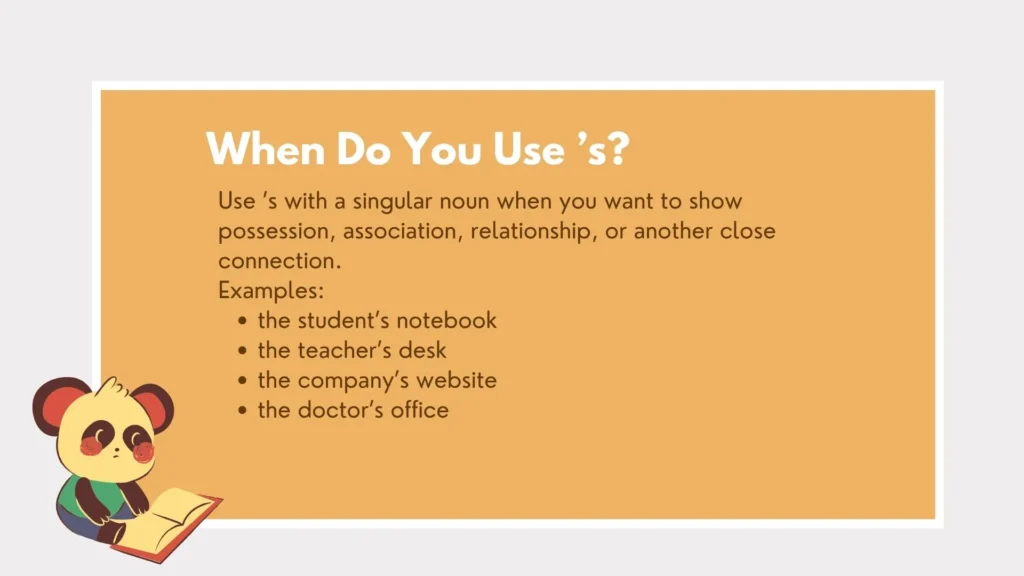
Use ’s with a singular noun when you want to show possession, association, relationship, or another close connection.
Examples:
- the student’s notebook
- the teacher’s desk
- the company’s website
- the doctor’s office
- the dog’s collar
- Sarah’s phone
For example:
The student’s notebook is on the desk.
There is one student, so:
student + ’s = student’s
Possessive ’s can also express more than literal ownership. English uses it for relationships, organizations, places, time, and other connections.
For example:
the company’s policy
yesterday’s newspaper
the country’s economy
The company does not literally “own” a policy. The apostrophe shows a relationship or association.
When Do You Use s’?
Use s’ when the noun is plural and already ends in s.
For example:
The students’ classroom is upstairs.
The noun is:
students
It is plural and already ends in s, so we add only the apostrophe:
students + ’ = students’
More examples:
- teachers’ lounge
- parents’ meeting
- players’ uniforms
- customers’ complaints
- employees’ rights
- doctors’ offices
- writers’ opinions
Cambridge specifically gives the pattern of placing the apostrophe after the s when the noun is plural.
Why Is Students’ Correct but Students’s Wrong?
This is one of the most common mistakes.
A learner may think:
student → student’s
students → students’s
It looks logical at first, but English does not normally form the possessive that way.
The plural word students already has its plural s.
So you do not add another s.
Correct
students’ books
Incorrect
students’s books
Think of it this way:
Singular
student + ’s → student’s
Plural
students + ’ → students’
The second s is unnecessary because the plural noun already ends in s.
When Is s’s Correct?
This is where the topic becomes more interesting.
s’s can appear when the underlying noun is singular and ends in s, depending on the word and style convention.
For example:
class’s rules
The word class is singular.
Therefore:
class + ’s = class’s
Likewise:
the boss’s office
Here, boss refers to one boss.
So:
boss + ’s = boss’s
This is completely different from:
bosses’ office
where bosses is plural.
Compare the Difference
| Meaning | Correct form |
| one class | class’s |
| several classes | classes’ |
| one boss | boss’s |
| several bosses | bosses’ |
| one student | student’s |
| several students | students’ |
This is why simply memorizing “words ending in s take s’” causes problems.
The better rule is:
First determine whether the noun is singular or plural.
Chicago’s current guidance likewise recommends ’s for singular nouns, including singular nouns ending in s, while plural nouns ending in s take an apostrophe alone.
Singular vs. Plural Possessives
The fastest way to understand possessive apostrophes is to compare singular and plural nouns side by side.
Student’s vs. Students’
The student’s bag is under the desk.
One student.
The students’ bags are under the desks.
Several students.
Teacher’s vs. Teachers’
The teacher’s computer is new.
One teacher.
The teachers’ computers are new.
Several teachers.
Parent’s vs. Parents’
The parent’s signature is required.
One parent.
The parents’ meeting begins at six.
Several parents.
The apostrophe position tells you something about the noun:
’s → normally singular
s’ → normally plural ending in s
Class’s or Classes’?
This is an especially useful comparison because the two forms can look confusing.
Class’s
The class’s schedule has changed.
There is one class.
Classes’
The classes’ schedules have changed.
There are multiple classes.
Notice what happens:
class → class’s
classes → classes’
The plural classes already ends in s, so only an apostrophe is added.
Boss’s or Bosses’?
The same principle applies.
The boss’s office is on the second floor.
One boss.
The bosses’ offices are on the second floor.
More than one boss.
This gives you a useful pattern:
Singular:
boss → boss’s
Plural:
bosses → bosses’
Do not decide based only on the final letter. Decide based on the number of the noun.
Children’s, Men’s, and Women’s
Not every plural noun ends in s.
Some English plurals are irregular:
- child → children
- man → men
- woman → women
- person → people
Because these plural forms do not end in s, they normally take ’s.
Examples:
children’s books
men’s shoes
women’s clothing
people’s opinions
So:
children → children’s
not:
childrens’ ❌
There is no standard plural childrens.
Cambridge specifically identifies irregular plurals such as children, men, people, and women as taking ’s in the possessive.
James’ or James’s?
Names ending in s are one of the places where readers often encounter different forms.
For example:
James’s book
You may also see:
James’ book
Why?
Because style conventions differ for some proper names ending in s.
Chicago’s current guidance uses ’s for a person’s name, including names such as James and Harris.
So under Chicago style:
James’s book
is preferred.
The important lesson is not to treat James’ and James’s as the same issue as students’ and students’s.
They are different grammatical situations:
students → plural noun → students’
James → singular proper name → James’s under Chicago style
If your university, publisher, employer, or publication follows another style guide, follow that guide consistently.
Kansas’s or Kansas’?
Place names can create another interesting case.
For example:
Kansas’s economy
Chicago treats Kansas as a singular name, so its possessive form is Kansas’s. By contrast, a plural form ending in s takes only the apostrophe under its rules.
This shows why the question:
“Does the word end in s?”
is not enough.
You need to ask:
“What grammatical form is this word?”
Apostrophe After s Does Not Always Mean Possession of a Person
The possessive apostrophe can describe relationships and other connections.
For example:
the students’ education
The students don’t necessarily “own” the education. The phrase describes education associated with the students.
Other examples include:
the company’s future
the country’s history
the team’s performance
the children’s safety
This broader idea of possession and association is important when identifying possessive nouns.
Time Expressions: One Week’s vs. Two Weeks’
Apostrophes can also appear with expressions of time.
For example:
one week’s holiday
Here, week is singular:
week → week’s
But:
two weeks’ holiday
Here, weeks is plural and ends in s:
weeks → weeks’
Another example:
an hour’s work
but:
three hours’ work
Cambridge documents this same singular/plural distinction for time expressions.
’s Is Not Always a Possessive
One reason apostrophe questions become confusing is that ’s can have different grammatical functions.
Consider:
The student’s late.
Here, student’s means:
student is
But:
The student’s book is missing.
Here, student’s is possessive.
Compare
The teacher’s tired.
= The teacher is tired.
The teacher’s desk is messy.
= The desk belongs to or is associated with the teacher.
So whenever you see ’s, ask whether it means:
- is
- has
- or a possessive relationship
Cambridge identifies ’s as a contraction for forms such as is and has, as well as a possessive marker.
Its or It’s?
This is another common apostrophe problem.
Its = possessive
The company changed its policy.
It’s = it is / it has
It’s a useful rule.
= It is a useful rule.
It’s changed recently.
= It has changed recently.
Do not write:
The company changed it’s policy. ❌
Write:
The company changed its policy. ✅
Cambridge specifically warns that its is the possessive form and it’s is the contraction.
Apostrophes Do Not Normally Make Regular Plurals
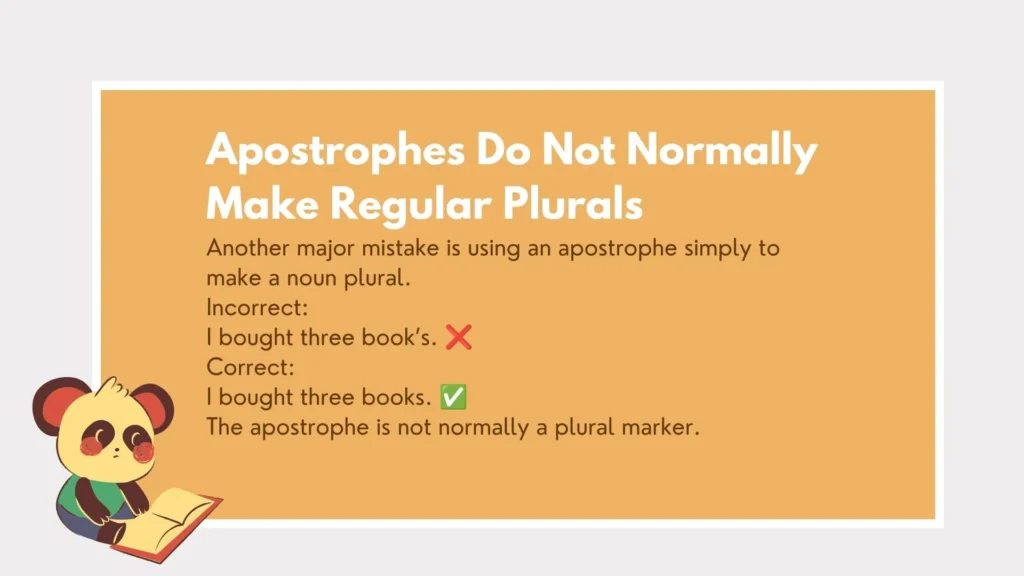
Another major mistake is using an apostrophe simply to make a noun plural.
Incorrect:
I bought three book’s. ❌
Correct:
I bought three books. ✅
The apostrophe is not normally a plural marker.
However, there are occasional situations where an apostrophe can improve clarity when pluralizing a letter, numeral, abbreviation, or unusual expression. Chicago discusses such special cases, while also noting that ordinary nouns normally form plurals without apostrophes.
For normal words, remember:
books, not book’s
students, not student’s
unless you actually mean possession.
Possessive Apostrophe vs. Plural Apostrophe
This distinction is worth memorizing.
Plural
students
Means more than one student.
Singular possessive
student’s
Means something associated with one student.
Plural possessive
students’
Means something associated with multiple students.
Look at all three together:
| Form | Meaning |
| student | one student |
| students | more than one student |
| student’s | belonging to/associated with one student |
| students’ | belonging to/associated with multiple students |
This four-form comparison can prevent a surprising number of apostrophe errors.
s’ or ’s: A 10-Second Decision Test
When you are writing and suddenly stop at an apostrophe, use this test.
Step 1: Find the noun
Example:
teachers
Step 2: Ask whether it is singular or plural
Teachers = plural.
Step 3: Does the plural already end in s?
Yes.
Step 4: Put the apostrophe after the s
teachers’
Now try:
child
Singular → child’s
Then:
children
Plural but does not end in s → children’s
The complete shortcut
One + ’s
Many + s → s’
Many + irregular plural → ’s
That is the practical rule to keep in your head.
A Simple Decision Tree
Use this whenever you are unsure:
Is the noun singular?
↓ Yes
Add ’s
teacher → teacher’s
↓ No
Is it a regular plural ending in s?
↓ Yes
Add only ’
teachers → teachers’
↓ No
Is it an irregular plural?
↓ Yes
Add ’s
children → children’s
This approach is much more reliable than simply looking at the last letter of the word.
Common Mistakes and How to Fix Them
| Incorrect | Correct | Reason |
| students’s | students’ | plural already ends in s |
| teachers’s | teachers’ | plural already ends in s |
| childrens’ | children’s | children is an irregular plural |
| teacher’ | teacher’s | singular noun |
| class’ | class’s in Chicago style | class is singular |
| book’s | books when simply plural | apostrophe isn’t normally a plural marker |
| it’s policy | its policy | its is possessive |
| your’s | yours | possessive pronouns do not take apostrophes |
The last example is especially useful because not every possessive form follows the noun-apostrophe pattern.
Possessive Pronouns Do Not Follow the ’s Rule
Some words already have their own possessive forms.
Correct:
This book is mine.
That car is yours.
The decision was theirs.
Not:
your’s ❌
their’s ❌
Cambridge specifically notes that possessive pronouns such as yours and theirs do not take an apostrophe.
So don’t assume:
“Possession = add ’s.”
The grammar of possessive pronouns works differently.
s’ or ’s With Joint Possession
Sometimes two people share ownership of the same thing.
For example:
John and Mary’s house
This normally means one house shared by John and Mary.
But compare:
John’s and Mary’s houses
This means John has one house and Mary has another.
The apostrophe placement can therefore communicate whether the possession is joint or separate.
Chicago discusses this distinction in its guidance on joint possession.
Shared possession
Tom and Sarah’s business
One business.
Separate possession
Tom’s and Sarah’s businesses
Different businesses.
This is an advanced but very practical use of possessive forms.
’s or Of: Do You Always Need an Apostrophe?
No.
English can express possession or association with ’s or an of construction in many contexts.
For example:
the company’s history
could sometimes be expressed as:
the history of the company
The better choice depends on the sentence, noun type, clarity, and style.
Possessive ’s is often natural with people, organizations, animals, time, and familiar relationships:
Sarah’s phone
the company’s website
the dog’s collar
The of construction can be useful when the noun phrase becomes long or complex.
The important point is that an apostrophe is one grammatical option, not the only way English can express a relationship. Cambridge covers both possessive ’s and of constructions.
A Real-World Editing Example
Imagine you’re editing a school website.
You write:
The students’s parents attended the teachers’s meeting.
At first glance, the sentence may look reasonable because you are thinking:
student → student’s
teacher → teacher’s
But the actual nouns are plural:
students
teachers
Therefore, the correct sentence is:
The students’ parents attended the teachers’ meeting.
Now imagine only one teacher organized the meeting:
The students’ parents attended the teacher’s meeting.
The difference is not merely punctuation. It changes who the noun refers to.
This is why identifying singular and plural forms before adding the apostrophe is such a useful editing habit.
A Practical Proofreading Method
When I check a possessive form, I don’t start by asking where the apostrophe “looks right.” I first remove the possessive ending and identify the base noun.
For example:
employees’
Remove the apostrophe:
employees
That’s plural and ends in s.
Therefore:
employees’
Now:
employee’s
Remove the possessive ending:
employee
That’s singular.
Therefore:
employee’s
This simple method is especially useful when proofreading articles, academic writing, website copy, business documents, and grammar exercises.
Common Misconceptions About s’ and ’s
“Any word ending in s should use s’.”
Not necessarily.
class → class’s
if it is singular.
“s’s is always wrong.”
Not exactly.
A form such as class’s contains an existing s plus the possessive ’s. It can therefore look like “s’s,” but the underlying noun is singular.
The important distinction is between:
class’s → singular class
and:
students’ → plural students
“An apostrophe means the word is plural.”
No.
An apostrophe usually indicates possession or contraction, not ordinary pluralization.
“Students’ means one student.”
No.
student’s = one student
students’ = multiple students
“Children’s must be wrong because children ends in n.”
No.
Children is an irregular plural, so:
children’s
is correct.
How to Choose the Correct Form Quickly
If you have only a few seconds, use this checklist:
1. Find the noun.
2. Make sure you know its plural form.
3. Ask whether the noun is singular or plural.
4. If singular, normally use ’s.
5. If plural and ending in s, use s’.
6. If plural but not ending in s, normally use ’s.
7. Check whether you are actually dealing with a contraction such as it’s.
8. For a person’s name ending in s, check the style guide if consistency matters.
This method is safer than memorizing isolated examples.
Quick Reference Chart
| Word | Singular/Plural | Possessive |
| student | singular | student’s |
| students | plural | students’ |
| teacher | singular | teacher’s |
| teachers | plural | teachers’ |
| class | singular | class’s |
| classes | plural | classes’ |
| child | singular | child’s |
| children | plural | children’s |
| man | singular | man’s |
| men | plural | men’s |
| woman | singular | woman’s |
| women | plural | women’s |
| James | singular name | James’s under Chicago style |
| it | pronoun | its |
| it is | contraction | it’s |
Frequently Asked Questions
Is it s’ or s’s?
For an ordinary plural noun ending in s, use s’, not s’s.
students’ books ✅
students’s books ❌
But a singular noun ending in s may take ’s, producing a form such as class’s.
Is students’ or student’s correct?
Both are correct in different situations.
student’s = one student
students’ = multiple students
Is students’s ever correct?
For the ordinary possessive of the plural noun students, no. The standard form is students’.
Is class’ or class’s correct?
For a singular noun such as class, class’s is the standard form in Chicago style. Some style traditions may use a different convention, so follow the style required for your publication or institution.
Is James’ or James’s correct?
Both forms can be encountered, depending on the style. Chicago currently recommends James’s for a singular person’s name ending in s.
Is children’s or childrens’ correct?
Children’s is correct.
children’s books ✅
Children is already the plural of child, so childrens is not the standard plural.
What is the difference between teachers’ and teacher’s?
teacher’s = belonging to or associated with one teacher
teachers’ = belonging to or associated with multiple teachers
Does an apostrophe make a noun plural?
Normally, no.
students = plural
student’s = possessive singular
An apostrophe should not normally be added simply to create a regular plural.
Why is it its and not it’s?
Its is possessive.
The company changed its name.
It’s means it is or it has.
It’s a new company.
What is the easiest way to remember possessive apostrophes?
Use this:
Singular → ’s
Plural ending in s → s’
Irregular plural → ’s
Then check special cases such as names ending in s, possessive pronouns, and contractions.
Key Takeaways
The confusion around s’ or s’s becomes much easier once you stop judging the word by its final letter.
The real question is:
Is the noun singular or plural?
Remember these core patterns:
- student’s → one student
- students’ → multiple students
- class’s → one class
- classes’ → multiple classes
- child’s → one child
- children’s → multiple children
- James’s → singular name under Chicago style
- its → possessive pronoun
- it’s → it is / it has
And the most important correction for the focus keyword is:
students’ ✅
students’s ❌
Once you identify the noun first, apostrophe placement becomes a much more logical process instead of a punctuation guess.

I’m Daniel Brooks, and I enjoy helping pet owners discover names that perfectly fit their new companions. Whether it’s a playful puppy, a curious cat, a colorful bird, or an exotic pet, I believe every animal deserves a name with character and meaning. At Meanixo, I focus on creating well-organized, easy-to-read pet name collections that make the naming process enjoyable.
I constantly research naming trends, cultures, and language meanings so readers can find names they’ll love for years to come.
Books:
- Modern Pet Naming Guide
- The Ultimate Book of Animal Names
 Michael Turner
 Sophia Mitchell