
If you’re unsure whether to write requester or requestor, you’re not alone. Both spellings appear in English, especially in business communication, legal documents, technical writing, and administrative systems. The difference is subtle, but choosing the right form can make your writing clearer and more consistent.
The short answer is that requester is the more common spelling in general English, while requestor is also an accepted variant, particularly in some legal, technical, and specialized contexts. Both refer to a person who makes a request. Your best choice depends on your audience, the document you’re writing, and any style rules you need to follow.
Requester vs. Requestor: Quick Comparison
| Feature | Requester | Requestor |
| Meaning | Someone who makes a request | Someone who makes a request |
| Correct spelling? | Yes | Yes |
| General English | Preferred choice | Less common variant |
| Business writing | Common and natural | Acceptable |
| Legal writing | Used | Used in some defined terms |
| Technical writing | Common | Used in some systems |
| Pronunciation | /rɪˈkwes.tər/ (US) | Usually the same |
| Plural | Requesters | Requestors |
| Best use | General writing | Established terminology |
Cambridge Dictionary lists requestor as another form of requester, confirming that both spellings are accepted.
English meaning – Cambridge Dictionary
+1
What Does “Requester” Mean?
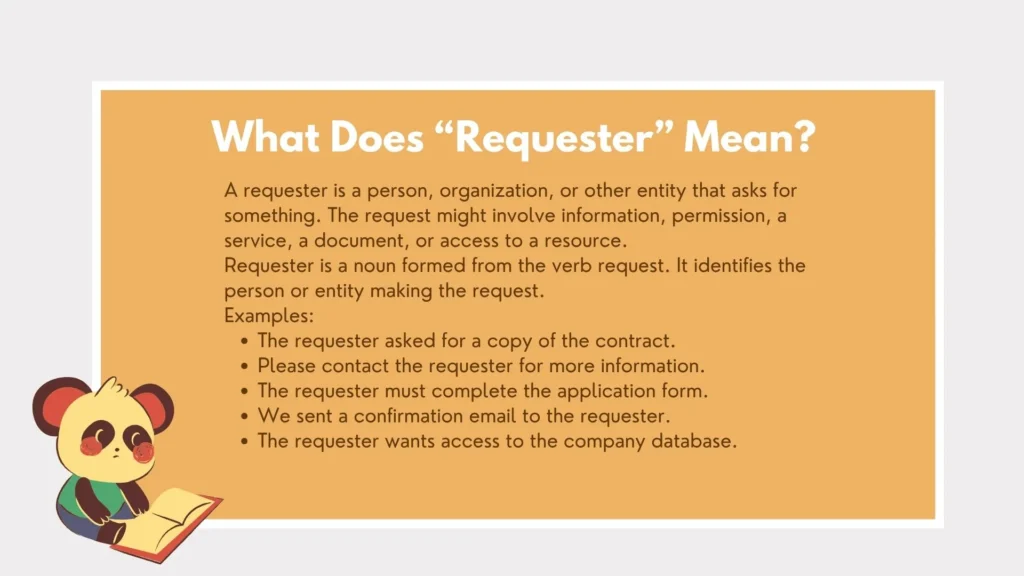
A requester is a person, organization, or other entity that asks for something. The request might involve information, permission, a service, a document, or access to a resource.
Requester is a noun formed from the verb request. It identifies the person or entity making the request.
Examples:
- The requester asked for a copy of the contract.
- Please contact the requester for more information.
- The requester must complete the application form.
- We sent a confirmation email to the requester.
- The requester wants access to the company database.
- Each requester will receive a reference number.
- The requester submitted the documents before the deadline.
- The manager contacted the requester to clarify the details.
- The requester’s identity must be verified.
- Every requester should receive a response within five working days.
In each sentence, requester identifies the person or entity initiating the request.
How to use “requester” in business writing
Requester works particularly well in everyday professional communication because its meaning is clear.
For example:
- Email: Please let the requester know when the application has been approved.
- Customer service: The requester will receive an update once the issue is resolved.
- Administration: The requester must provide the required identification.
- Human resources: The requester submitted a leave application yesterday.
- Records management: The requester asked for access to the archived files.
If you’re writing an email, report, article, or general business document, requester is a sensible default.
What Does “Requestor” Mean?
A requestor is someone or something that makes a request. Its basic meaning is the same as requester.
The spelling appears in certain legal, administrative, and technical contexts. It can also be used when a company or software platform has adopted it as its official terminology.
Examples:
- The requestor must provide a valid identification number.
- The requestor submitted the access request through the portal.
- The system records the requestor’s details.
- The requestor will be notified when the transaction is complete.
- The requestor must obtain approval before proceeding.
- The requestor’s account has been temporarily restricted.
- Please verify the requestor’s authorization.
- The application stores the requestor ID in its database.
- The requestor is responsible for supplying accurate information.
- The requestor may appeal the decision under the applicable procedure.
These examples demonstrate how requestor can be used grammatically in a sentence. They don’t mean the spelling is mandatory in these fields; the established terminology of the relevant organization or document determines the preferred form.
Is “requestor” a misspelling?
No. Requestor is an accepted spelling variant, not automatically a spelling mistake.
A spellchecker might flag it because its dictionary prefers requester or does not recognize the alternative. That doesn’t make requestor incorrect in every context.
If you encounter requestor in a legal document, application, or technical manual, check the surrounding terminology before changing it.
Requester vs. Requestor: What Is the Difference in Meaning?
In ordinary usage, there is no essential difference in meaning between requester and requestor. Both identify the person or entity making a request.
The distinction is mainly spelling preference and context.
Consider these sentences:
- The requester asked for permission to access the files.
- The requestor asked for permission to access the files.
Both communicate the same basic idea.
However, a specialized document may define Requestor as a particular role or party. In that situation, the term should be interpreted according to the document’s definition rather than general English usage.
The key is to distinguish a spelling variant from a genuine difference in meaning. Unlike requester and requestor, some similar-looking word pairs have entirely different definitions.
Requester or Requestor in British and American English?
Neither spelling represents a straightforward British-versus-American distinction like colour and color.
Both requester and requestor can be encountered in English-language material, including American and British contexts. The choice is more closely related to usage preferences and specialized terminology than to a strict regional spelling rule.
| Context | Recommended choice |
| General American English | Requester |
| General British English | Requester |
| Australian English | Requester is a suitable general-purpose choice |
| Canadian English | Requester is a suitable general-purpose choice |
| Legal or government terminology | Follow the relevant document |
| Company or software terminology | Follow the established spelling |
These are practical recommendations, not absolute rules for every publication or organization.
If a British company uses Requestor in its internal software, there’s no need to change it simply because another variety of English generally favors requester.
The best rule: use requester for general writing unless an established style guide, legal definition, or technical system specifies requestor.
Requester vs. Requestor: Pronunciation
Requester and requestor are generally pronounced alike or very similarly. The difference is primarily written rather than spoken.
Cambridge Dictionary gives the following pronunciations for requester:
Pronunciation in English
- British English: /rɪˈkwes.tə/
- American English: /rɪˈkwes.tɚ/
A simple pronunciation guide is ri-KWES-ter.
The word has three syllables:
- re — a short opening sound
- quest — the stressed syllable
- er — the final syllable
The main stress falls on quest. In American English, the final r is usually pronounced clearly. In many British accents, the final r is not pronounced unless the following sound connects it to another word.
The spelling ending -or in requestor does not automatically create a different pronunciation.
Requester vs. Requestee: What Is the Difference?
Requester and requestee are related words, but they describe different roles.
- Requester: the person or entity making the request.
- Requestee: the person or entity being asked or receiving the request.
For example, imagine an employee asking the IT department for access to a new application.
The employee is the requester because they initiate the request. The IT department may be described as the requestee if it is the party receiving the request.
| Term | Role | Example |
| Requester | Makes the request | The employee requests access. |
| Requestor | Alternative spelling for requester | The requestor submits the access form. |
| Requestee | Receives the request | The department receives the access request. |
The word requestee is less common and may not be the preferred term in every workflow. In technical or administrative documentation, terms such as recipient, approver, service provider, or respondent may be more precise, depending on the role.
Don’t confuse the person making a request with the person receiving or handling it.
Requester vs. Requestor: Singular, Plural, and Possessive Forms
Both spellings follow ordinary English noun rules.
| Grammatical form | Requester | Requestor |
| Singular | Requester | Requestor |
| Plural | Requesters | Requestors |
| Singular possessive | Requester’s | Requestor’s |
| Plural possessive | Requesters’ | Requestors’ |
Singular examples
- The requester needs additional information.
- The requestor has submitted the application.
Plural examples
- The requesters are waiting for approval.
- The requestors will receive separate notifications.
Possessive examples
- The requester’s application is incomplete.
- The requestor’s identification number is missing.
- The requesters’ applications have been reviewed.
- The requestors’ accounts are ready for verification.
Remember that the apostrophe indicates possession, not plurality.
Requesters means more than one requester, while requester’s means something belonging to one requester.
Common Mistakes When Using Requester and Requestor
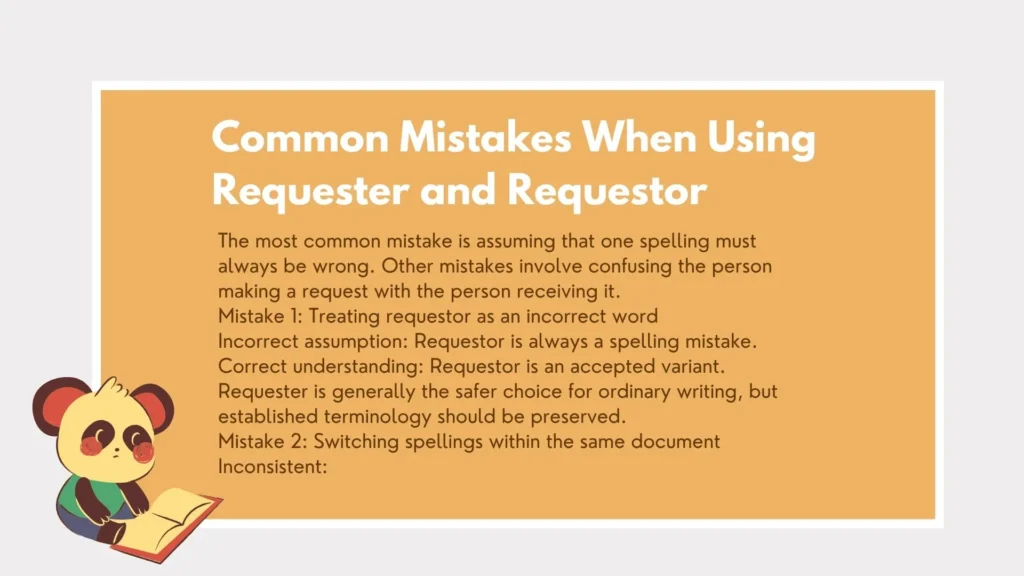
The most common mistake is assuming that one spelling must always be wrong. Other mistakes involve confusing the person making a request with the person receiving it.
Mistake 1: Treating requestor as an incorrect word
Incorrect assumption: Requestor is always a spelling mistake.
Correct understanding: Requestor is an accepted variant. Requester is generally the safer choice for ordinary writing, but established terminology should be preserved.
Mistake 2: Switching spellings within the same document
Inconsistent:
- The requester submitted the form.
- The requestor received a confirmation.
- The requester must now wait for approval.
Better:
- The requester submitted the form.
- The requester received a confirmation.
- The requester must now wait for approval.
Consistency makes the document easier to read. If you’re documenting a system that officially uses requestor, use that spelling consistently instead.
Mistake 3: Confusing requester with requestee
Incorrect: The requester is always the person receiving the request.
Correct: The requester makes the request. The requestee is the person or entity being asked.
For instance, when a customer asks a company for a refund, the customer is the requester. The company receives the request.
Mistake 4: Assuming requestor is more formal
Incorrect assumption: Requestor is always more professional than requester.
Correct understanding: Both can appear in professional writing. Formality depends on the document, audience, and terminology—not simply the suffix.
Mistake 5: Changing official technical labels
Incorrect approach: Replacing every occurrence of Requestor ID with Requester ID in documentation without checking the application.
Better approach: Match the actual field name or use the organization’s terminology guide. This prevents mismatches between documentation and software.
Frequently Asked Questions
1. Is requester or requestor correct?
Both are correct. Requester is generally preferred for ordinary English, while requestor is an accepted alternative that may be used in legal, technical, and organization-specific contexts.
2. Is requestor a real English word?
Yes. Requestor is a recognized spelling variant of requester. It isn’t automatically a typo, although some writing tools may prefer requester.
3. Is requester more common than requestor?
Requester is the better general-purpose choice and is widely used in everyday and professional English. Requestor is less common overall but remains established in some specialized contexts.
4. Should I use requester or requestor in a business email?
Use requester unless your company has a preferred spelling or the email refers to a field, role, or process officially called requestor.
For example: “The requester will receive an email once the approval process is complete.”
5. Is requestor used in legal documents?
Yes. Requestor appears in some legal, regulatory, and administrative documents, particularly where a specific term is defined. Follow the exact wording of the relevant document.
6. Are requester and requestor pronounced the same?
They are generally pronounced the same or very similarly. The main distinction is spelling, not pronunciation.
7. What is the plural of requester?
The plural is requesters. For example: “All requesters must provide a valid email address.”
8. What is the plural of requestor?
The plural is requestors. For example: “The requestors will receive a notification when their applications are processed.”
9. What is the difference between requester and requestee?
A requester makes the request, while a requestee receives it. The terms describe different roles rather than alternative spellings of the same word.
10. Is requester correct in British English?
Yes. Requester is suitable in British English. Requestor may also appear in particular documents or specialized contexts, so follow the relevant organization’s preferred terminology.
Conclusion
Both requester and requestor are correct English spellings for someone who makes a request. The main difference is how they are used, not what they mean.
Choose requester for everyday writing, business emails, general articles, and communication with a broad audience. Choose requestor when a legal document, company policy, or technical system already uses that form.
If you’re unsure, requester is the simplest and most reliable default. Above all, keep your spelling consistent and follow any terminology requirements that apply to your work.

I’m Daniel Brooks, and I enjoy helping pet owners discover names that perfectly fit their new companions. Whether it’s a playful puppy, a curious cat, a colorful bird, or an exotic pet, I believe every animal deserves a name with character and meaning. At Meanixo, I focus on creating well-organized, easy-to-read pet name collections that make the naming process enjoyable.
I constantly research naming trends, cultures, and language meanings so readers can find names they’ll love for years to come.
Books:
- Modern Pet Naming Guide
- The Ultimate Book of Animal Names
 Michael Turner
 Sophia Mitchell