If you’re learning Spanish, por or para can be surprisingly confusing. Both words are prepositions, and both can sometimes be translated into English as “for.” That doesn’t mean they are interchangeable, though.
The easiest way to understand the difference is to stop translating the English word “for” directly. Instead, look at the relationship you’re expressing.
In general, por is commonly used for ideas such as cause, reason, duration, movement through a place, exchange, means, and approximate time. Para is commonly used for purpose, destination, recipient, deadlines, intended use, and a point of view.
For example:
- Gracias por tu ayuda. — Thank you for your help.
- Este regalo es para Ana. — This gift is for Ana.
- Estudié por dos horas. — I studied for two hours.
- Estudio para el examen. — I study for the exam.
The English translation uses “for” in all four examples, but Spanish uses por or para according to the meaning.
Por or Para: The Quick Answer
Por and para are both correct Spanish words. The right choice depends on what you mean.
A useful starting point is this:
| Meaning or function | Use | Example |
| Cause or reason | por | Lo hice por ti. |
| Duration | por | Estudié por dos horas. |
| Movement through an area | por | Caminamos por el parque. |
| Exchange | por | Pagué $20 por el libro. |
| Means or method | por | Hablamos por teléfono. |
| Approximate time | por | Llegó por las ocho. |
| Purpose | para | Estudio para aprender. |
| Destination | para | Salimos para Madrid. |
| Recipient | para | El regalo es para Ana. |
| Deadline | para | Es para mañana. |
| Intended use | para | Es una herramienta para cortar. |
| Point of view | para | Para mí, es correcto. |
These aren’t every possible use of the two prepositions, but they cover many of the situations that cause learners the most confusion.
How to Know When to Use Por or Para
Instead of memorizing dozens of disconnected rules, ask yourself a few questions.
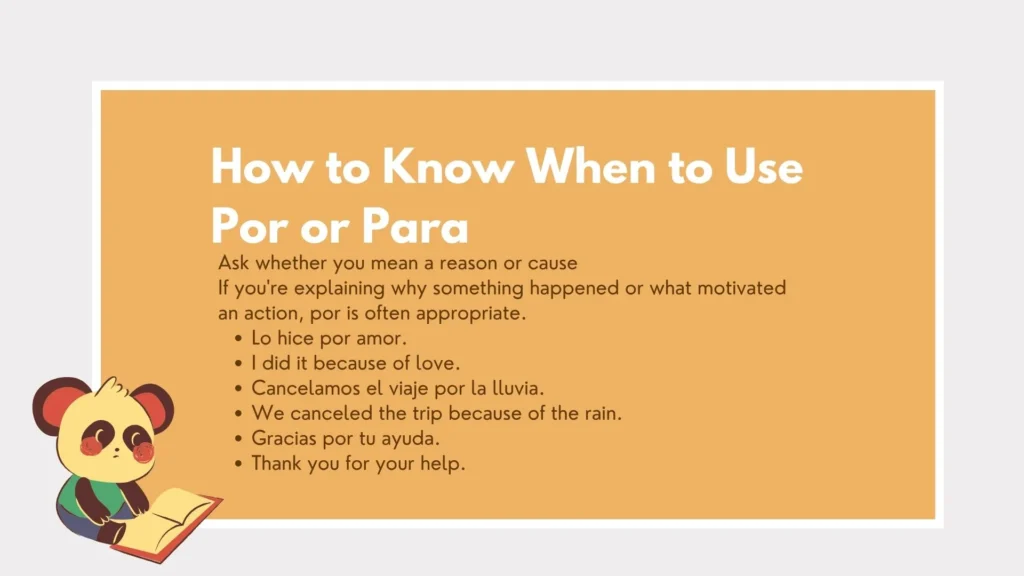
Ask whether you mean a reason or cause
If you’re explaining why something happened or what motivated an action, por is often appropriate.
- Lo hice por amor.
I did it because of love. - Cancelamos el viaje por la lluvia.
We canceled the trip because of the rain. - Gracias por tu ayuda.
Thank you for your help.
Think:
Why did it happen? → por
Ask whether you mean a purpose or goal
If you’re explaining what someone wants to accomplish, use para.
- Estudio español para aprender.
- Trabajo para ahorrar dinero.
- Salimos temprano para evitar el tráfico.
Think:
What is the goal? → para
Ask whether you’re describing how long something lasts
For a straightforward period of duration, por is commonly used.
- Estudié por dos horas.
- Vivieron allí por cinco años.
- Esperamos por veinte minutos.
Think:
How long? → por
Ask whether you’re giving a deadline
When something needs to be completed by a particular time, use para.
- Necesito el informe para el viernes.
- La tarea es para mañana.
- Debes terminarlo para las cinco.
Think:
By when? → para
Ask whether you’re moving through a place or going to a destination
This is another useful distinction.
Por can describe movement through, around, or within an area:
- Caminamos por el parque.
- Paseamos por la ciudad.
- Viajamos por España.
Para can identify a destination or intended destination:
- Salimos para Madrid.
- El tren sale para Sevilla.
- Mañana viajamos para México.
Think:
Through/around where? → por
Where to? → para
Ask whether something is exchanged
When one thing is exchanged for another, por is commonly used.
- Pagué $30 por el libro.
- Cambié mi bicicleta por una computadora.
- Te doy diez dólares por ese teléfono.
Think:
What did you give in exchange? → por
Ask whether something is intended for someone
When you identify the person who is supposed to receive or use something, use para.
- Este regalo es para María.
- Compré flores para mi madre.
- Tengo una carta para ti.
Think:
Who is it intended for? → para
This is one of the clearest examples of why English “for” cannot simply be translated word for word.
When to Use Por in Spanish
Por has several important uses. Learning the underlying idea behind each one is more useful than memorizing isolated sentences.
Por for cause or reason
Use por when something happens because of a particular reason or cause.
- Lo hice por ti.
- No salimos por la lluvia.
- Lo hizo por amor.
- Lucharon por su familia.
Compare this with purpose:
- Lo hice por ti. → You were the reason, motivation, or person on whose behalf I did it.
- Lo hice para ti. → I did it with you as the intended recipient or beneficiary.
Context can affect the exact interpretation.
Por for duration
Use por to express a period during which an action continues.
- Trabajé por tres horas.
- Vivimos allí por un año.
- Esperé por media hora.
- Estudiaron por toda la tarde.
The important question is:
How long did it last?
That points toward por.
Por for movement through or around a place
Use por when you are talking about moving through an area, around a location, or along a route.
- Caminamos por el centro.
- Paseamos por el parque.
- Condujimos por la ciudad.
- Viajaron por Europa.
This is different from a destination.
- Caminamos por Madrid. → We walked around/through Madrid.
- Salimos para Madrid. → We left for Madrid.
Por for exchange
Use por when something is exchanged for something else.
- Pagué $20 por el libro.
- Compré la camisa por $40.
- Cambió su bicicleta por una motocicleta.
The basic idea is:
one thing in exchange for another → por
Por for means or method
Por can identify the means or method used to communicate, travel, send something, or accomplish an action.
Examples include:
- por teléfono
- por correo
- por Internet
- por escrito
- por tren
For example:
- Hablamos por teléfono.
- Te enviaré el documento por correo.
- Lo compré por Internet.
- Prefiero comunicarme por escrito.
Por for approximate time
Use por when referring to an approximate time rather than a firm deadline.
- Llegó por las ocho.
- Nos vemos por la tarde.
- Trabajo por la mañana.
- Estaré allí por las seis.
Compare:
- Llegaré por las ocho. → I’ll arrive around eight.
- Necesito que llegues para las ocho. → I need you to arrive by eight.
Por with passive agents
In passive constructions, por can introduce the person or thing that performs the action.
- El libro fue escrito por una autora española.
- La canción fue compuesta por un músico mexicano.
- La casa fue diseñada por un arquitecto famoso.
Here, por identifies the agent responsible for the action.
Por for rates and distribution
Por is also used in expressions involving rates, proportions, or distribution.
- Dos veces por semana.
- Diez dólares por persona.
- Cien kilómetros por hora.
- Tres clases por mes.
The idea is often similar to “per” in English.
When to Use Para in Spanish
Para commonly points toward a goal, destination, recipient, deadline, or intended function.
Para for purpose
Use para when you explain the purpose of an action.
- Estudio para aprender español.
- Trabajo para ganar dinero.
- Fui al supermercado para comprar leche.
- Salimos temprano para evitar el tráfico.
A particularly useful pattern is:
para + infinitive = in order to
For example:
- Practico todos los días para mejorar.
- Leo en español para aprender vocabulario.
- Ahorramos dinero para viajar.
Para for destination
Use para when describing a destination or intended destination.
- Salimos para Madrid.
- El avión sale para México.
- Mañana viajamos para Barcelona.
The contrast with por is important:
- Caminamos por Madrid. → We walked around/through Madrid.
- Salimos para Madrid. → We left for Madrid.
Para for recipients
Use para when something is intended for a person.
- Este regalo es para Ana.
- La carta es para mi padre.
- Compré un café para mi amiga.
- Esto es para ti.
The recipient rule is especially useful when English makes the distinction less obvious.
Para for deadlines
Use para when something is expected or required by a particular time.
- El proyecto es para el lunes.
- Necesito el documento para mañana.
- La tarea debe estar lista para las cinco.
This is different from duration:
- Trabajé por tres horas. → duration
- El trabajo es para mañana. → deadline
Para for intended use
Use para when describing what something is designed, intended, or suitable for.
- Esta herramienta es para cortar madera.
- Necesito una bolsa para libros.
- Es una aplicación para aprender idiomas.
- Compré zapatos para correr.
The idea is:
What is it intended to be used for? → para
Para for a point of view or standard
Para can introduce a person’s viewpoint or a standard against which something is considered.
- Para mí, es una buena idea.
- Para ella, la decisión fue difícil.
- Para un niño, este libro puede ser complicado.
Here, para can be understood as “from the perspective of” or “as judged by.”
Para with employment or affiliation
Para can also identify the person, organization, or company someone works for.
- Trabajo para una empresa internacional.
- Ella trabaja para una organización educativa.
- Mi hermano trabaja para una compañía de tecnología.
This use is different from expressing a purpose.
Why English “For” Can Mean Por or Para
One of the biggest reasons por or para is difficult for English speakers is that English often uses one word—for—where Spanish uses two different prepositions.
Consider these sentences:
- Thanks for your help.
- This gift is for Maria.
- I studied for two hours.
- I studied for the exam.
- I paid $20 for the book.
The English word is the same, but the Spanish relationships are different.
| English idea | Spanish | Reason |
| Thanks for your help | Gracias por tu ayuda | Cause/reason |
| This is for Maria | Esto es para María | Recipient |
| I studied for two hours | Estudié por dos horas | Duration |
| I studied for the exam | Estudié para el examen | Purpose |
| I paid $20 for the book | Pagué $20 por el libro | Exchange |
So don’t ask:
“What is the Spanish word for English for?”
Instead ask:
“What does for mean in this particular sentence?”
That question will usually lead you toward the correct Spanish preposition.
Por + Infinitive vs. Para + Infinitive
This is an especially useful distinction for Spanish learners.
Por + infinitive
Por + infinitive can explain a reason, cause, or basis for an action.
- Gracias por venir.
- Gracias por ayudarme.
- Perdón por llegar tarde.
- Te felicito por ganar.
For example:
Gracias por ayudarme.
The help is the reason for the speaker’s thanks.
Para + infinitive
Para + infinitive commonly expresses purpose.
- Estudio para aprender.
- Trabajo para ahorrar.
- Practico para mejorar.
- Salí temprano para evitar el tráfico.
For example:
Estudio para aprender español.
Learning Spanish is the purpose of studying.
Compare Them Directly
- Gracias por ayudarme.
→ Thank you for helping me. - Estudio para ayudarte.
→ I study in order to help you.
A useful memory rule is:
por + infinitive → reason/basis
para + infinitive → purpose/goal
This is a helpful pattern, although context always matters.
Por vs. Para for Time
Time is one of the areas where learners frequently mix up the two prepositions.
Por for duration
Use por when you’re describing how long something lasts.
- Estudié por dos horas.
- Trabajó por toda la noche.
- Vivimos allí por cinco años.
Para for a deadline
Use para when you’re identifying when something needs to be completed or ready.
- Es para mañana.
- Lo necesito para el viernes.
- Debe estar listo para las ocho.
Por for approximate time
Use por when the time is approximate.
- Llegaré por las ocho.
- Nos vemos por la tarde.
- Llegaron por la mañana.
Compare:
Llegaré por las ocho.
I’ll arrive around eight.
Lo necesito para las ocho.
I need it by eight.
The difference is:
around a time → por
by a time → para
Gracias Por or Gracias Para?
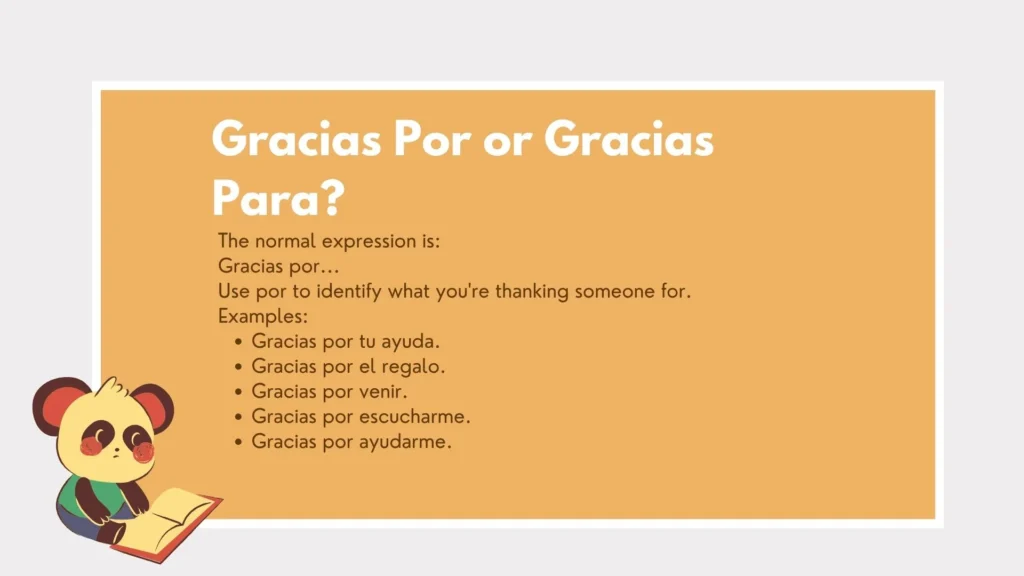
The normal expression is:
Gracias por…
Use por to identify what you’re thanking someone for.
Examples:
- Gracias por tu ayuda.
- Gracias por el regalo.
- Gracias por venir.
- Gracias por escucharme.
- Gracias por ayudarme.
Why Is It “Gracias Por”?
The phrase introduces the reason or basis for the gratitude.
For example:
Gracias por ayudarme.
The speaker is thanking someone because they helped.
Therefore:
Gracias por tu ayuda. ✓
Gracias para tu ayuda. ✗
For ordinary expressions of thanks, gracias por is the construction to remember.
Is Destination Por or Para?
For a destination, para is generally the appropriate choice.
- Voy para Madrid.
- Salimos para Sevilla.
- El tren parte para Barcelona.
But por can be used when the idea is movement through or around a place:
- Caminamos por Madrid.
- Viajamos por España.
- Pasamos por el centro.
A useful conceptual distinction is:
Destination or endpoint → para
Route or area traveled through → por
Is Duration Por or Para?
For a straightforward duration, use por.
- Estudié por tres horas.
- Vivió allí por diez años.
- Esperamos por media hora.
If you’re giving a deadline instead, use para:
- La tarea es para mañana.
- El informe es para el viernes.
So remember:
How long? → por
By when? → para
Is Purpose Por or Para?
For purpose, use para.
- Trabajo para ahorrar.
- Estudio para aprender.
- Fui allí para hablar con ella.
- Compré una computadora para estudiar.
When you can naturally replace the idea with “in order to,” para is often the right choice.
Is Recipient Por or Para?
For a recipient or intended person, use para.
- El regalo es para Juan.
- Compré flores para mi madre.
- Tengo una carta para ti.
Think:
Who is supposed to receive it? → para
Is Deadline Por or Para?
For a deadline, use para.
- Lo necesito para mañana.
- La tarea es para el lunes.
- Debes terminarlo para las seis.
Don’t confuse this with duration:
- Trabajé por seis horas.
- Trabajé para el lunes.
The first tells us how long you worked. The second identifies a deadline.
Is Exchange Por or Para?
For an exchange, use por.
- Pagué $50 por los zapatos.
- Cambié mi bicicleta por una computadora.
- Te doy diez dólares por el libro.
The basic relationship is:
A in exchange for B → por
Compare that with a recipient:
- Compré flores para María. → Maria is the recipient.
- Pagué $20 por las flores. → $20 was exchanged for the flowers.
Por or Para Siempre?
The familiar everyday expression meaning “forever” is:
para siempre
Examples:
- Te recordaré para siempre.
- Seremos amigos para siempre.
- Quiero guardar este recuerdo para siempre.
You may also encounter por siempre, especially in literary, poetic, formal, or regional contexts. It can express a similar idea.
Therefore, don’t treat por siempre as an automatic spelling or grammar error. For ordinary learners looking for the most familiar expression, para siempre is the form to recognize first.
Por or Para: Side-by-Side Examples
The fastest way to understand the difference is often to compare similar sentences.
Cause vs. purpose
- Lo hice por amor.
→ I did it because of love. - Lo hice para ayudarte.
→ I did it in order to help you.
Por explains the reason; para explains the purpose.
Duration vs. deadline
- Estudié por tres horas.
→ I studied for three hours. - El examen es para el viernes.
→ The exam is for Friday / due Friday.
Por tells you how long; para gives the target time.
Route vs. destination
- Caminamos por el parque.
- Salimos para el parque.
The first describes movement through or around the park. The second identifies the destination.
Exchange vs. recipient
- Pagué $30 por el regalo.
- Compré el regalo para Ana.
Por identifies the exchange. Para identifies the intended recipient.
Approximate time vs. deadline
- Llegaré por las ocho.
- Necesito que llegues para las ocho.
The first means around eight. The second means no later than eight.
Por or Para Examples
Examples With Por
- Gracias por tu ayuda.
- Caminamos por el centro.
- Estudié por dos horas.
- Pagué $25 por el libro.
- Lo hice por amor.
- Hablamos por teléfono.
- Llegó por las siete.
- Viajaron por España.
- El libro fue escrito por una autora mexicana.
- Dos veces por semana practico español.
Examples With Para
- Este regalo es para ti.
- Estudio para aprender español.
- Salimos para Madrid.
- Necesito el informe para mañana.
- Compré flores para mi madre.
- Esta aplicación es para aprender idiomas.
- Practico para mejorar mi pronunciación.
- El tren sale para Sevilla.
- Para mí, es una buena idea.
- Trabajo para una empresa internacional.
Common Por and Para Mistakes
Mistake: “Gracias para”
Incorrect:
Gracias para tu ayuda.
Correct:
Gracias por tu ayuda.
Use por because the help is the reason for the thanks.
Mistake: Using por for a deadline
Incorrect for the intended deadline meaning:
Necesito el documento por mañana.
Correct:
Necesito el documento para mañana.
The deadline is para mañana.
Mistake: Using para for duration
Incorrect for the intended duration meaning:
Estudié para dos horas.
Correct:
Estudié por dos horas.
The phrase describes how long the studying lasted.
Mistake: Translating every English “for” as por
English:
This gift is for Maria.
Spanish:
Este regalo es para María.
But:
Thank you for the gift.
Spanish:
Gracias por el regalo.
The same English preposition does not produce the same Spanish preposition.
Mistake: Confusing route and destination
Compare:
Caminamos por la ciudad.
and:
Salimos para la ciudad.
The first focuses on the area through which you move. The second focuses on where you’re headed.
A Simple Por and Para Memory Trick
A practical beginner shortcut is to remember two groups.
Think POR: Reason, Route, Duration, Exchange
Reason
- Lo hice por ti.
Route
- Caminamos por el parque.
Duration
- Trabajé por tres horas.
Exchange
- Pagué $20 por el libro.
You can also add means, approximate time, passive agent, and rates to your understanding of por.
Think PARA: Purpose, Destination, Recipient, Deadline
Purpose
- Estudio para aprender.
Destination
- Salimos para Madrid.
Recipient
- Es para Ana.
Deadline
- Es para mañana.
You can also remember intended use, point of view, and employment/affiliation as common uses of para.
This memory trick is a starting point, not a complete grammar rule. When a sentence feels uncertain, return to the meaning and context.
Por vs. Para Cheat Sheet
Keep this quick reference in mind:
| If you mean… | Choose |
| Why? / because of what? | por |
| How long? | por |
| Through or around where? | por |
| In exchange for what? | por |
| By what means? | por |
| Around what time? | por |
| Who performed the passive action? | por |
| What is the purpose? | para |
| Where are you headed? | para |
| Who is the recipient? | para |
| By what deadline? | para |
| What is something intended to be used for? | para |
| From whose point of view? | para |
| Who do you work for? | para |
Por or Para Quiz
Test yourself before looking at the answers.
- Gracias ___ tu ayuda.
- Este regalo es ___ mi hermana.
- Estudié ___ dos horas.
- Salimos ___ Madrid mañana.
- Pagué $40 ___ los zapatos.
- Trabajo ___ ahorrar dinero.
- Caminamos ___ el parque.
- Necesito el informe ___ el viernes.
- Llegaré ___ las ocho.
- Practico español ___ mejorar mi pronunciación.
- Hablamos ___ teléfono.
- El libro fue escrito ___ una autora española.
- Compré flores ___ mi madre.
- Viajamos ___ España durante el verano.
- El proyecto debe estar listo ___ mañana.
Quiz Answers
- por — Gracias por tu ayuda.
The help is the reason for the thanks. - para — Este regalo es para mi hermana.
Your sister is the intended recipient. - por — Estudié por dos horas.
This expresses duration. - para — Salimos para Madrid mañana.
Madrid is the destination. - por — Pagué $40 por los zapatos.
The shoes were obtained in exchange for money. - para — Trabajo para ahorrar dinero.
Saving money is the purpose. - por — Caminamos por el parque.
The park is the area through which you move. - para — Necesito el informe para el viernes.
Friday is the deadline. - por — Llegaré por las ocho.
The time is approximate. - para — Practico español para mejorar mi pronunciación.
Improving pronunciation is the purpose. - por — Hablamos por teléfono.
The phone is the means of communication. - por — El libro fue escrito por una autora española.
The author is the agent performing the action. - para — Compré flores para mi madre.
Your mother is the intended recipient. - por — Viajamos por España durante el verano.
Spain is the area through which you traveled. - para — El proyecto debe estar listo para mañana.
Tomorrow is the deadline.
Frequently Asked Questions About Por or Para
Is por or para used for purpose?
Para is normally used for purpose.
- Estudio para aprender español.
- Trabajo para ganar dinero.
- Salí temprano para evitar el tráfico.
A useful test is whether the idea can be expressed as “in order to.”
Is destination por or para?
Para is generally used for a destination.
- Salimos para Madrid.
- El avión sale para México.
Use por when describing movement through or around a place:
- Caminamos por Madrid.
Is duration por or para?
For a straightforward duration, use por.
- Estudié por dos horas.
- Vivimos allí por cinco años.
For a deadline, use para:
- El trabajo es para el lunes.
Is recipient por or para?
Use para for a recipient.
- Este regalo es para Ana.
- La carta es para mi padre.
Is exchange por or para?
Use por for an exchange.
- Pagué $20 por el libro.
- Cambié mi bicicleta por una computadora.
Is time por or para?
Both can be used with time, but the meaning changes.
Por can indicate duration or approximate time:
- Estudié por dos horas.
- Llegaré por las ocho.
Para can indicate a deadline:
- Lo necesito para las ocho.
Is “gracias por” or “gracias para” correct?
The standard expression is gracias por.
- Gracias por venir.
- Gracias por tu ayuda.
- Gracias por el regalo.
Is “para siempre” or “por siempre” correct?
Para siempre is the familiar everyday expression meaning “forever.”
- Te recordaré para siempre.
Por siempre can also occur, particularly in literary, poetic, formal, or regional usage.
Can por and para be used interchangeably?
Usually not. Although both can correspond to English “for,” they generally express different relationships.
For example:
- Gracias por tu ayuda.
- Este regalo es para ti.
The correct choice depends on the meaning of the sentence.
How can I quickly remember por and para?
Start with these two groups:
POR: reason, route, duration, exchange, means, approximate time.
PARA: purpose, destination, recipient, deadline, intended use.
Then ask yourself what relationship the preposition is expressing rather than translating the English word “for” directly.
Conclusion
The difference between por and para becomes much easier once you stop treating them as two interchangeable translations of the English word “for.”
Instead, focus on the relationship expressed by the sentence.
Remember the most useful patterns:
- Reason or cause → por
- Duration → por
- Movement through an area → por
- Exchange → por
- Means → por
- Approximate time → por
- Purpose → para
- Destination → para
- Recipient → para
- Deadline → para
- Intended use → para
- Point of view → para
The quickest mental checklist is:
Why? → por
How long? → por
Through where? → por
In exchange for what? → por
For what purpose? → para
Where to? → para
For whom? → para
By when? → para
Most importantly, don’t translate “for” mechanically. Look at the meaning first.
Once you start thinking in terms of cause vs. purpose, duration vs. deadline, route vs. destination, and exchange vs. recipient, choosing between por and para becomes much more natural.

I’m Daniel Brooks, and I enjoy helping pet owners discover names that perfectly fit their new companions. Whether it’s a playful puppy, a curious cat, a colorful bird, or an exotic pet, I believe every animal deserves a name with character and meaning. At Meanixo, I focus on creating well-organized, easy-to-read pet name collections that make the naming process enjoyable.
I constantly research naming trends, cultures, and language meanings so readers can find names they’ll love for years to come.
Books:
- Modern Pet Naming Guide
- The Ultimate Book of Animal Names
 Michael Turner
 Sophia Mitchell