I’ve learned that “paid” and “payed” can look interchangeable at first, but using the wrong one can quickly make a sentence sound incorrect. If you’ve ever paused over which word belongs in your writing, I’ll break down the difference clearly, with the practical examples I’ve found most useful.
So, is it “paid” or “payed”? The answer depends on what you mean and this guide will make the choice easy.
Quick Answer
Paid is the standard past tense and past participle of pay when you mean giving money, settling a bill, receiving wages, or fulfilling an obligation. Payed is not normally correct in these situations. However, payed is a real word with a specialized nautical use meaning to coat or seal something with a waterproof substance.
So, if you mean money, use paid:
I paid the bill yesterday.
If you are describing a specialized nautical process, payed may be correct.
Quick Comparison Table
| Word | Main Use | Example |
| paid | Past tense/past participle of pay for money, debts, services, attention, etc. | She paid for the tickets. |
| payed | Specialized nautical verb meaning to coat with a waterproof substance | The ship’s seams were payed with a protective material. |
Oxford lists paid as both the past simple and past participle of pay. Merriam-Webster separately records payed as a form of a specialized verb meaning to coat something with a waterproof composition.
What Does “Paid” Mean?
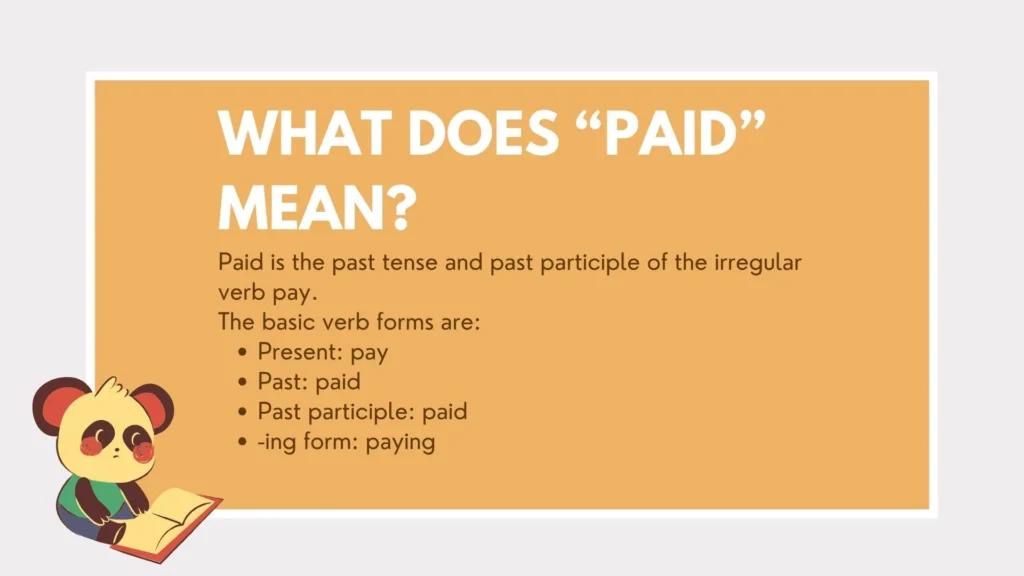
Paid is the past tense and past participle of the irregular verb pay.
The basic verb forms are:
- Present: pay
- Past: paid
- Past participle: paid
- -ing form: paying
Oxford and Cambridge both identify paid as the past form of pay.
You use paid when someone gave money, settled something they owed, or used pay in another ordinary sense.
Paying for something
I paid for my coffee.
Paying a bill
We paid the electricity bill yesterday.
Paying a person
She paid the driver in cash.
Paying a debt
He finally paid his debt.
Receiving wages
I got paid on Friday.
Using an expression
She paid attention to the instructions.
The word paid can also work as an adjective:
This is a paid position.
He took a paid vacation.
The invoice has been marked paid.
Cambridge lists paid as an adjective for work, leave, services, bills, and situations in which money has been received or a payment has been made.
What Does “Payed” Mean?
Payed exists, but it has a very limited use.
In ordinary English, payed should not replace paid when you are talking about money. For example, I payed my rent is not the standard spelling; the correct sentence is I paid my rent.
Merriam-Webster records payed as the past form of a separate, specialized verb meaning to coat something with a waterproof composition. This use belongs mainly to technical or nautical contexts.
For example:
The workers payed the wooden seams to help protect the vessel.
This is very different from:
The workers paid the shipyard for the repairs.
The first sentence uses the specialized nautical sense. The second uses the ordinary money-related verb.
Important point
Do not assume that payed is simply an alternative spelling of paid.
For ordinary English, the distinction is straightforward:
money → paid
specialized waterproofing/nautical use → payed
Paid vs Payed: Key Difference
The main difference is meaning and grammatical history, not British versus American spelling.
Use “paid” for ordinary meanings of pay
Use paid when someone:
- gives money
- receives money
- settles a bill
- pays a debt
- pays for goods or services
- pays attention
- pays a fine
- pays a price or penalty
- fulfills a financial obligation
Examples:
She paid for the meal.
They paid their employees on time.
I have paid the rent.
He paid attention during the meeting.
We paid a small fee.
Use “payed” only in its specialized sense
Payed can occur when pay means to coat or treat something with a waterproof substance, particularly in technical or nautical language.
Example:
The vessel’s seams were payed with protective material.
This is uncommon in everyday writing.
If you are writing an email, school assignment, business document, text message, blog post, or ordinary conversation, you will almost certainly need paid, not payed.
When Should You Use “Paid”?
In everyday conversation
Use paid for normal conversations about money.
I paid for dinner last night.
Have you paid the bill?
She already paid me back.
In formal writing
Paid is the correct standard form in reports, essays, applications, invoices, and professional documents.
The company paid all outstanding taxes.
The customer has paid the full amount.
In business
Use paid for salaries, invoices, subscriptions, fees, contracts, and services.
The invoice was paid in full.
All employees are paid monthly.
The client paid the deposit yesterday.
In emails
I have paid the outstanding balance.
We have paid the required registration fee.
In texting and social media
The same standard spelling applies.
Just got paid today!
I already paid for it.
Have you paid the subscription?
Informal writing does not change the standard past tense of pay.
When Should You Use “Payed”?
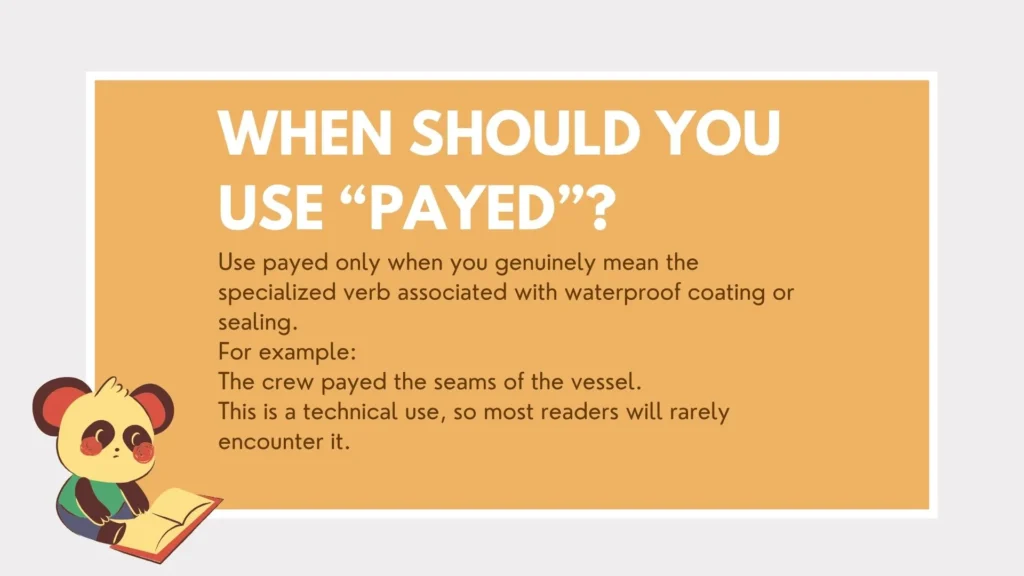
Use payed only when you genuinely mean the specialized verb associated with waterproof coating or sealing.
For example:
The crew payed the seams of the vessel.
This is a technical use, so most readers will rarely encounter it.
When you should NOT use “payed”
Do not use payed for:
- salaries
- rent
- bills
- taxes
- tickets
- food
- shopping
- subscriptions
- loans
- debts
- fees
- wages
- attention
- compliments
- respects
For all of these ordinary meanings, use paid.
Common Sentence Variations
Paid or payed for something?
Use paid.
I paid for the new shoes.
Not:
❌ I payed for the new shoes.
Paid or payed the bill?
Use paid.
She paid the bill before leaving.
Not:
❌ She payed the bill before leaving.
Paid or payed rent?
Use paid.
We paid the rent yesterday.
Paid or payed attention?
Use paid.
He paid attention to every detail.
The expression is pay attention, so its past form is paid attention.
Paid or payed back?
Use paid.
I paid her back last week.
Not:
❌ I payed her back last week.
Paid or payed a fee?
Use paid.
They paid a registration fee.
Paid or payed taxes?
Use paid.
The business paid its taxes on time.
Paid or payed for the service?
Use paid.
We paid for the service in advance.
Paid or payed in full?
Use paid.
The balance has been paid in full.
Common Phrases With “Paid”
These expressions normally use paid, not payed.
Paid in full
This means that the entire amount owed has been paid.
The invoice was paid in full.
Paid in advance
This means payment was made before something happened.
The hotel room was paid in advance.
Get paid
This means to receive money, usually for work.
When do you get paid?
Well paid
This describes work or a person receiving a good amount of money.
She has a well-paid job.
Paid leave
This means time away from work for which the employee still receives pay.
Employees receive 20 days of paid leave.
Paid work
This means work for which someone receives money.
He is looking for paid work.
Paid attention
This means to give attention to something.
Please pay attention to the warning signs.
In the past:
She paid attention to the instructions.
Oxford and Cambridge both document common uses of paid in employment and payment contexts.
Common Mistakes
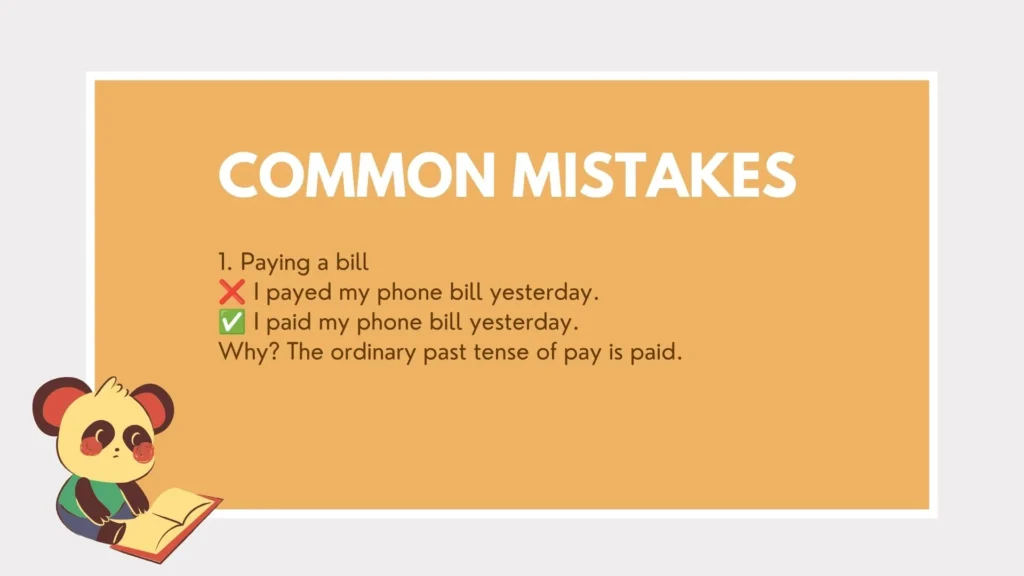
1. Paying a bill
❌ I payed my phone bill yesterday.
✅ I paid my phone bill yesterday.
Why? The ordinary past tense of pay is paid.
2. Paying someone
❌ She payed the worker.
✅ She paid the worker.
3. Paying for food
❌ He payed for lunch.
✅ He paid for lunch.
4. Paying rent
❌ We payed the rent on Monday.
✅ We paid the rent on Monday.
5. Getting a salary
❌ I finally got payed.
✅ I finally got paid.
6. Paying attention
❌ You should have payed attention.
✅ You should have paid attention.
7. Paying someone back
❌ I’ll have payed you back by Friday.
✅ I’ll have paid you back by Friday.
8. Paying a fee
❌ The customer payed the fee.
✅ The customer paid the fee.
Why Do People Get This Wrong?
The confusion is understandable because many English verbs form their past tense by adding -ed:
- walk → walked
- work → worked
- clean → cleaned
- open → opened
A learner may therefore expect:
pay → payed
But pay is an irregular verb in its ordinary financial sense.
Its standard forms are:
pay → paid → paid
Oxford specifically lists paid as both the past simple and past participle.
The spelling payed looks logical because it follows the common -ed pattern, but that pattern does not apply to the ordinary past tense of pay.
There is also a second reason for confusion: payed is a genuine word, but its specialized meaning is rarely encountered by everyday readers.
Can Both Forms Be Correct?
Yes, but not normally with the same meaning.
Paid
Use paid for the ordinary verb pay:
She paid for the tickets.
He paid his debt.
We have paid the invoice.
Payed
Use payed for the specialized verb meaning to coat something with a waterproof substance:
The vessel was payed with a protective coating.
So the two forms are not simply interchangeable spellings.
A useful way to think about them is:
paid = ordinary pay
payed = specialized technical/nautical pay
Merriam-Webster recognizes this distinction by listing ordinary pay with paid as its past form while separately recording payed for the waterproof-coating sense.
British vs American English
There is no major British-versus-American spelling difference between paid and payed.
Both British and American English use paid as the normal past tense and past participle of pay. Cambridge gives the same form in its British and American entries.
For example, both varieties use:
I paid the bill.
She paid for the tickets.
He has paid the money.
So changing from British English to American English does not make payed the normal spelling.
Pronunciation
Paid and payed are pronounced the same in ordinary English:
/peɪd/
That means the distinction is mainly visible in writing, not pronunciation.
For example:
I paid the bill.
and a specialized sentence containing:
The surface was payed with a waterproof substance.
would not normally be distinguished by pronunciation alone.
This is one reason spelling mistakes involving the two forms can be easy to miss when someone learns English primarily through conversation.
Word Origin and History
The ordinary verb pay has a long history in English and ultimately comes through Anglo-French from Latin. The modern irregular form paid developed as the standard past form of the ordinary verb. Merriam-Webster records the ordinary verb from Middle English and separately traces the specialized waterproof-coating verb to a different historical source.
This separate history helps explain an important point: payed is not merely a modern misspelling that dictionaries accidentally accept. It has a legitimate specialized history, even though most people should use paid when talking about money.
What About “Payed Out” for a Rope?
This is an especially confusing case.
In technical contexts, you may encounter pay out meaning to release a rope or cable in a controlled way. However, major learner-dictionary entries give paid as the past tense and past participle of this expression. Cambridge, for example, lists:
pay out → paid out
when referring to releasing rope or cable.
So:
The crew paid out the rope.
is the safer standard form.
Do not assume that every nautical use of pay automatically requires payed. The specialized payed form is associated with the separate sense of coating or waterproofing something.
Simple Memory Trick
Remember this:
Money is PAID.
If you are talking about:
- money
- bills
- rent
- wages
- fees
- debts
- tickets
- services
- attention
choose PAID.
A second reminder:
Payed is for a specialized technical meaning, not ordinary payments.
Quick Decision Guide
Are you talking about giving or receiving money?
→ Use paid.
Are you talking about a bill, rent, tax, fee, debt, or ticket?
→ Use paid.
Are you talking about getting a salary or wages?
→ Use paid.
Are you talking about paying attention or paying respects?
→ Use paid in the past tense.
Are you describing a specialized process of coating or waterproofing something, especially in nautical language?
→ Payed may be correct.
Are you simply unsure which spelling to use in everyday English?
→ Choose paid.
Mini Quiz
1. I ___ my credit card bill yesterday.
A. paid
B. payed
Answer: A — paid.
The ordinary past tense of pay is paid.
2. She has ___ for the hotel room.
A. paid
B. payed
Answer: A — paid.
The past participle of ordinary pay is paid.
3. You should have ___ attention.
A. paid
B. payed
Answer: A — paid.
The standard expression is paid attention.
4. The company ___ all its employees on Friday.
A. paid
B. payed
Answer: A — paid.
Payment of wages uses the ordinary verb pay.
5. The vessel’s seams were ___ with a waterproof substance.
A. paid
B. payed
Answer: B — payed.
This sentence uses the specialized waterproof-coating sense of payed.
6. We ___ the registration fee in advance.
A. paid
B. payed
Answer: A — paid.
A fee is an ordinary financial payment.
7. The crew ___ out the cable slowly.
A. paid
B. payed
Answer: A — paid.
For the phrasal verb pay out, major dictionaries give paid as the past form.
FAQ
Is “paid or payed” correct?
Both words exist, but they do not normally have the same use. Paid is the standard past tense and past participle of pay when talking about money and ordinary meanings of the verb. Payed has a specialized technical use connected with waterproof coating.
Is “payed” a real word?
Yes. Payed is a real word, but it is uncommon in everyday English. Merriam-Webster records it as the past form of a specialized verb meaning to coat something with a waterproof composition.
Is “I payed the bill” correct?
No, not in standard everyday English. Write “I paid the bill.” The ordinary past tense of pay is paid.
Is “I have payed” correct?
Normally, no. If you mean that you have given money or settled an obligation, write “I have paid.” The ordinary past participle is paid.
Is “paid” the past tense of “pay”?
Yes. Paid is both the past simple and past participle of the ordinary verb pay.
Is “payed” ever correct?
Yes, but only in a specialized sense. It can be the past form of a verb meaning to coat or waterproof something, particularly in nautical or technical contexts.
Is “paid attention” or “payed attention” correct?
Paid attention is correct. The expression is pay attention, whose past tense is paid attention.
She paid attention to the teacher.
Should I write “paid for” or “payed for”?
Use paid for.
We paid for the meal.
Payed for is not the standard form when pay for means giving money in exchange for something. Cambridge lists the ordinary past form of pay for as paid.
Is “paid” used in both British and American English?
Yes. Both British and American English use paid as the ordinary past tense and past participle of pay. The spelling does not change between these varieties.
Which is more common: paid or payed?
Paid is overwhelmingly the form you need in ordinary English. Payed is uncommon because its legitimate use is specialized rather than related to everyday payments.
Final Takeaway
For ordinary English, the rule is simple:
If you mean money or an ordinary use of “pay,” use PAID.
Pay → paid → paid
Use payed only when you are using the specialized technical verb meaning to coat or waterproof something. So if you are writing “I paid the bill,” “She paid for lunch,” “He got paid,” or “We have paid the fee,” the correct choice is always paid.
Confused about paid or payed? Learn which spelling is correct, what each word means, when to use them, common mistakes, and easy examples.

My name is Michael Turner, and I have always been fascinated by animals and the unique relationships people build with them. I enjoy researching naming ideas from different cultures, languages, and traditions to help pet owners discover names that truly stand out. At Meanixo, I write informative articles designed to make pet naming fun, simple, and stress-free. I believe reliable information and creativity should always go hand in hand.
Books:
- The Ultimate Pet Name Collection
- Living Better with Pets
 Daniel Brooks
 Sophia Mitchell