I’ve seen many writers pause over “into” and “in to” because they look almost identical, yet their meanings can change depending on the sentence. If you’ve ever wondered which one is correct, you’re in the right place. In this guide, I’ll show you a simple way to tell them apart, with clear examples you can actually remember.
Quick answer: Use “into” when it shows movement or a change, while “in to” is usually two separate words that belong to different parts of the sentence.
Quick Answer
Into and in to can both be correct, but they are not interchangeable. Into is normally one preposition that shows movement toward or inside something, a change of state, or involvement in something.
In to is simply the adverb in followed by the separate word to, often because to belongs to the verb that follows. The correct choice depends on the sentence’s grammar and meaning.
Quick Comparison Table
| Form | Main Use | Example |
| into | Movement toward or inside something | She walked into the room. |
| into | Change from one state or form to another | They turned the garage into an office. |
| into | Interest or involvement | He is into photography. |
| in to | in + separate to, usually with a phrasal verb or infinitive | She came in to help us. |
| in to | in and to perform separate grammatical jobs | Please hand the form in to your teacher. |
The key point is that in to is not a different spelling of into. It is two separate words that happen to appear next to each other.
What Does “Into” Mean?
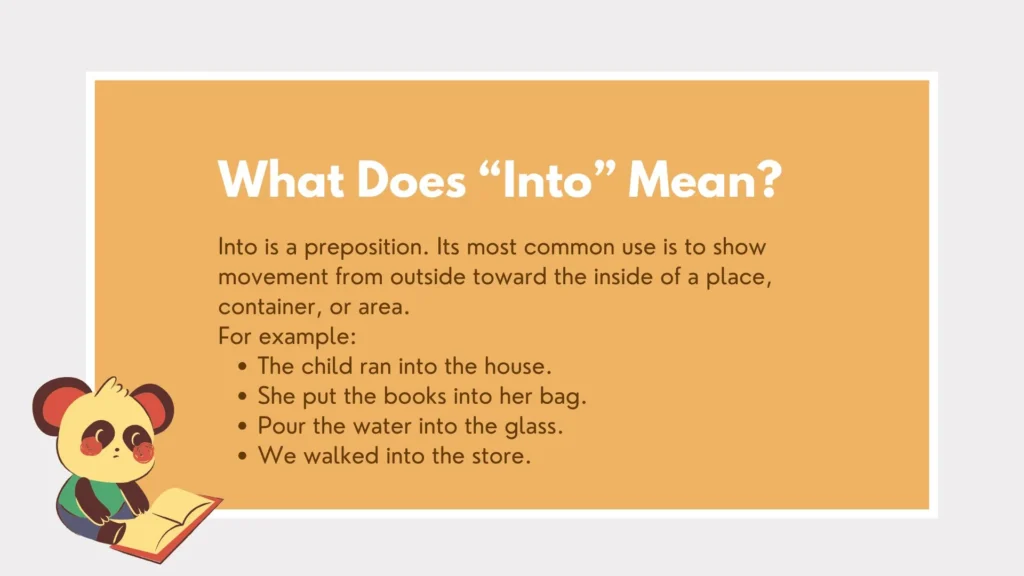
Into is a preposition. Its most common use is to show movement from outside toward the inside of a place, container, or area.
For example:
- The child ran into the house.
- She put the books into her bag.
- Pour the water into the glass.
- We walked into the store.
The word can also describe a change from one condition, form, or purpose to another:
- The caterpillar changed into a butterfly.
- They converted the basement into a bedroom.
- The company turned the old building into a hotel.
English also uses into for interest or involvement:
- I’m really into jazz.
- She’s into fitness.
- He’s getting into photography.
Other meanings include investigating something, dividing numbers, and movement involving impact. For example, you can look into a problem or say that a car crashed into a wall.
What Does “In To” Mean?
In to is not one word. It is the adverb or particle in followed by the separate word to.
This usually happens because in belongs to the verb or phrasal verb, while to introduces another part of the sentence.
For example:
She came in to talk to the manager.
Here, in is connected with the idea of coming inside, while to talk expresses the purpose of her coming.
Another example is:
He handed in the assignment to his teacher.
Here, hand in means “submit,” and to his teacher identifies the person receiving it.
Because in and to have separate grammatical roles, joining them into into would change the structure or meaning.
Into vs In To: Key Difference
The simplest way to understand the difference is to ask whether into is functioning as one word with its own meaning.
Use “into” when it means movement inside
The dog ran into the kitchen.
The dog moved from outside the kitchen to inside it.
Use “in to” when “in” and “to” belong to different parts of the sentence
The doctor came in to examine the patient.
Here, in describes the doctor’s movement inside, while to examine explains the purpose.
Compare these:
She walked into the office.
She entered the office.
She walked in to speak with the manager.
She walked in, and she did so in order to speak with the manager.
The second sentence contains the separate structure in + to speak.
When Should You Use “Into”?
Use “into” for movement inside something
Use into when something moves from outside to inside.
Examples:
- He jumped into the pool.
- We went into the restaurant.
- She stepped into the elevator.
- The bird flew into the room.
This is one of the clearest uses of into. Cambridge Grammar explains that in describes position, while into commonly describes movement toward or inside a place.
Use “into” for a change of form or condition
Use into when one thing becomes, changes into, or is transformed into something else.
- The empty room became into a classroom. ❌
- They turned the empty room into a classroom. ✅
- The ice melted into water.
- She divided the cake into six pieces.
- The story developed into a full-length novel.
Verbs such as turn, change, transform, divide, convert, develop, and translate commonly appear with into when they express a change or result.
Use “into” for interest or involvement
You can use be into to say that someone is very interested in something.
- I’m into rock music.
- She’s really into fashion.
- He’s into video games.
This use is generally informal and conversational.
Use “into” for investigation
Some verbs naturally take into when the meaning involves investigating or examining something.
- The police are looking into the complaint.
- We need to look into the problem.
- The committee launched an inquiry into the issue.
Here, into does not mean physical movement. It forms part of the expression meaning “investigate” or “examine.”
When Should You Use “In To”?
Use “in to” when “in” belongs to a phrasal verb
Many phrasal verbs contain in, and the following to belongs to another part of the sentence.
For example:
She turned in the application to the office.
Turn in means submit, while to the office tells us where or to whom it was submitted.
Other examples include:
- He handed in his paper to the teacher.
- She gave in to the pressure.
- They checked in to the hotel.
However, some modern usage can vary with particular verbs, so you should judge the entire construction rather than applying a mechanical rule.
Use “in to” before an infinitive when the grammar requires it
Consider:
He came in to help us.
The word to introduces the infinitive to help. It is not part of the preposition into.
Another example:
She went in to get her phone.
The meaning is essentially “went in” + “to get her phone.”
This structure is especially easy to recognize when replacing the phrase with a longer version:
She went in because she wanted to get her phone.
Use “in to” when “to” has its own grammatical function
Consider:
Please log in to your account.
Here, in can function as part of log in, while to your account identifies the destination.
You may also see log into in everyday modern usage, particularly in computing contexts. The important point is to recognize that the spelling can depend on whether in is being treated as part of the verb construction or whether to is functioning separately.
Common Sentence Variations
Into or in to a room?
Use into when the meaning is simply movement inside:
She walked into the room.
Use in to when in and to have separate functions:
She came in to discuss the problem.
The first sentence says where she moved. The second can mean she came inside for the purpose of discussing something.
Into or in to the house?
He went into the house.
This means he entered the house.
But:
He went in to get his coat.
Here, in describes going inside, while to get gives the purpose.
Into or in to work?
These can produce different structures.
She went into the office.
She entered the office.
She went in to work.
This can mean she went inside in order to work, although the exact interpretation depends on the surrounding sentence.
Into or in to see someone?
Usually write:
I went in to see the doctor.
Here, to see is an infinitive expressing purpose.
Compare:
I walked into the doctor’s office.
Here, into is a preposition showing movement inside.
Into or in to the meeting?
He walked into the meeting room.
This describes physical movement into the room.
But:
He came in to discuss the meeting.
Here, in and to discuss perform separate jobs.
Into or in to an account?
This depends on the verb and intended construction.
She signed in to her account.
Here, sign in is the verb phrase and to her account identifies the account.
You may also encounter sign into as a single written form in everyday digital usage. When writing for a particular organization or style guide, follow its preferred treatment consistently.
Common Phrases With “Into”
Get into
Get into can mean enter, become involved in something, or become interested in something.
We got into the car and left.
She got into photography last year.
Turn into
Turn into means change from one thing or state into another.
The small project turned into a successful business.
Look into
Look into means investigate or examine.
I’ll look into the issue tomorrow.
Run into
Run into can mean collide with something or meet someone unexpectedly.
I ran into an old friend at the mall.
Get into trouble
This means become involved in a difficult or problematic situation.
He got into trouble at school.
Be into
This informal expression means to be very interested in something.
My sister is really into photography.
Common Mistakes
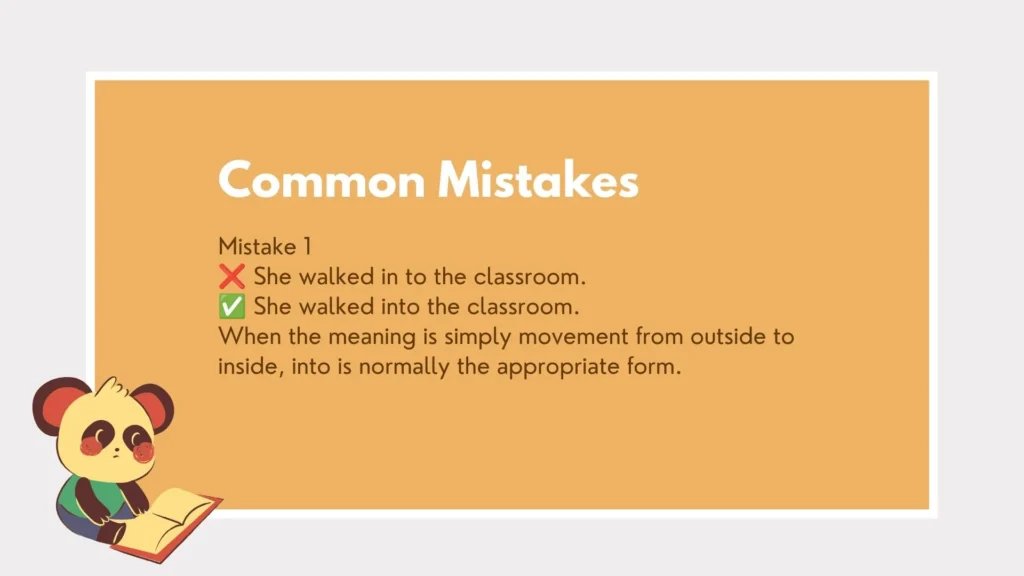
Mistake 1
❌ She walked in to the classroom.
✅ She walked into the classroom.
When the meaning is simply movement from outside to inside, into is normally the appropriate form.
Mistake 2
❌ He went into talk to his boss.
✅ He went in to talk to his boss.
Here, to talk is an infinitive expressing purpose, so in and to are separate.
Mistake 3
❌ They turned the garage in to an office.
✅ They turned the garage into an office.
Turn into expresses transformation.
Mistake 4
❌ She poured the milk in to the cup.
✅ She poured the milk into the cup.
The milk moves from outside the cup to inside it.
Mistake 5
❌ I’m really in to jazz.
✅ I’m really into jazz.
The expression be into something means to be interested in it.
Mistake 6
❌ The car crashed in to the wall.
✅ The car crashed into the wall.
Crash into is a standard expression for collision.
Mistake 7
❌ The company divided the project in to four parts.
✅ The company divided the project into four parts.
Divide into expresses separation into groups or parts.
Mistake 8
❌ The researchers are looking in to the complaint.
✅ The researchers are looking into the complaint.
Look into means investigate.
Why Do People Get “Into” and “In To” Wrong?
The confusion happens because the two forms are pronounced very similarly in ordinary speech. When people hear a sentence such as “She went in to help,” they may not immediately know whether the words should be written together.
The problem becomes harder because both forms are genuinely possible in English.
Compare:
He went into the shop.
and:
He went in to buy some bread.
The sound can be similar, but the grammar is different. In the first sentence, into is a preposition showing movement. In the second, in is separate and to buy expresses purpose.
The safest approach is therefore to examine the role of each word rather than relying on pronunciation alone.
Can Both Forms Be Correct?
Yes. Into and in to are both correct English forms, but they are correct in different grammatical structures.
“Into” is correct when it functions as one word
The children ran into the garden.
Here, into shows movement toward the inside of the garden.
“In to” is correct when the words have separate roles
The children came in to eat dinner.
Here, in indicates movement inside, while to eat gives the reason or purpose.
Meaning can change with the spelling
Compare:
She looked into the matter.
This means she investigated the matter.
She looked in to check on the baby.
Here, in is connected with the action of entering or looking in, and to check expresses purpose.
That distinction is why automatically replacing every in to with into can create grammatical errors.
British vs American English
There is no major British-versus-American spelling difference between into and in to. Both varieties use into as a standard preposition and use in to when the two words have separate grammatical functions.
There can, however, be variation with particular verb constructions, especially in informal or technical writing. Digital expressions such as log in to and log into may both be encountered.
For formal writing, the best approach is to consider the grammatical structure and follow the style conventions appropriate to your context rather than assuming that one variety of English always uses one spelling.
Pronunciation
Into is commonly pronounced approximately as /ˈɪn.tuː/ in both British and American English, although the exact vowel and the strength of the final syllable can vary in natural speech.
In to can sound almost identical when spoken quickly because the words occur next to each other.
That similarity explains why the distinction is much easier to notice in writing than in conversation.
Simple Memory Trick
Use this quick test:
If “inside” or “entering” fits, try “into.”
For example:
She walked into the room.
She walked inside the room.
If you can separate the sentence into in + to + verb, keep the words apart:
He came in to help.
He came in to help.
Another useful reminder is:
One meaning = one word. Separate jobs = separate words.
This is not a perfect test for every sentence, but it works well for many everyday examples.
Quick Decision Guide
Does the word show movement toward or inside something?
→ Use into.
Does it show a change from one thing or state to another?
→ Use into.
Does it mean “interested in”?
→ Use into.
Is “in” part of a verb and “to” introduces another word or phrase?
→ Use in to.
Does “to” introduce an infinitive such as “to help,” “to see,” or “to buy”?
→ In to may be correct.
Are you unsure?
→ Look at the words immediately before and after in/to and identify what grammatical job each word performs.
Mini Quiz
1. She walked ___ the kitchen.
A. into
B. in to
Answer: A — into. The sentence describes movement from outside the kitchen to inside it.
2. He came ___ help me with the boxes.
A. into
B. in to
Answer: B — in to. The phrase to help is an infinitive expressing purpose.
3. They turned the garage ___ a studio.
A. into
B. in to
Answer: A — into. Turn into describes a transformation.
4. I’m really ___ classical music.
A. into
B. in to
Answer: A — into. Be into is an expression meaning to be very interested in something.
5. The car crashed ___ a tree.
A. into
B. in to
Answer: A — into. Crash into describes a collision.
6. She went ___ check whether the door was locked.
A. into
B. in to
Answer: B — in to. To check expresses the purpose of going in.
7. The teacher divided the class ___ four groups.
A. into
B. in to
Answer: A — into. Divide into is the standard construction for separating something into parts or groups.
8. He came ___ discuss the proposal.
A. into
B. in to
Answer: B — in to. The words to discuss form an infinitive, while in remains separate.
FAQ
Is “into” or “in to” correct?
Both can be correct. Into is one preposition, while in to consists of two separate words. The correct choice depends on the grammatical structure and intended meaning.
What is the main difference between “into” and “in to”?
Into commonly shows movement inside, transformation, interest, or involvement. In to occurs when in and to have separate grammatical functions, such as in came in to help.
When should I use “into”?
Use into for movement toward the inside, transformation, and expressions such as look into, turn into, and be into. For example, “She walked into the store” and “They turned the room into an office.”
When should I use “in to”?
Use in to when in belongs to the surrounding verb or construction and to belongs to what follows. For example, “He came in to talk” contains in plus the infinitive to talk.
Is “in to” ever grammatically correct?
Yes. It is completely legitimate when the two words perform separate grammatical jobs. “She came in to see me” is a clear example.
Is “into” always about physical movement?
No. Into has several nonphysical uses. It can describe transformation, investigation, involvement, interest, and even mathematical division, as in “What does 6 go into 24?”
Is “look into” correct?
Yes. Look into is a standard expression meaning to investigate or examine something. For example, “The manager will look into the complaint.”
Is “turn into” correct?
Yes. Turn into means to change or transform into something else. For example, “The old warehouse was turned into a restaurant.”
Should I write “go into” or “go in to”?
Both can occur, but they have different structures. Go into the house means enter the house, while go in to talk to someone can mean go inside for the purpose of talking.
Is “log in to” or “log into” correct?
Both forms are encountered in modern English, particularly in computing. Log in to your account clearly treats log in as the verb and to your account as the destination; log into is also widely used as a combined form in contemporary usage.
Does British English use “into” differently from American English?
Not in any major way for this distinction. Both varieties use into as a standard preposition and in to when the words have separate grammatical functions. Particular expressions may show variation in style or usage.
Final Takeaway
Into and in to are both correct, but they do different grammatical jobs.
Use into when it acts as one word:
She walked into the room.
Use in to when in and to are separate:
She came in to help us.
The easiest rule to remember is: if “into” expresses one relationship such as movement inside or transformation, write it as one word; if “in” and “to” belong to separate parts of the sentence, keep them apart.
Sharpen Your English:
- Counselling or Counseling: Which Spelling Is Correct? In 2026
- Email or E-Mail: Which Spelling Is Correct? In 2026

My name is Michael Turner, and I have always been fascinated by animals and the unique relationships people build with them. I enjoy researching naming ideas from different cultures, languages, and traditions to help pet owners discover names that truly stand out. At Meanixo, I write informative articles designed to make pet naming fun, simple, and stress-free. I believe reliable information and creativity should always go hand in hand.
Books:
- The Ultimate Pet Name Collection
- Living Better with Pets
 Daniel Brooks
 Sophia Mitchell