Afterward and afterwards are both correct English words. They have essentially the same meaning: at a later time or after something has happened.
The main difference is regional preference. Afterward is especially associated with American English, while afterwards is especially common in British English. Cambridge lists afterward as US and afterwards as mainly UK, while also recognizing both forms.
So, if you’re wondering “afterward or afterwards?”, you usually aren’t choosing between a correct word and an incorrect one. You’re choosing between two accepted forms that can fit different varieties of English.
Afterward or Afterwards: Quick Answer
Both “afterward” and “afterwards” are correct. Both are adverbs meaning “later” or “after that.” Afterward is especially common in American English, while afterwards is especially common in British English.**
| Form | Part of speech | Meaning | Common regional preference |
| afterward | Adverb | Later; after that | Especially common in American English |
| afterwards | Adverb | Later; after that | Especially common in British English |
Quick examples
- We had dinner and went for a walk afterward.
- We had dinner and went for a walk afterwards.
Both sentences are correct and communicate essentially the same idea.
Which should you use?
- American English: afterward is a natural default.
- British English: afterwards is a natural default.
- International English: either can work.
- A publication with a house style: follow its preferred style.
- When no style is specified: choose the form that sounds natural to your intended audience and use it consistently.
The important point is that neither form is universally “more correct.”
What Does “Afterward” Mean?
Afterward is an adverb that means at a later time, after something mentioned previously has happened.
It normally connects a later action or event to something that came before it.
For example:
We finished the meeting and went for coffee afterward.
Here, afterward means after the meeting.
You can also use it when the earlier event is understood from context:
I didn’t think much about it afterward.
The reader understands that afterward refers to the event being discussed.
Simple meaning of “afterward”
You can usually understand afterward as:
- later
- after that
- at a later time
- following the event just mentioned
However, these alternatives aren’t always perfect substitutes. The relationship between the earlier event and the later one matters.
What Does “Afterwards” Mean?
Afterwards has essentially the same meaning as afterward.
It means at a later time or after something else has happened.
For example:
We finished the meeting and went for coffee afterwards.
Here, afterwards means after the meeting.
Cambridge identifies afterwards as mainly UK and gives afterward as the usual US equivalent.
Simple meaning of “afterwards”
Afterwards can mean:
- later
- after that
- following something that has already happened
- at a subsequent time
For ordinary sentences, you can usually replace afterward with afterwards without changing the basic meaning.
Afterward vs. Afterwards: What’s the Difference?
The primary difference is usage preference, not meaning.
Compare these sentences:
We talked about it afterward.
We talked about it afterwards.
Both mean that the conversation happened later, following an event already understood from context.
The distinction becomes clearer when you consider regional English.
American English
Afterward is generally the more typical choice.
We went home afterward.
British English
Afterwards is generally the more typical choice.
We went home afterwards.
But these regional preferences should not be turned into rigid rules.
An American writer can use afterwards, and a British writer can encounter or use afterward. The forms are not separated by a strict grammatical boundary.
The easiest rule to remember
Afterward = especially common in US English.
Afterwards = especially common in UK English.
That’s a preference rule, not a simple right-versus-wrong rule.
Is “Afterward” a Word?
Yes. Afterward is a standard English word.
It is an adverb, which means it can tell you when something happens.
For example:
We spoke afterward.
The word tells us when we spoke.
Other examples include:
- She apologized afterward.
- I’ll explain it afterward.
- We went out afterward.
- He regretted it afterward.
- They returned home afterward.
You do not need to add an s to make afterward correct.
Is “Afterwards” a Word?
Yes. Afterwards is also a standard English word.
It is an adverb, not a plural noun.
For example:
We spoke afterwards.
The final s does not mean that the word is plural. It is simply part of the established form afterwards.
Examples:
- She apologized afterwards.
- I’ll explain it afterwards.
- We went out afterwards.
- He regretted it afterwards.
- They returned home afterwards.
Are “Afterward” and “Afterwards” Interchangeable?
Usually, yes.
In many sentences, either form can be used without changing the basic meaning.
Example 1
We went to dinner afterward.
We went to dinner afterwards.
Example 2
She called me afterward.
She called me afterwards.
Example 3
They discussed the problem afterward.
They discussed the problem afterwards.
The choice is mainly about regional preference, audience, and style.
There can be differences in how natural a form sounds to a particular audience, but there is generally no change in the underlying meaning.
American English: “Afterward” or “Afterwards”?
If you’re writing primarily for an American audience, afterward is the natural default.
Examples:
- We went home afterward.
- I’ll call you afterward.
- She felt better afterward.
- They discussed the decision afterward.
- I understood what had happened only afterward.
Afterwards is also recognized and used in American English. The point is not that Americans cannot use afterwards, but that afterward is generally the more characteristic US form. Cambridge explicitly labels afterward US and notes that the US usually uses afterward for the corresponding form.
Best practical choice for US writing
If your website, publication, school assignment, or business communication follows American English, afterward is a straightforward choice.
British English: “Afterward” or “Afterwards”?
If you’re writing primarily for a British audience, afterwards is generally the more natural choice.
Examples:
- We went home afterwards.
- I’ll call you afterwards.
- She felt better afterwards.
- They discussed the decision afterwards.
- I understood what had happened only afterwards.
Cambridge labels afterwards as mainly UK and gives afterward as the usual US counterpart.
Best practical choice for UK writing
If your content is specifically written in British English, afterwards is a natural default.
How to Use “Afterward” in a Sentence
Because afterward is an adverb, it can appear in several positions.
At the end of a sentence
This is very natural:
We went home afterward.
She called me afterward.
I felt tired afterward.
At the beginning of a sentence
You can also begin a sentence with afterward.
Afterward, we went home.
Afterward, she called her parents.
Afterward, everyone agreed that the decision had been sensible.
When afterward begins the sentence as an introductory adverb, a comma is commonly used to separate it from the main clause.
In the middle of a sentence
It can sometimes appear in a medial position:
The committee afterward reviewed the decision.
This is grammatically possible, but in ordinary modern prose, writers will often find the beginning or end position more natural:
Afterward, the committee reviewed the decision.
or:
The committee reviewed the decision afterward.
A useful rule
For clear everyday writing, these two positions are usually the easiest:
Beginning:
Afterward, we went home.
End:
We went home afterward.
How to Use “Afterwards” in a Sentence
The same basic sentence-position rules apply to afterwards.
At the end
We went home afterwards.
She called me afterwards.
I felt tired afterwards.
At the beginning
Afterwards, we went home.
Afterwards, she called her parents.
Afterwards, everyone discussed what had happened.
In the middle
The committee afterwards reviewed the decision.
This is possible, but sentence-final or sentence-initial placement is often simpler for ordinary prose.
“After” vs. “Afterward” vs. “Afterwards”
These words are related, but they don’t always perform the same grammatical job.
After + noun
After can function as a preposition when it comes before a noun or noun phrase.
We went home after dinner.
Here, after introduces the noun phrase dinner.
After + clause
After can also introduce a clause.
We went home after the meeting ended.
Here, after introduces the clause the meeting ended.
Afterward / afterwards
Afterward and afterwards function as adverbs.
We had dinner and went home afterward.
We had dinner and went home afterwards.
This gives you a useful grammar distinction:
| Form | Typical grammatical role | Example |
| after | Preposition | We left after dinner. |
| after | Conjunction | We left after the meeting ended. |
| afterward | Adverb | We left afterward. |
| afterwards | Adverb | We left afterwards. |
Cambridge similarly distinguishes after as a preposition and conjunction and discusses afterwards as an adverb.
Afterward vs. Later: Are They the Same?
Afterward and later can overlap in meaning, but they don’t always communicate exactly the same relationship.
“Later” is broader
I’ll call you later.
This simply means at some future or subsequent time. It does not necessarily identify a particular event that the later action follows.
“Afterward” points back to an earlier event
We finished dinner and went for a walk afterward.
Here, afterward clearly refers to what happened after dinner.
Cambridge’s thesaurus notes that later or later on generally refers to a later time, while afterwards/afterward can specifically connect the second event to the first.
Compare
I’ll talk to you later.
This is broad.
I’ll talk to you afterward.
This normally suggests that the conversation will happen after something already mentioned or understood.
So, while later can be a useful synonym, don’t assume the two words are interchangeable in every context.
Afterward vs. After That
After that and afterward can often express the same sequence.
Compare:
We finished the meeting. After that, we went home.
We finished the meeting. Afterward, we went home.
Both make the sequence clear.
The difference is grammatical:
- after that is a phrase;
- afterward is a single adverb.
Which sounds more concise?
Afterward is often more compact:
We discussed the issue and left afterward.
After that can be useful when you want to emphasize the specific event being referred to:
We discussed the issue. After that, we left.
Both are natural.
Afterward vs. Afterwards vs. Subsequently
Subsequently can sometimes replace afterward, but it has a different tone.
Afterward/afterwards are ordinary, everyday choices.
We talked about it afterward.
Subsequently is more formal and often appears in academic, legal, business, or formal written contexts.
The company subsequently changed its policy.
There can also be a difference in how much time has passed. Subsequently can refer to something occurring at any later point, including considerably later, rather than suggesting a closely connected next event. Cambridge’s thesaurus makes a similar distinction between afterwards, later, next, and subsequently.
Synonyms for “Afterward” and “Afterwards”
Depending on context, possible alternatives include:
- later
- later on
- after that
- soon after
- shortly afterward
- shortly afterwards
- subsequently
- at a later time
- at a later date
- next
But these are not perfect substitutes in every sentence.
| Expression | Typical meaning/use |
| afterward | Later, following an event already mentioned |
| afterwards | Same basic meaning; especially common in UK English |
| later | At a subsequent time; broader than afterward |
| later on | At some later point |
| after that | Following the specific event just mentioned |
| soon after | Not long after an event |
| shortly afterward | A short time after an event |
| subsequently | At a later stage; often more formal |
| next | The event immediately following another in a sequence |
The key is to choose the expression that communicates the intended timing rather than replacing words mechanically.
Common Expressions With “Afterward” and “Afterwards”
Some combinations are especially useful in everyday English.
Soon afterward / soon afterwards
This means not long after the event.
The meeting ended, and soon afterward everyone left.
The meeting ended, and soon afterwards everyone left.
Shortly afterward / shortly afterwards
This also means a short time later.
She moved to the city and shortly afterward found a new job.
She moved to the city and shortly afterwards found a new job.
Immediately afterward / immediately afterwards
This emphasizes that the second event followed very quickly.
He called me immediately afterward.
He called me immediately afterwards.
Long afterward / long afterwards
This means a considerable amount of time had passed.
Long afterward, she still remembered that conversation.
The next day
Sometimes a more precise expression is better than afterward.
We met on Monday and spoke again the next day.
If the exact time matters, say what you mean rather than relying on a vague time adverb.
“Shortly Afterward” or “Shortly Afterwards”?
Both are correct.
- shortly afterward — especially natural in American English
- shortly afterwards — especially natural in British English
For example:
The storm passed, and shortly afterward the roads reopened.
The storm passed, and shortly afterwards the roads reopened.
The choice does not change the basic meaning.
Cambridge lists shortly afterward and soon afterward as established expressions and gives the corresponding afterwards form as well.
Pronunciation of “Afterward”
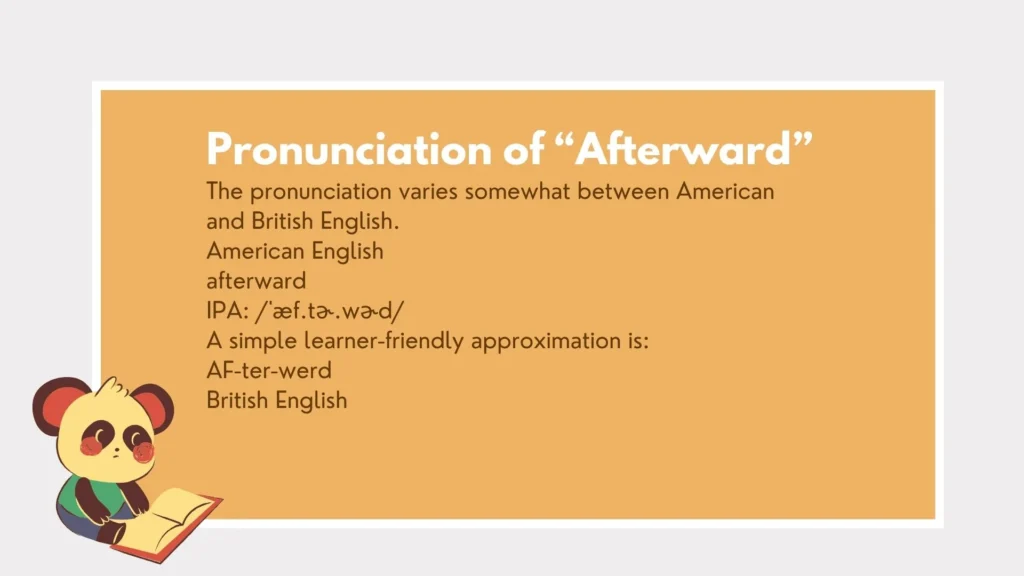
The pronunciation varies somewhat between American and British English.
American English
afterward
IPA: /ˈæf.tɚ.wɚd/
A simple learner-friendly approximation is:
AF-ter-werd
British English
afterward
IPA: /ˈɑːf.tə.wəd/
A simple approximation is:
AHF-tuh-wuhd
Cambridge provides both US and UK pronunciations for afterward.
Where is the stress?
The main stress is on the first part:
AF-terward
Pronunciation of “Afterwards”
American English
afterwards
IPA: /ˈæf.tɚ.wɚdz/
British English
afterwards
IPA: /ˈɑːf.tə.wədz/
The final s in afterwards is pronounced as a /z/ sound in the standard pronunciation represented by these dictionary transcriptions.
So don’t pronounce the ending as if the word simply stopped at afterward.
Is “Afterward” Formal or Informal?
Afterward is suitable for both everyday and formal writing.
You can use it in:
- emails
- essays
- articles
- books
- business writing
- general correspondence
- journalism
- conversation
For example:
The committee reviewed the proposal afterward.
There is nothing inherently informal about the word.
The choice between afterward and afterwards is primarily about regional preference and style, not a simple formal-versus-informal distinction.
Is “Afterwards” Formal or Informal?
Afterwards is also suitable for standard formal writing.
For example:
The researchers discussed the results afterwards.
It is not an incorrect or sloppy form.
If you’re writing in British English, afterwards can be the natural choice even in formal prose.
Can You Use “Afterward” in a Book?
Yes.
Afterward is completely acceptable in book writing.
It can appear naturally in:
- novels
- memoirs
- nonfiction
- essays
- textbooks
- articles
- academic prose
For example:
Afterward, she realized that the conversation had changed everything.
There is no general rule requiring authors to use afterwards instead.
The appropriate choice depends largely on the variety of English and the author’s or publisher’s style.
Can You Use “Afterwards” in a Book?
Yes.
Afterwards is also completely acceptable in published writing.
For example:
Afterwards, he returned to his office and began working on the report.
British English writers may naturally prefer this form, while American English writers may more often choose afterward.
For an author, the important consideration is not whether the word is “allowed,” but whether it fits the intended variety and style of English.
Common Mistakes With “Afterward” and “Afterwards”
Mistake 1: Thinking “afterwards” is always wrong
Incorrect assumption:
“Afterwards” is a mistake. It should always be “afterward.”
Correct understanding:
Both forms are standard.
Why:
The difference is primarily regional and stylistic, not a universal grammatical distinction.
Mistake 2: Thinking “afterward” is an American-only word
Incorrect assumption:
“Afterward” can only be used in American English.
Correct understanding:
Afterward is also used outside American English.
Why:
It is an established English adverb. Afterwards simply has a stronger association with British English.
Mistake 3: Thinking the final “s” makes “afterwards” plural
Incorrect assumption:
“Afterwards” must be plural because it ends in s.
Correct understanding:
Afterwards is an adverb.
Why:
The final s is part of the word. It doesn’t make the word plural.
Mistake 4: Using “later” when the preceding event matters
Consider:
We finished the interview and spoke privately afterward.
Here, afterward clearly connects the private conversation to the interview.
Simply changing it to:
We finished the interview and spoke privately later.
can make the timing less specifically tied to the interview.
Why:
Later is broader, while afterward naturally points back to the earlier event.
Mistake 5: Treating regional preference as grammar
It is misleading to say:
“Afterward is grammatically correct, but afterwards is grammatically incorrect.”
A better explanation is:
Both are grammatically acceptable; their frequency and regional preference differ.
“Afterward” or “Afterwards” in Formal Writing
If you’re deciding which form to use in professional or formal writing, consider these factors:
Writing for an American audience
Use afterward as the natural default.
Writing for a British audience
Use afterwards as the natural default.
Writing for an international audience
Either is acceptable. Choose one based on your preferred English variety and remain consistent.
Following a publication’s style guide
Use whatever form the publication prefers.
The key point is that formality does not automatically make one of these words correct and the other incorrect.
What About AP Style or Chicago Style?
Searchers sometimes look specifically for “afterward or afterwards AP style” or “afterward or afterwards Chicago Manual of Style.”
The important distinction is between general English correctness and a particular organization’s house style.
For general English:
Both afterward and afterwards are standard forms.
For a specific publication or editorial environment, follow its current style instructions if they prescribe a preference.
Don’t assume that a general regional preference is automatically an official rule of every style guide.
If a style guide or publisher specifies one form for consistency, that becomes the practical choice for that publication.
“Afterward” in a Sentence: 10 Examples
Here are examples showing different natural patterns:
- We finished the presentation and answered questions afterward.
- Afterward, I called my sister.
- She felt much calmer afterward.
- We went out for dinner afterward.
- I’ll explain everything afterward.
- He apologized afterward for his comment.
- The children played outside afterward.
- I didn’t understand the decision until afterward.
- They returned to the office shortly afterward.
- Soon afterward, the situation began to improve.
These examples show that afterward can naturally occur at the beginning or end of a sentence and can combine with timing words such as soon and shortly.
“Afterwards” in a Sentence: 10 Examples
- We finished the presentation and answered questions afterwards.
- Afterwards, I called my sister.
- She felt much calmer afterwards.
- We went out for dinner afterwards.
- I’ll explain everything afterwards.
- He apologized afterwards for his comment.
- The children played outside afterwards.
- I didn’t understand the decision until afterwards.
- They returned to the office shortly afterwards.
- Soon afterwards, the situation began to improve.
The grammatical pattern is essentially the same as with afterward.
A Simple Decision Guide: Which Form Should You Use?
If you’re still unsure, use this guide:
| Your situation | Natural choice |
| American English | afterward |
| British English | afterwards |
| Formal American writing | afterward |
| Formal British writing | afterwards |
| International audience | Either |
| No required style | Either |
| Publication has a house style | Follow its style |
| You want the shortest form | afterward |
The easiest memory trick
Think:
US → afterward
UK → afterwards
This is a useful preference guide, not a rule that makes the other form wrong.
Frequently Asked Questions
Is “afterward” or “afterwards” correct?
Both are correct. Afterward and afterwards are adverbs meaning “later” or “after that.” Afterward is especially common in American English, while afterwards is especially common in British English.
Which is more common in American English?
Afterward is generally the preferred form in American English. Afterwards is also understood and used, but Cambridge identifies afterward as the US form and notes that US English usually uses it.
Which is more common in British English?
Afterwards is generally more common in British English. Cambridge labels it mainly UK and gives afterward as the US counterpart.
Does “afterward” mean the same thing as “afterwards”?
Yes. In ordinary usage, they mean essentially the same thing: later or after something else has happened.
Is “afterwards” a plural word?
No. Afterwards is an adverb, and its final s does not make it plural.
Can “afterward” begin a sentence?
Yes.
Afterward, we went home.
This is a natural sentence structure.
Can “afterwards” begin a sentence?
Yes.
Afterwards, we went home.
This is also natural.
Is “shortly afterward” correct?
Yes. Shortly afterward means a short time later. Shortly afterwards is equally correct and is particularly common in British English.
Is “afterward” suitable for formal writing?
Yes. Afterward can be used in formal and informal writing. The choice between afterward and afterwards is mainly influenced by regional English and style.
Is “afterwards” suitable for American English?
Yes. Americans use and understand afterwards, although afterward is generally the more typical American choice.
Conclusion
Afterward and afterwards are both correct English words. They are adverbs that generally mean later or after that.
The practical difference is mainly regional:
- Afterward is especially common in American English.
- Afterwards is especially common in British English.
They can usually be substituted for one another without changing the basic meaning.
If you’re writing for an American audience, afterward is a natural default. If you’re writing for a British audience, afterwards is a natural default. If no particular variety or house style is required, either form is acceptable.
The most important thing is not to treat the choice as a simple correct-versus-incorrect question. It is primarily a matter of regional usage, audience, and style.
For related timing expressions, remember the distinction between afterward, later, after that, and subsequently: they overlap, but they don’t always carry exactly the same timing or grammatical function.

I’m Daniel Brooks, and I enjoy helping pet owners discover names that perfectly fit their new companions. Whether it’s a playful puppy, a curious cat, a colorful bird, or an exotic pet, I believe every animal deserves a name with character and meaning. At Meanixo, I focus on creating well-organized, easy-to-read pet name collections that make the naming process enjoyable.
I constantly research naming trends, cultures, and language meanings so readers can find names they’ll love for years to come.
Books:
- Modern Pet Naming Guide
- The Ultimate Book of Animal Names
 Michael Turner
 Sophia Mitchell